
How to Become a Registered ISO in Payment Processing
Published:

Becoming a registered payment-processing ISO isn’t a single license application. The process starts with finding an acquiring sponsor. If you’re researching how to become a registered ISO, that distinction matters: you can’t register directly with Visa or Mastercard, and a payment-processing ISO isn’t the same as an organization certified to an ISO standard.
The pathway involves a sponsor bank, card-network registration, and preparation to manage compliance and merchant oversight. The process can take two to four months, though timing depends on the application and sponsor relationship.
This guide explains the parties involved, what to prepare for a credible application, and the operational responsibilities to plan for before launch. It also covers how partner infrastructure can support growth after approval. For example, Strictly’s platform includes tools for partner compensation and merchant-retention intelligence, helping ISOs manage operations without replacing sponsor approval or network registration.
Key Takeaways
- Learn how to become a registered ISO by preparing a sponsor-specific picture of your business model, ownership, finances, sales, support, and risk approach.
- Understand the distinct stages of sponsor discussions, application review, due diligence, agreement review, and network registration.
- Separate sponsor and network approval from the legal, contractual, and ongoing compliance responsibilities that shape your operating plan.
- Assess platform capabilities across online, in-person, and mobile payments, plus integration and partner-management workflows.
- See how automated compensation and merchant-retention tools can support partner operations after launch.
Table of Contents
- What Does It Mean to Become a Registered ISO in Payment Processing?
- What Should You Prepare Before Applying to Become a Registered ISO?
- How Does the Registered ISO Application and Approval Process Work?
- How Can You Address Compliance and Registration Concerns Before Launch?
- How Can a Payment Platform Support Your ISO After Registration?
What Does It Mean to Become a Registered ISO in Payment Processing?
A payment-processing ISO markets or supports payment services through relationships with acquiring banks and other payment providers. Its work may include connecting merchants with payment acceptance, helping with onboarding, and providing ongoing account support. The acronym can be confusing: here, ISO means Independent Sales Organization, not certification by the International Organization for Standardization.
That distinction is a useful first step in learning how to become a registered ISO. Registration concerns the payment business’s relationship with its acquiring sponsor and card networks. Certification to an ISO-published standard follows a separate process and serves a different purpose.
For a closer look at the idea of a payment intermediary, watch this video:
Payment ISO vs. ISO standards certification: what is the difference?
In merchant services, an Independent Sales Organization is a business that helps market or support payment acceptance under acquiring relationships. A merchant agreement can involve an ISO as an intermediary, as described in this overview of the Independent Sales Organization (ISO).
By contrast, ISO standards are published frameworks for management or technical practices. An organization seeking certification to a standard pursues an assessment against that standard. A company building a merchant-services sales operation explores sponsor and network registration; it doesn’t obtain a standards certification simply to become a payment ISO.
Who participates in payment ISO registration?
The ISO develops merchant relationships and carries out the sales or support activities set out in its sponsor agreement. The acquiring bank provides the sponsorship relationship and typically connects the ISO with applicable card-network registration requirements. The processor supports transaction routing and may provide reporting and merchant support, depending on the arrangement. Merchants accept payments through the setup, while card networks establish rules for participating entities and transactions.
An ISO operates through an acquiring sponsor, which connects its business to the relevant card-network registration process. The ISO, sponsor, and processor are not interchangeable: each has a distinct role, and the arrangement should make those responsibilities clear.
Requirements can vary with the sponsor, network rules, business model, and jurisdiction. A business serving different merchant types or sales channels may have different operational expectations from one with a narrower model. Treat registration as a sponsor-led relationship with network and compliance considerations, not as universal approval that automatically covers every activity.
What Should You Prepare Before Applying to Become a Registered ISO?
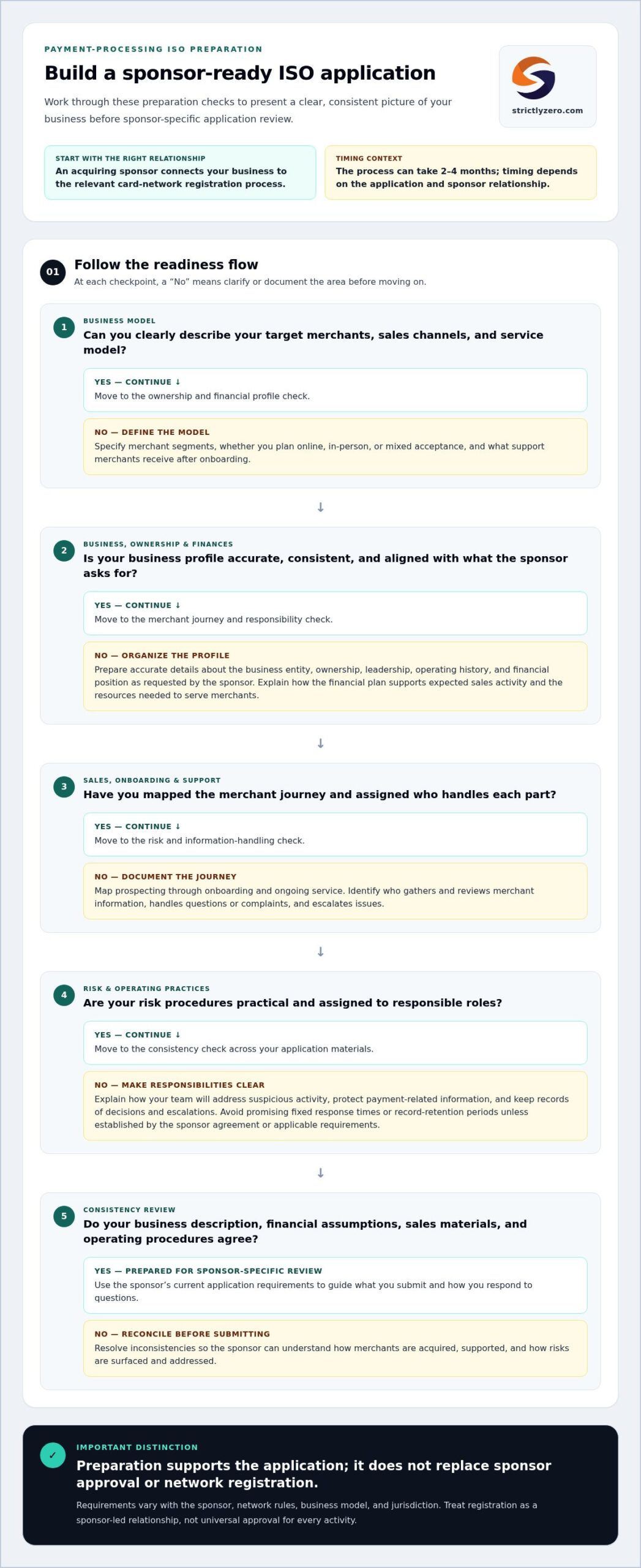
Preparation is sponsor-specific. There isn’t one checklist that applies to every applicant. Use early research to build a clear, consistent picture of the business, then align your materials with the sponsor’s current application requirements. A well-documented plan explains what you intend to sell and how you’ll acquire and support merchants responsibly.
Build a clear business and ownership profile
Describe your target merchant segments, planned sales channels, and service model. Explain whether you expect to focus on online merchants, in-person acceptance, or a mix, and what support merchants will receive after onboarding. Sponsors may also request information about the business entity, ownership, leadership, operating history, and financial position. Prepare accurate, consistent details, but don’t assume a particular document or format is mandatory unless your sponsor specifies it.
Show how your financial plan supports the proposed model, including expected sales activity and the resources needed to serve merchants. If your plans involve a particular merchant category or sales approach, explain the associated risks and how your business intends to manage them. The sponsor’s specific questions and evidence requirements will vary by applicant and business profile.
Document sales, support, and risk processes
Map the merchant journey from prospecting through onboarding and ongoing service. Identify who handles each step, how merchant information is gathered and reviewed, where questions or complaints go, and how issues are escalated. A process map or concise written procedure can make responsibilities easier to assess. Keep the description practical and consistent with the staffing and systems you plan to use.
Explain how your team will handle concerns about suspicious activity, protect payment-related information, and maintain records of decisions and escalations. Assign responsible roles rather than relying on a vague statement that “the team” will manage everything. Avoid promising fixed response times or record-retention periods unless those are established by your sponsor agreement or applicable requirements.
Before submitting an application, compare your business description, financial assumptions, sales materials, and operating procedures for inconsistencies. The sponsor should be able to understand how merchants are acquired, what support they receive, and how risks are surfaced and addressed. This groundwork also helps you respond to sponsor-specific questions and refine the plan.
Registration is one milestone. The systems behind merchant onboarding, payment acceptance, partner operations, and retention matter after launch. Explore how a payment processing platform for ISOs can support those workflows as your operation grows.
How Does the Registered ISO Application and Approval Process Work?
There isn’t one universal application route. The sponsor’s onboarding process, applicable card-network requirements, and your business model can affect the order of steps and the information requested. To understand how to become a registered ISO, separate sponsor discussions, application review, due diligence, contract terms, and network registration, even when some work happens at the same time.
From sponsor discussions to a complete application
Start by presenting potential acquiring sponsors with a concise account of your business: who you plan to serve, how you’ll find merchants, what support you’ll provide, and how you’ll manage operations. The sponsor can explain its eligibility criteria, application process, and the information it needs to assess the proposed relationship.
Once there’s a fit to explore, submit the sponsor’s application and supporting information in the requested format. The sponsor may review ownership, leadership, financial capacity, operating plans, controls, and your merchant pipeline. Requirements vary, so don’t assume another ISO’s application checklist will apply to your business.
Keep details consistent across the application, sales materials, business plan, and compliance procedures. For example, if your application describes one merchant segment but your sales materials target another, the mismatch may prompt follow-up questions. Clear, aligned information helps the sponsor understand the business it is being asked to support.
Due diligence, agreements, and network registration
During due diligence, the sponsor may request clarification or additional information. Respond with accurate updates and track open questions so key details don’t diverge across submissions. If the review moves forward, examine the proposed agreement carefully, including the responsibilities, limits, and operating expectations that apply to the relationship. The sponsor determines the relevant agreement terms and explains which registration steps apply.
Sponsor approval and card-network registration are related but distinct steps: sponsor approval establishes the acquiring relationship, while network registration addresses applicable network requirements. Visa and Mastercard processes and terminology can change, and their requirements may not be identical. The sponsor can identify the current process that applies to your arrangement and coordinate any required network submissions. Some review activities may overlap, but don’t treat network registration as automatic just because sponsor discussions are underway.
Approval isn’t guaranteed, and no single timeline applies to every applicant. The process can take two to four months, but actual timing depends on the sponsor’s review, how quickly questions are resolved, and the applicable registration steps. Plan for a sequence, not a promised launch date, and wait for the relevant approvals and agreements before representing the business as registered.
How Can You Address Compliance and Registration Concerns Before Launch?
Registration isn’t necessarily a single nationwide license that settles every compliance question. It’s one part of a broader operating framework involving sponsor and network approval, contractual commitments, and requirements that may depend on your activities and jurisdiction. As you research how to become a registered ISO, keep these workstreams separate so approval in one area isn’t mistaken for blanket permission to operate in every situation.
Is there one universal license to become a registered ISO?
No single approval should be assumed to cover every sponsor relationship, network rule, business activity, or jurisdiction. The applicable pathway depends on those factors, and registration still matters where required for the planned relationship. Have qualified legal counsel review relevant federal and state requirements for your business model. This helps distinguish registration steps from other obligations without treating the process as optional.
Use this planning view to keep responsibilities organized. The exact tasks and timing depend on the sponsor, network, and your operations.
| Stage | What to clarify | Practical focus |
|---|---|---|
| Before application | Proposed activities, data flows, and applicable obligations | Document the business model and identify compliance owners. |
| Approval review | Sponsor and network requirements, agreement terms, and requested controls | Resolve questions and align procedures with the approved relationship. |
| After launch | Ongoing sponsor commitments, reporting, and merchant support | Monitor processes, maintain records, and address issues through defined channels. |
What responsibilities continue after approval?
Approval is the start of operating under the agreed arrangement, not the end of oversight. Follow the sponsor’s contractual requirements, support merchants as agreed, keep appropriate records, and complete reporting required by the relationship. Assign clear owners for escalations and review processes when the business, merchant mix, or payment setup changes.
PCI DSS obligations depend on the ISO’s actual role in handling, storing, or transmitting payment account data and on how its systems connect to the payment environment. Map those data flows and confirm the applicable scope with the relevant sponsor and qualified security professionals. Don’t assume that outsourcing payment processing automatically removes every responsibility; the actual setup determines what applies.
Operational infrastructure can help organize payment acceptance and partner workflows, but it doesn’t replace sponsor approval, registration, or compliance work. Explore payment-processing infrastructure built for ISOs to see how platform capabilities can support operations after launch.
How Can a Payment Platform Support Your ISO After Registration?
Registration establishes an important relationship, but running an ISO means turning that approval into consistent merchant onboarding, payment support, and partner operations. Choose a platform that fits the business you plan to build, not just the application you submitted. As you consider how to become a registered ISO, include post-approval systems in your operating plan so your team can support merchants and partners as activity grows.
Match platform capabilities to your ISO operating model
Start with how your merchants accept payments. If your portfolio spans digital storefronts, physical locations, and mobile transactions, look for a platform that supports those channels in a coherent operating environment. A unified approach can help provide a consistent merchant experience while giving your team a clearer way to manage payment activity across channels.
Integration needs matter, too. Consider whether your model depends on API-based connections with software platforms, or whether merchants and staff need tools for day-to-day payment operations. Compare capabilities such as:
- Channel coverage: online, in-person, and mobile acceptance suited to your target merchants.
- Integration approach: options that fit your software partners and merchant workflows.
- Operations: tools that support merchant onboarding, payment activity, and account servicing.
- Partner management: clear workflows for compensation and merchant-retention efforts.
Strictly provides payment-processing infrastructure for ISOs, MSPs, and developers, with payment acceptance across online, in-person, and mobile channels. Match your intended merchant base and partner model to the systems you’ll need after launch.
Support partner growth with compensation and retention tools
As an ISO adds partners, compensation administration and merchant relationships become ongoing operational work. ClearSplit™ supports automated partner compensation, helping organize that part of partner management. ChurnIQ™ provides merchant-retention intelligence, giving teams information to support retention efforts. These tools address different needs: one focuses on partner compensation workflows, while the other supports merchant-retention insight.
Evaluate how those capabilities fit your operating model alongside channel coverage and integration needs. The right infrastructure can connect payment acceptance with partner operations, but it doesn’t replace sponsor approval, network registration, or the responsibilities set by your agreements.
See how Strictly supports payment-processing partners with infrastructure designed for payment acceptance and partner operations.
Build Your ISO for the Next Stage
Knowing how to become a registered ISO starts with understanding that approval is sponsor-led, not a one-size-fits-all license. Prepare a clear business and operating plan, work through sponsor and network requirements, and treat compliance as an ongoing responsibility rather than a box to check before launch.
Once approved, operational infrastructure can help turn your plans into a consistent merchant and partner experience. Strictly supports online, in-person, and mobile payment acceptance. ClearSplit™ supports automated partner compensation, while ChurnIQ™ provides merchant-retention intelligence.
Explore Strictly’s payment platform for partners to see how it can support your ISO’s operations as you grow. A thoughtful registration plan and systems built for the work ahead can help you move forward with confidence.
Frequently Asked Questions
What does it mean to be a registered ISO in payment processing?
A registered payment ISO is an Independent Sales Organization that markets or supports payment services through acquiring relationships. Registration typically involves an acquiring sponsor and applicable card-network processes, with requirements that can vary by business model and jurisdiction. This use of “ISO” is different from certification to a standard published by the International Organization for Standardization. It describes a role in the payment ecosystem, not a management or technical standards certification.
Is a registered ISO the same as an ISO-certified company?
No. A registered payment ISO participates in the card-payment ecosystem through applicable sponsor and network arrangements. An ISO-certified company has been assessed against a specific management or technical standard published by the International Organization for Standardization. The shared abbreviation can cause confusion, but the terms refer to different activities, authorities, and processes. Registration as a payment ISO doesn’t automatically qualify a company for certification, or the other way around.
How do I become a registered ISO for Visa or Mastercard?
Begin by defining your payment business model and identifying an acquiring sponsor. Then prepare for the sponsor’s due diligence, review the applicable agreements, and follow the relevant network-registration steps. The process for how to become a registered ISO depends on the sponsor, network, and planned business activities. Follow the procedures and eligibility requirements for your specific arrangement. There isn’t one universal application form or guaranteed route to approval.
Do I need a sponsor bank to become a payment ISO?
Payment ISOs commonly work through an acquiring sponsor that establishes the acquiring relationship and guides applicable registration requirements. The precise structure depends on the business model and agreements involved. A sponsor relationship is different from selecting a payment software platform: a platform can support payment operations, merchant workflows, and partner management, but it doesn’t replace sponsor approval or applicable card-network registration. Clarify each party’s responsibilities within the proposed arrangement.
How long does it take to become a registered ISO?
There’s no reliable universal timeline for becoming a registered ISO. Timing can depend on how complete the application is, the sponsor’s due diligence and agreement review, the complexity of the business, and applicable network processes. Prepare consistent ownership, operating, and risk information to help reduce avoidable follow-up. Submitting an application doesn’t guarantee approval or establish a launch date, so plan around the sponsor’s process rather than a fixed deadline.
What compliance requirements apply to a registered ISO?
Compliance obligations depend on the ISO’s activities, sponsor agreements, business operations, payment-data environment, and applicable law. PCI DSS relevance depends on whether and how the business stores, processes, or transmits payment-account data, so assess the actual data flows and responsibilities. Registration doesn’t replace ongoing operational duties. Because federal and state requirements can depend on the business model and jurisdiction, have qualified legal counsel review which obligations apply.
Can I start building an ISO business before registration is complete?
You can prepare a business plan and operating processes without representing that registration or approval has been granted. For example, define target merchants, document onboarding and support workflows, and assess platform needs while following sponsor guidance. Don’t begin marketing or processing activity that conflicts with sponsor agreements or applicable rules. Which activities are permitted before approval depends on your business model and circumstances, so seek qualified legal advice.