
AI Payment Fraud Detection in 2026: Protecting Multi-State Revenue
Published:

Did you know that 71% of companies reported a sharp increase in AI-powered fraud attempts in 2026? As bad actors use generative AI to scale synthetic identity attacks, legacy rules simply can’t keep up. If you’re managing a multi-state business, you’ve likely felt the sting of high chargeback rates eating into your profits or the frustration of false positives turning away your most loyal customers. It’s exhausting to balance security with a smooth checkout experience, especially when you’re trying to stay compliant with the new Nacha expanded fraud monitoring rules. Implementing robust ai payment fraud detection is no longer optional; it’s a requirement for survival.
You deserve a processing partner that works as hard as you do. This article explores how AI-driven prevention secures your revenue across every sales channel while eliminating traditional processing fees through a smart surcharge program. You’ll discover how to automate your security layer to meet the June 2026 standards, reduce your fraud-to-sales ratio, and keep your margins healthy. We’ll break down the shift toward real-time protection and show you how a unified platform handles the complexity of state-level compliance so you don’t have to.
Key Takeaways
- Identify why legacy security tools fall short against modern threats like deepfake transactions and synthetic identity theft.
- Explore how real-time ai payment fraud detection uses neural networks and BIN lookups to stop risks in milliseconds.
- Compare the hidden operational costs of manual fraud review teams against the speed and accuracy of automated protection.
- Learn to implement a multi-state compliant surcharge or dual pricing program to offset processing costs while securing your revenue.
- Discover the benefits of an omni-channel platform that provides a unified data layer for consistent security across all sales channels.
Table of Contents
- The State of Payment Fraud in 2026: Why Legacy Tools Fail
- How AI and Machine Learning Transform Payment Security
- Legacy Fraud Prevention vs. AI-Driven Detection
- Strategies for Secure Multi-State Scaling
- Strictly: AI-Powered Fraud Prevention Meets Zero-Fee Processing
The State of Payment Fraud in 2026: Why Legacy Tools Fail
Modern commerce moves too fast for human review. In 2026, ai payment fraud detection has evolved into a necessity. It uses complex neural networks to analyze thousands of data points and identify potential threats in milliseconds. This isn’t just about blocking a bad card; it’s about understanding the intent behind the transaction before it’s even processed, a process rooted in the broader field of Artificial intelligence in fraud detection.
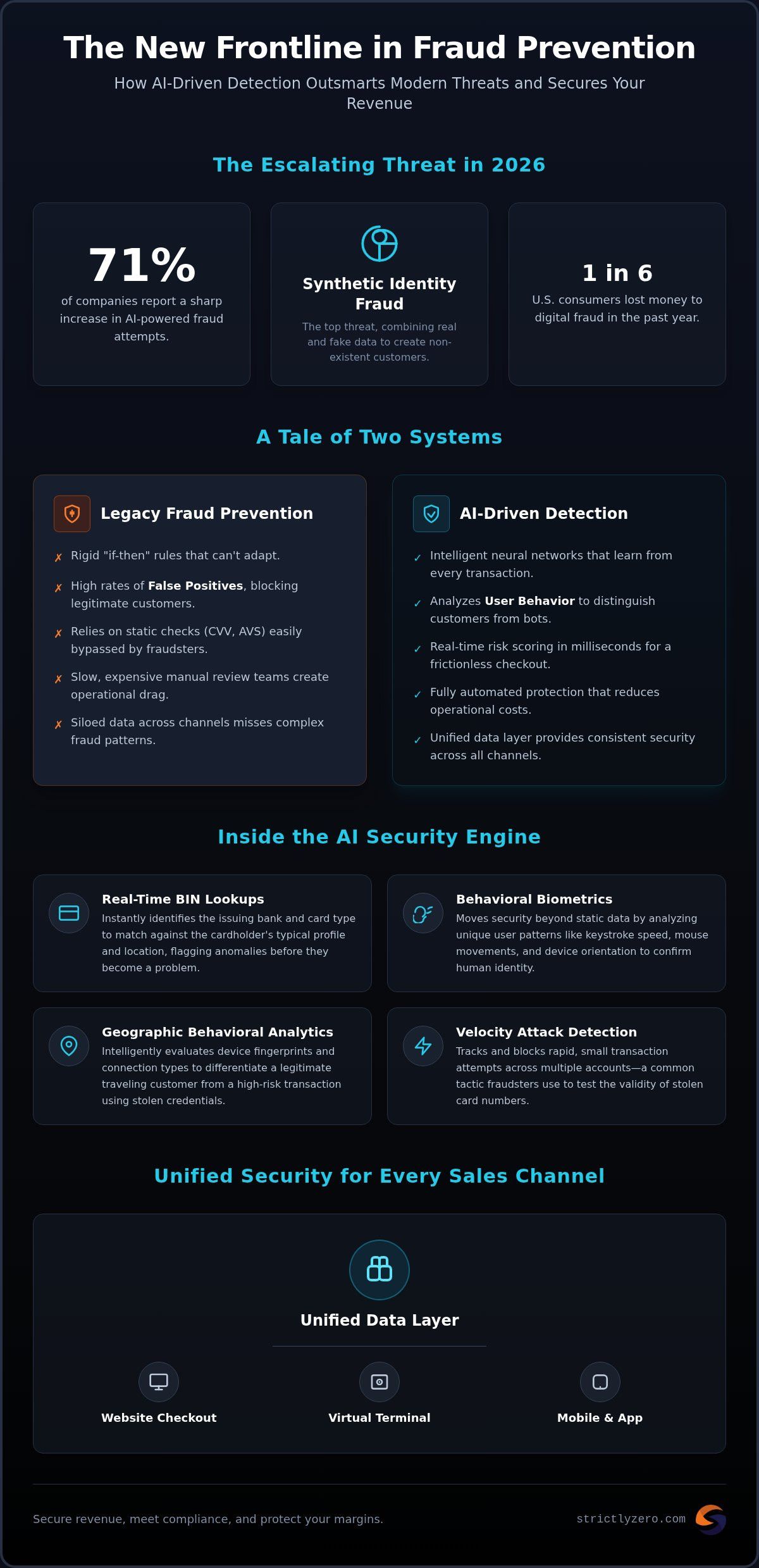
Synthetic identity fraud is currently the most significant threat facing multi-state merchants. Fraudsters combine real social security numbers with fake names and addresses to create “people” who don’t actually exist. These synthetic identities are often coupled with deepfake transactions where AI generates realistic voices or video to bypass traditional security layers. Because these identities have no history of fraud, static rules like CVV or AVS checks won’t flag them. 71% of companies reported an increase in these AI-powered fraud attempts in the past year, according to Trustpair data from 2026. This is a growing crisis, as TransUnion reported in April 2026 that one in six U.S. consumers lost money to digital fraud over the previous twelve months.
To better understand this concept, watch this helpful video:
Behavioral biometrics is the new standard for payment security, analyzing unique user patterns like keystroke speed, mouse movements, and device orientation to confirm identity. It moves security beyond what a customer knows to how a customer acts, making it nearly impossible for bots to mimic legitimate human behavior.
The Shift from Rules-Based to Intelligence-Based Systems
Old “if-then” logic creates a rigid environment. If a customer buys from a new state, a legacy system might block them automatically. This leads to high false-positive rates, which are just as damaging as fraud itself because you lose the sale and the customer’s future lifetime value. ai payment fraud detection solves this by learning from every successful transaction. It recognizes that a legitimate customer’s behavior changes, such as shopping while traveling, and adjusts its risk scoring in real time.
Omni-Channel Vulnerabilities
Fraud looks different depending on the entry point. A mobile app transaction carries different risks than a virtual terminal or a website checkout. Multi-state businesses face the added challenge of “friendly fraud,” where customers claim they didn’t receive a shipment or that a charge was unauthorized. Managing these risks across state lines requires a unified data layer to spot patterns that single-channel tools miss. Check out our ecommerce payment processing guide to see how an omni-channel approach secures your entire sales ecosystem.
How AI and Machine Learning Transform Payment Security
Modern ai payment fraud detection does more than just scan for blacklisted names. It starts with real-time BIN (Bank Identification Number) lookups. By instantly identifying the issuing bank and card type, the system determines if a transaction matches the cardholder’s typical profile. If a debit card usually used in Florida suddenly appears on a high-value virtual terminal in Oregon, the system pauses. It also tracks velocity attacks, where fraudsters attempt small transactions across multiple merchant accounts to test card validity. This level of pattern recognition is vital because 33% of U.S. consumers who lost money to digital fraud in 2026 cited stolen credit cards as the cause, according to data from TransUnion.
Geographic behavioral analytics take this a step further. Instead of flatly blocking out-of-state purchases, the AI evaluates whether the transaction looks like a traveling customer or a stolen credential. It looks at device fingerprints and connection types. Our Smart Pricing Engine also plays a role here. By validating the transaction type for surcharge compliance, it adds another layer of verification that ensures the payment data aligns with the merchant’s specific industry and state regulations. If you want to see how these layers work together, you can explore our integrated payment solutions for multi-state growth.
Machine Learning Models: Supervised vs. Unsupervised
Supervised learning models use historical data to recognize known fraud signatures. They’re excellent at stopping repeat offenders. However, with the rise of synthetic identities in 2026, unsupervised learning is just as critical. These models don’t need a history of fraud to act; they identify anomalies that have never been seen before by spotting deviations from normal human behavior. A hybrid approach combining both is the only way to stay ahead of generative AI threats.
Reducing Chargebacks with Predictive Scoring
Every transaction is assigned a Risk Score before it ever hits the authorization stage. If a score is low, the customer enjoys a frictionless checkout. If it’s borderline, the system triggers automated step-up authentication, like 3D Secure, to confirm the user’s identity without involving a human agent. By automating these decisions, AI-driven scoring reduces manual review time by 80%. This proactive approach directly lowers your fraud-to-sales ratio while protecting your merchant account from the long-term damage of excessive chargebacks.
Legacy Fraud Prevention vs. AI-Driven Detection
Legacy fraud management relies on rigid filters and human intuition. When a transaction looks suspicious, it’s flagged for manual review. This process takes minutes, causing significant friction at the checkout. In contrast, ai payment fraud detection operates in milliseconds. It doesn’t just look at the individual transaction; it leverages network-wide intelligence. If a specific device fingerprint was flagged on a merchant account in California five minutes ago, the system instantly blocks it on your New York store. This collective data depth is something a manual team simply can’t replicate.
Manual review teams are also expensive. You’re paying for salaries and ongoing training, yet human error remains a persistent factor. AI scales effortlessly without increasing your overhead. For multi-state businesses handling high transaction volumes, the ability to process thousands of payments simultaneously without a bottleneck is the difference between scaling up and hitting a wall. Transitioning to an automated system allows your team to focus on growth rather than chasing suspicious zip codes.
The ROI of AI Security
The true cost of fraud isn’t just the lost transaction. When a chargeback occurs, you lose the cost of the merchandise, the initial shipping fees, and you’re hit with a heavy chargeback fee from the processor. If your chargeback ratio climbs too high, your merchant account could be terminated entirely. By using predictive models to stop fraud before authorization, you protect your margins. Higher approval rates also boost customer lifetime value. A legitimate customer who is wrongly declined (a false positive) rarely returns to that store. Implementing modern credit card processing for small business ensures you’re using tools that prioritize both security and the customer experience.
Integration and Technical Overhead
Switching to an AI-driven model doesn’t have to be a technical hurdle. API-first platforms allow developers to integrate advanced security layers into existing workflows seamlessly. This approach often includes tokenization, which replaces sensitive card data with unique identifiers. Tokenization significantly reduces your PCI DSS compliance burden because the actual credit card numbers never touch your servers. Using a unified platform for both processing and fraud prevention eliminates data silos. When your processing engine and your fraud detection speak the same language, you get faster authorizations and more accurate risk scoring across every channel.
Strategies for Secure Multi-State Scaling
Expanding your business into new territories requires more than just a marketing plan. It demands a localized approach to risk management that accounts for regional fraud trends. Integrating ai payment fraud detection into your scaling strategy allows you to identify which regions are prone to specific threats, such as synthetic identity clusters in certain metropolitan hubs. To scale securely, follow these strategic steps:
- Step 1: Audit your current fraud-to-sales ratio. Break down your data by state and sales channel to see where leaks are occurring.
- Step 2: Implement a multi-state compliant surcharge or dual pricing program. This offsets the cost of advanced security while keeping your margins consistent across different tax jurisdictions.
- Step 3: Centralize your payment data. Use an omni-channel gateway to ensure your fraud tools have a unified view of every customer interaction, whether online or via a virtual terminal.
- Step 4: Enable real-time AI monitoring for all card-not-present (CNP) transactions. These are the primary targets for AI-driven velocity attacks in 2026.
- Step 5: Use ChurnIQ. This metric helps you monitor if your fraud-prevention friction is causing customer loss, allowing you to fine-tune your risk thresholds.
Managing Compliance and Security
Our Smart Pricing Engine ensures surcharge compliance at the state level while your fraud tools verify the legitimacy of the card in the background. Managing state-level privacy laws like CCPA or CPRA is also essential; your fraud checks must respect consumer data rights while protecting your bottom line. Understanding your Regulatory Nexus is critical for multi-state payment security because it defines the legal intersection between your business location and where your customers reside.
Customer Communication and Trust
Transparency is key when scaling across state lines. Explain the security benefits of zero-fee processing to your customers so they understand that these programs fund the advanced AI protecting their financial data. Building a consistent checkout experience from New York to California creates brand trust and reduces the likelihood of “friendly fraud” disputes. For a deeper look at how these models work, read our zero fee credit card processing guide. If you’re ready to secure your expansion, you can modernize your multi-state payment strategy with our unified platform.
Strictly: AI-Powered Fraud Prevention Meets Zero-Fee Processing
Strictly provides a unique advantage by pairing top-tier ai payment fraud detection with a zero-fee revenue model. While many competitors charge a flat percentage regardless of whether their tools successfully block a fraudulent transaction, we believe security shouldn’t come with a heavy tax on your legitimate sales. By utilizing our surcharge and dual pricing engine, you can offset processing costs entirely. This allows you to reinvest those significant savings into marketing, inventory, or further regional expansion, turning a traditional expense into a growth engine.
Our omni-channel platform serves as the backbone for ISOs and merchants who prioritize trust. We provide a unified data layer that connects your virtual terminal, invoicing, and e-commerce transactions. This integration ensures that your fraud defense is consistent across every touchpoint, preventing the data silos that fraudsters often exploit. Our Smart Pricing Engine automates state-level compliance in real-time. It ensures every surcharge is applied correctly based on the customer’s specific location while the AI simultaneously verifies the transaction’s legitimacy in the background.
A Unified Solution for 2026
In the current high-risk environment, security and profitability must work in tandem. At the point of sale, our AI-driven fraud prevention evaluates risk scores while the surcharge program calculates the exact pricing model required for compliance. This happens in milliseconds, ensuring a frictionless customer experience. For those managing complex partnerships across state lines, our ClearSplit™ tool provides total transparency into revenue shares. Adopting the best credit card processing for small business in 2026 means choosing a system that protects your bottom line from both cybercriminals and unnecessary processing fees.
Get Started with Strictly
Onboarding with Strictly is designed for the fast-paced needs of multi-state entities. We don’t just set you up with a processing account; we start with an AI-driven audit of your current risk profile. This identifies existing vulnerabilities and provides immediate suggestions for improvement, helping you lower your fraud-to-sales ratio from day one. Whether you’re dealing with synthetic identity threats or managing a high volume of card-not-present transactions, our platform scales with your business volume without increasing your technical overhead.
Stop letting high processing fees and chargebacks erode your margins. You can secure your revenue and eliminate fees with Strictly today. Our team is ready to help you implement a secure, compliant, and cost-effective payment strategy that supports your long-term growth across every state.
Future-Proof Your Multi-State Revenue
The payment landscape of 2026 requires a proactive stance against increasingly sophisticated digital threats. Moving beyond rigid legacy filters to advanced ai payment fraud detection ensures that your business stays protected from synthetic identities and velocity attacks without sacrificing a seamless customer experience. By unifying your data across web, mobile, and virtual terminals, you create a robust security layer that scales as fast as your multi-state ambition. This omni-channel approach ensures that no transaction goes unverified, regardless of where your customer is located.
You no longer have to choose between high-level security and healthy profit margins. Our AI-driven Smart Pricing Engine handles 50-state surcharge compliance automatically; this allows you to eliminate 100% of processing fees while maintaining top-tier defenses. It’s time to stop letting rising fraud rates and hidden fees dictate your growth potential. Protect your business and eliminate processing fees. Get started with Strictly today. Your business deserves a partner that turns complex compliance into a simple, competitive advantage for your long-term success.
Frequently Asked Questions
How does AI actually detect payment fraud in 2026?
AI identifies fraud by analyzing thousands of data points in real time through complex neural networks. It looks at transaction velocity, device fingerprints, and behavioral biometrics to spot anomalies that human reviewers would miss. This proactive approach allows the system to identify complex threats like synthetic identities by cross-referencing network-wide data. It moves beyond static rules to understand the context of every single payment attempt instantly.
Will AI fraud detection slow down my customer’s checkout experience?
Modern ai payment fraud detection operates in milliseconds, so your customers won’t notice any delay during checkout. The speed of these neural networks ensures that risk scoring happens simultaneously with the authorization request. This eliminates the need for manual reviews that typically stall orders for minutes or even hours. You can maintain a frictionless checkout flow while keeping your business secure from the latest generative AI threats.
What is the difference between a chargeback and a false positive?
A chargeback occurs when a customer disputes a transaction, often resulting in lost revenue and high fees for the merchant. A false positive happens when your security system incorrectly flags and blocks a legitimate customer’s purchase. While chargebacks eat into your current profits, false positives damage your brand reputation and long-term customer lifetime value. AI helps balance these risks by refining accuracy through continuous machine learning.
Can AI detect synthetic identity fraud across different states?
Yes, AI is specifically designed to catch synthetic identity fraud by spotting patterns across different geographic regions. It analyzes whether the provided credentials match the user’s behavioral history and device location. Because synthetic identities often lack a consistent digital footprint, the AI flags these inconsistencies in real time. This is essential for multi-state merchants who face diverse fraud tactics across different tax jurisdictions and sales channels.
Is AI fraud prevention included in zero-fee processing programs?
AI-driven protection is a core component of our trust-based processing platform, including our surcharge and dual pricing programs. We integrate security directly into our Smart Pricing Engine to ensure that every transaction is both compliant and verified. This means you can eliminate 100% of your processing fees while still benefiting from top-tier fraud prevention. You don’t have to sacrifice security to achieve a zero-fee revenue model.
Do I need a developer to integrate AI fraud detection into my website?
While our platform is API-first for custom builds, you don’t necessarily need a developer to get started. We provide intuitive tools and partner management resources that simplify the integration process for most e-commerce environments. Our team handles the heavy lifting of the AI auditing and risk profiling during your onboarding. This ensures that your multi-state business is protected from day one without requiring a massive technical overhaul.
How does Strictly’s AI recognize legitimate out-of-state transactions?
Strictly uses geographic behavioral analytics to distinguish between a traveling customer and a stolen card. The system evaluates device fingerprints, connection types, and past shopping habits to determine if an out-of-state transaction is legitimate. By leveraging our omni-channel data, the AI recognizes when a customer who usually buys in-person is now using your virtual terminal or website while on a business trip, preventing unnecessary declines.
What happens to my merchant account if my fraud rate is too high?
If your fraud-to-sales ratio exceeds industry thresholds, you risk facing heavy penalties or even the termination of your merchant account. High fraud rates signal to banks that your business is a high-risk entity, which can lead to your inclusion on the MATCH list. This makes it extremely difficult to obtain processing services in the future. Implementing automated AI protection is the best way to keep your ratios low and your account in good standing.