
Beyond the Haggle: 5 Effective Alternatives to Negotiating Credit Card Processing Fees
Published:

What if your annual “negotiation ritual” with your payment processor is actually a waste of time? Most business owners feel the sting of rising interchange rates, such as the 1.80% plus $0.10 e-commerce fees Visa set in April 2026. You’ve likely spent hours trying to shave off a few basis points, only to find those marginal savings swallowed by the next opaque billing cycle or a new assessment fee. It’s frustrating to fight for pennies while the card brands continue to raise the floor on your costs.
Fortunately, there are more powerful alternatives to negotiating credit card processing fees that address the root cause of the problem rather than just trimming the edges. You don’t have to settle for slightly lower markups when you can restructure how you handle payments entirely. This guide will show you how to eliminate the burden of processing fees through structural shifts that offer more impact than traditional haggling. We’ll explore five effective strategies, including dual pricing engines and automated compliance tools, that deliver predictable monthly costs while keeping you aligned with the latest state regulations and PCI DSS v4.0.1 standards.
Key Takeaways
- Understand why traditional haggling only affects the processor’s markup, leaving the bulk of non-negotiable interchange and assessment fees untouched.
- Learn why technical alternatives to negotiating credit card processing fees, like leveraging Level 2 or 3 data and ACH transfers, provide deeper savings for B2B transactions.
- Discover how surcharge and dual pricing models can eliminate your processing burden by shifting costs to the cardholder while maintaining transparency.
- Identify the critical differences between credit and debit card regulations to ensure your fee-shifting strategy remains compliant with card brand rules.
- Gain a strategic roadmap for implementing fee changes that protects your customer relationships through clear digital disclosures and point-of-sale signage.
Table of Contents
- The Negotiation Myth: Why Haggling Over Markup Rarely Moves the Needle
- Structural Alternatives to Negotiation: Technical Fee Reduction
- The Zero-Fee Revolution: Surcharge and Dual Pricing Programs
- Implementation Strategy: Moving Beyond Negotiation Without Losing Customers
- The Strictly Advantage: Automated Compliance and Zero-Fee Processing
The Negotiation Myth: Why Haggling Over Markup Rarely Moves the Needle
Many business owners treat their monthly processing statement like a battleground. They assume a stern phone call to their current provider will result in massive, long-term savings. While you might win a few small concessions, traditional negotiation hits a ceiling almost immediately. This is why looking into structural alternatives to negotiating credit card processing fees is a more sustainable path for modern merchants who want to protect their bottom line.
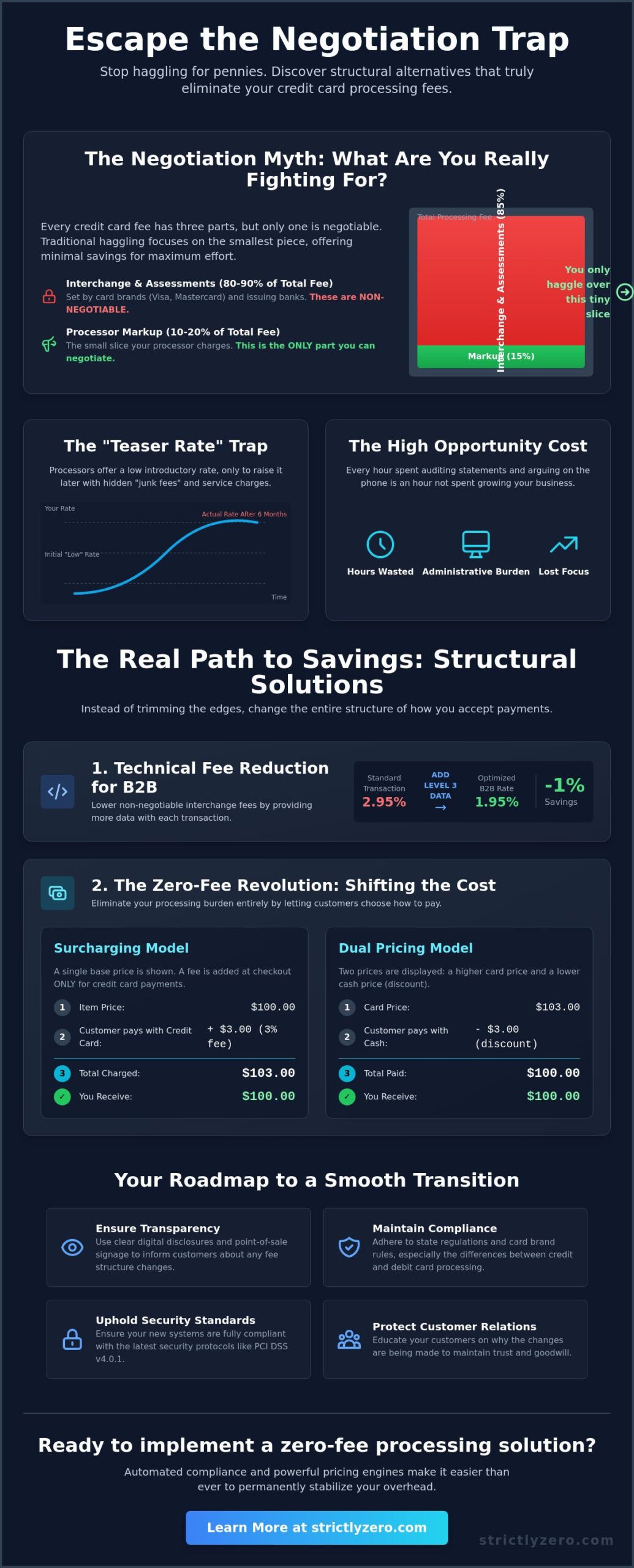
Every transaction fee is built on three pillars: interchange, assessments, and the processor’s markup. Interchange fees are paid to the card-issuing bank and represent the bulk of your costs. Assessments go directly to card brands like Visa and Mastercard. Both are non-negotiable and set at the network level. The only part you can actually haggle over is the markup, which is the small slice the processor keeps for their services. Since you’re only arguing over a fraction of the total bill, the impact of a “win” is often negligible.
To better understand how negotiation dynamics work with financial creditors, watch this helpful video:
Interchange vs. Markup: Knowing What You Can Actually Change
Interchange is the non-negotiable baseline cost of every transaction, determined by the card networks based on risk and card type. Most negotiation efforts only target the processor markup, which often accounts for less than 20% of the total processing cost. Chasing a 10-basis-point discount on that small fraction usually isn’t worth the administrative hours spent on hold or auditing complex spreadsheets. It’s a high-effort, low-reward cycle that fails to address the rising interchange rates set by the card brands themselves.
The Hidden Cost of Constant Negotiation
Constantly fighting for better rates often leads to the “teaser rate” trap. A processor might offer a low introductory markup to win your business, only to let those fees creep back up through new service charges or “junk fees” six months later. There’s also a significant opportunity cost involved. Every hour you spend auditing statements is an hour you aren’t spending on customer acquisition or product development. Switching processors for a slightly lower rate frequently leads to higher long-term costs once you factor in the time spent retraining staff or troubleshooting new software. Instead of focusing on these diminishing returns, many businesses are exploring Surcharge programs as alternatives to negotiating credit card processing fees to permanently stabilize their overhead.
Structural Alternatives to Negotiation: Technical Fee Reduction
While haggling over markups might save you a few dollars, technical optimization targets the interchange fees themselves. These alternatives to negotiating credit card processing fees focus on data transmission and payment routing to lower the baseline cost of every transaction. Instead of asking your processor for a favor, you’re changing the transaction’s DNA to qualify for lower rates. This approach is more sustainable because it works within the existing framework of the card networks.
Maximizing B2B Efficiency with Level 3 Data
If you sell to other businesses or government agencies, you’re likely paying premium rates for corporate and purchasing cards. These cards carry higher risks for banks, so they charge more. However, you can lower these interchange rates by up to 1% by providing Level 3 data. This includes line-item details like product codes, quantities, and tax amounts. Most standard systems fail to capture this data automatically. Optimizing credit card processing for small business often requires specialized virtual terminals that prompt for these details, ensuring every B2B sale is processed at the lowest possible cost.
ACH and E-Checks: The Low-Cost Alternative for Large Invoices
Percentage-based fees are a major drain on high-value invoices. A $5,000 credit card transaction can easily cost $145.30 in fees, whereas an ACH transfer typically costs between $0.20 and $1.50. In the third quarter of 2025, B2B payments on the ACH network grew by 10%, signaling a massive shift away from expensive card transactions. You don’t have to choose between one or the other. You can integrate ACH alongside credit cards in a unified omni-channel payment processing system. This gives your clients flexible payment options while allowing you to steer large settlements toward lower-cost channels.
Beyond data and ACH, simple technical tweaks like optimizing your batching schedules can reduce per-transaction communication costs. Implementing Address Verification Service (AVS) is another powerful lever. It verifies the cardholder’s billing address, which moves transactions into lower-risk interchange categories. When you pair these technical adjustments with AI-driven fraud prevention, you create a robust defense against both high fees and unauthorized transactions. Before you implement any new fee-shifting strategies, it’s wise to review Visa’s official surcharging rules to ensure your business remains fully compliant with the latest network requirements.
The Zero-Fee Revolution: Surcharge and Dual Pricing Programs
Traditional negotiation focuses on reducing the processor’s markup, but it leaves the massive burden of interchange fees on your shoulders. If you want to eliminate that cost entirely, you must look at structural alternatives to negotiating credit card processing fees. The most effective method is shifting the cost of acceptance from the merchant to the cardholder. This isn’t just about saving a few basis points; it’s about reclaiming your entire margin. By implementing a surcharge or dual pricing model, you can effectively reach a zero-fee environment where your business no longer subsidizes the rewards programs of your customers’ credit cards.
While both models aim for the same result, they function differently at the point of sale. Surcharging adds a clear fee to credit card transactions at checkout. Dual pricing, however, presents two distinct prices for every item: a standard price and a discounted cash price. This distinction is vital for customer psychology. Most shoppers view a surcharge as a penalty, but they see dual pricing as a “cash discount” reward. This subtle shift in framing often leads to higher customer satisfaction while achieving the same goal of zero fee credit card processing.
Surcharging vs. Dual Pricing: Choosing Your Strategy
Choosing between these two models depends on your specific business type and customer base. High-volume retailers and service providers are increasingly adopting these alternatives to negotiating credit card processing fees to offset rising network costs. Use the table below to understand the key differences:
| Feature | Surcharging | Dual Pricing |
|---|---|---|
| Signage | Requires disclosure at entry and POS. | Requires two prices on every label/menu. |
| Customer Perception | Often viewed as an “added fee.” | Viewed as a “cash discount” incentive. |
| Debit Cards | Illegal to surcharge. | Applies to all non-cash (Credit and Debit). |
Compliance and State Regulations in 2026
Compliance is the biggest hurdle when moving away from traditional billing. As of May 2026, the legal landscape is a patchwork of state-specific rules. Connecticut, Massachusetts, and Maine explicitly prohibit credit card surcharges. Other states have strict caps; Colorado limits surcharges to 2%, while Illinois caps them at 1% or the actual processing cost. In New York and New Jersey, you cannot charge more than what you actually pay the processor.
The most dangerous compliance trap is surcharging a debit card. Even if a customer runs a debit card “as credit,” it’s illegal to apply a surcharge. This is where a smart Surcharge & Dual Pricing Engine becomes essential. Modern systems use real-time BIN (Bank Identification Number) lookups to identify debit cards instantly. This automation ensures you stay compliant with both state laws and Visa’s 3% surcharge cap without having to manually inspect every card that swipes through your terminal.
Implementation Strategy: Moving Beyond Negotiation Without Losing Customers
Moving from negotiation to a surcharge or dual pricing model requires a clear communication plan. The fear of losing customers often keeps merchants trapped in high-fee cycles, but transparency is a powerful tool. When you implement alternatives to negotiating credit card processing fees, you aren’t just changing a price; you’re changing the conversation. Customers in 2026 are increasingly aware of the costs behind credit card rewards. They often appreciate a merchant who is honest about why prices are changing rather than one who hides costs behind sudden, across-the-board inflation hikes.
Signage is your first line of defense. Card brand rules require clear disclosures at the point of entry and the point of sale. For digital environments, this means ensuring your checkout page clearly breaks down the “cash price” versus the “card price.” This level of detail builds trust and prevents surprise at the final click. Monitoring customer feedback during the first 90 days is essential to ensure your messaging resonates and your churn rates remain stable.
The Art of the Transparent Transition
Training your staff is critical. Instead of being defensive, team members should frame the change as an option for the customer. A simple script helps: “To keep our prices as low as possible, our listed prices now reflect a cash discount. You’re welcome to pay with a credit card for the standard price, which includes a small processing fee.” This approach positions the fee as a choice rather than a penalty.
Many merchants find that using the best credit card processing for small business tools allows them to highlight these savings directly on the receipt. When a customer sees exactly how much they saved by using cash or a debit card, the value proposition becomes concrete. It transforms a potentially negative interaction into a moment of transparent value.
Leveraging Technology for Frictionless Payments
The transition is much smoother when the technology is invisible. Using virtual terminals and secure payment links allows customers to pay on their own terms without feeling the friction of a manual surcharge calculation. These systems should automatically handle the math, ensuring compliance with state-specific caps like Colorado’s 2% limit or New York’s actual-cost requirements. This technical precision is one of the most reliable alternatives to negotiating credit card processing fees because it removes human error from the compliance equation.
Modern credit card processing services also help offset the cost of fees by providing extra security. For example, AI-driven fraud prevention identifies high-risk transactions before they happen. This reduces the “hidden” costs of chargebacks, which generally cost between $5 and $25 for ACH and significantly more for credit cards. By combining zero-fee models with robust security, you protect your margins from multiple angles.
Ready to stop haggling and start saving? Explore how a Surcharge & Dual Pricing Engine can automate your compliance and eliminate your processing debt today.
The Strictly Advantage: Automated Compliance and Zero-Fee Processing
The “haggle” culture in payment processing is a byproduct of a broken system. When you choose alternatives to negotiating credit card processing fees, you’re opting for a structural fix rather than a temporary patch. The Strictly Smart Pricing Engine represents this shift by automating compliance for every transaction. Instead of you manually verifying if a surcharge is legal in your state or if a card is eligible, the engine does the heavy lifting in milliseconds. This takes the guesswork out of your daily operations and ensures your business remains on the right side of card network rules.
Real-time identification is the backbone of this technology. Every time a card is swiped, tapped, or keyed into the system, the engine identifies if it’s a debit or credit card. This is vital because surcharging debit cards remains illegal, even if they are processed through credit networks. By integrating this intelligence into an omni-channel payment processing system, Strictly provides one unified account for your e-commerce, in-person, and mobile sales. This creates a foundation of trust as a payment processor, offering the stability you need to face the rising interchange rates and assessment fees that Visa and Mastercard implemented in early 2026.
Beyond simple fee shifting, the system incorporates AI-driven fraud prevention to lower your total cost of acceptance. While traditional processors might offer a low markup, they often leave you vulnerable to chargebacks and “junk fees” that erode your savings. Strictly focuses on protecting your entire transaction lifecycle. By ensuring every payment meets the mandatory PCI DSS v4.0.1 requirements automatically, the system reduces the administrative burden that usually follows a traditional negotiation attempt.
Why Automation Beats Manual Negotiation
Automation removes the need for the exhausting annual fee audits that plague most businesses. By maintaining a $0 net cost for the merchant, Strictly ensures that your margins remain protected regardless of how often card brands raise their baseline rates. For partners and ISOs, ClearSplit™ provides a transparent way to scale these zero-fee models across multiple locations or merchant accounts. Additionally, the system uses ChurnIQ™ to help businesses identify and retain their most valuable relationships by focusing on long-term value and automated compliance rather than temporary, negotiable markups. It’s one of the most sustainable alternatives to negotiating credit card processing fees available today.
Getting Started with a Zero-Fee Model
Transitioning from traditional pricing to a dual pricing model is a straightforward onboarding process. You don’t need to wait for a contract to expire or for a processor to approve a minor discount. You can access the Strictly virtual terminal and invoicing tools almost immediately for fee-free billing. This allows you to send digital requests that include automated compliance and fraud prevention right out of the box. You can offer your customers the choice to pay the standard price with a card or the discounted price with cash, all while the software handles the complex math and disclosure requirements in the background.
Eliminate your processing fees today with Strictly and stop fighting for pennies in a system designed to favor the card brands.
Take Control of Your Margins Today
Haggling over a few basis points is a temporary fix for a structural problem. As card brands continue to adjust interchange rates, the most sustainable path forward involves adopting alternatives to negotiating credit card processing fees that actually remove the burden from your bottom line. By shifting to a dual pricing or surcharge model, you turn a recurring expense into a predictable, zero-cost operation. You no longer have to spend hours auditing statements or fighting for marginal discounts that disappear within months.
Switch to a Zero-Fee Model with Strictly Today and reclaim the revenue your business deserves.
Frequently Asked Questions
Is it legal to pass credit card fees to customers in 2026?
Yes, passing credit card fees to customers is legal in the majority of U.S. states as of May 2026. Merchants must provide clear disclosure at the point of entry and the point of sale to remain compliant with card network rules. However, you cannot implement these fees in Connecticut, Massachusetts, Maine, or Puerto Rico, as these jurisdictions explicitly prohibit surcharging.
What is the difference between a surcharge and a cash discount?
A surcharge is an additional fee added to the regular price when a customer chooses to pay with a credit card. A cash discount is a reduction in the posted price for customers who pay with cash or check. While surcharges are strictly limited to credit card transactions, cash discounts can be offered across all payment types to encourage lower-cost settlement methods.
Do customers actually leave businesses that implement surcharging?
Most industry professionals report that customer churn is minimal when fee changes are handled with transparency. Shoppers are increasingly aware of rising interchange rates, such as the Visa e-commerce rates that exceeded 1.80% in April 2026. Many customers actually prefer a clear, optional fee over hidden price increases that affect everyone regardless of how they pay.
Can I negotiate the interchange fees set by Visa and Mastercard?
No, interchange fees are non-negotiable baseline costs set directly by the card networks. These rates, along with assessment fees like Visa’s 0.14% credit fee, apply to every processor equally. This fixed reality is why many merchants seek alternatives to negotiating credit card processing fees, as haggling only affects the small markup kept by the service provider.
How does a dual pricing program work at the point of sale?
A dual pricing program presents two distinct prices for every item: a lower price for cash and a standard price for card payments. Modern software handles these calculations automatically at the terminal so staff don’t have to do manual math. This model is often viewed more favorably by consumers because it frames the lower price as a reward for using cash rather than a penalty for using plastic.
What happens if I accidentally surcharge a debit card?
Surcharging a debit card is illegal and violates your merchant agreement, even if the customer runs the transaction “as credit.” Doing so can result in significant fines from card brands and potential legal action in certain states. To prevent this, smart pricing engines use real-time BIN lookups to identify debit cards instantly and disable the surcharge for that specific transaction.
Are there any states where surcharging is still prohibited?
As of May 2026, Connecticut, Massachusetts, and Maine are the three states that explicitly prohibit credit card surcharging. Other states allow the practice but impose strict caps on the amount. For example, Colorado limits surcharges to 2%, while Illinois caps them at 1% or the actual cost of the processing fee. Always verify your local requirements before updating your pricing structure.
How much can a small business save by switching to a zero-fee model?
Switching to a zero-fee model can eliminate nearly 100% of your credit card processing burden. For businesses looking for alternatives to negotiating credit card processing fees, the savings are often substantial compared to traditional markups. For instance, shifting a $5,000 invoice from a credit card to an ACH transfer can reduce your fee from over $140 to as little as $0.50, directly protecting your profit margins.