
California Credit Card Surcharge Rules 2026: The Merchant’s Compliance Guide
Published:

If you’re still adding a surprise 3% fee at the end of a checkout, you might be accidentally inviting a letter from the California Attorney General. Staying on top of the California credit card surcharge rules has become a complex challenge since SB 478, the Honest Pricing Law, changed the game for every merchant in the state. It’s frustrating to watch your margins shrink under rising processing costs while you’re simultaneously worried about “hidden fee” enforcement. We know you need to protect your profits without risking your reputation or your business.
This guide will show you exactly how to master these regulations and use compliant strategies to eliminate your processing fees for good. You’ll get a clear “yes or no” on current legality, a step-by-step compliance checklist, and a look at how an automated dual pricing engine can handle the technical rules for you. By the end of this article, you’ll have a roadmap to full transparency that keeps both your customers and the regulators happy.
Key Takeaways
- Understand how the California credit card surcharge rules shifted from a total ban to a transparency-first mandate under SB 478.
- Learn why traditional surcharging is risky and how “all-in” pricing prevents your business from facing Attorney General enforcement.
- Discover why a dual pricing model is the most compliant way to pass on processing costs by showing cash and card prices upfront.
- Identify the critical steps for updating your payment workflows, including card network registration and mandatory debit card detection.
- Explore how an automated pricing engine can manage complex state rules and card brand requirements in real-time.
Table of Contents
- The Current Legal Status of Credit Card Surcharges in California
- SB 478 and the 'Hidden Fees' Statute: The New 2026 Standard
- Surcharging vs. Dual Pricing: Finding the Compliant Path
- How to Implement a Compliant Program in California
- Automating California Compliance with Strictly
The Current Legal Status of Credit Card Surcharges in California
For decades, California Civil Code Section 1748.1 prohibited merchants from adding extra fees for credit card usage. This law was designed to protect consumers from surprise costs at the register. However, the legal environment changed significantly following high-profile court challenges. To understand the broader context of these fees, it helps to look at the global history of Surcharge (payment systems). In 2018, a federal court case involving Italian Colors Restaurant effectively stopped the state from enforcing a total ban, ruling that it violated merchants’ First Amendment rights.
This doesn’t mean the state has a “wild west” approach to fees. While the old ban is technically unenforceable, it’s been replaced by strict consumer protection standards. The focus shifted from prohibiting the fee itself to ensuring the way you communicate that fee is honest. You can’t hide behind the old rules anymore. Today, the Attorney General cares more about price transparency than whether you offer a discount for cash or a surcharge for credit. Understanding the current California credit card surcharge rules is the only way to protect your margins without attracting legal scrutiny.
To better understand this concept, watch this helpful video:
Is Surcharging Legal in California in 2026?
Yes, surcharging is legal, but it’s heavily regulated. The permanent injunction against the old statute allows you to pass on costs, provided you follow the new transparency rules. Legality doesn’t equal immunity. The California Attorney General monitors for “unconscionable” fees that far exceed your actual processing costs. If you charge 4% when your actual cost is 2.3%, you’re asking for a lawsuit. Simply being “legal” isn’t enough; your pricing must be fair and clearly disclosed to the consumer before the transaction begins.
Credit Card vs. Debit Card Rules
One of the fastest ways to get into legal trouble is failing to distinguish between card types. Under the federal Durbin Amendment, it’s illegal to apply a surcharge to debit or prepaid cards, even if they’re processed as “credit.” California merchants often face penalties because their systems aren’t sophisticated enough to tell the difference. You need a system with smart debit detection to automatically bypass fees on these transactions. If you don’t, you’re violating federal law and card brand agreements simultaneously, which can lead to heavy fines or losing your merchant account.
Visa and Mastercard have their own requirements that sit on top of state law. For instance, Visa currently limits surcharges to 3% of the transaction. You’re also required to notify the card networks 30 days before you start surcharging. If you ignore these California credit card surcharge rules or the network mandates, you risk losing your ability to accept cards entirely. Balancing state law, federal law, and card brand rules is a full-time job, which is why most successful merchants now look for automated compliance solutions.
SB 478 and the ‘Hidden Fees’ Statute: The New 2026 Standard
SB 478, popularly known as the “Honest Pricing Law,” fundamentally changed how businesses operate in the Golden State. Since it went into effect on July 1, 2024, the days of adding extra fees at the very last step of a transaction have ended. By 2026, the California Attorney General has made it clear that “all-in” pricing is the only way to stay compliant. This means any mandatory charge must be included in the price you display to the customer. If you’re struggling to keep up with these evolving California credit card surcharge rules, you aren’t alone.
The law targets “drip pricing,” where a low price is advertised only to be inflated by hidden fees at checkout. Under the updated framework related to California Civil Code section 1748.1, the “advertised price” now includes what’s shown on your digital storefront, physical menus, and even promotional emails. If a fee is mandatory, it has to be there from the start. Failing to do this opens your business up to private lawsuits where consumers can seek statutory damages of at least $1,000 per violation. Mastering the California credit card surcharge rules is no longer optional; it’s a requirement for survival.
The End of ‘Surprise’ Surcharges
The traditional model of adding a 3% fee at the register is now a high-risk gamble. In 2026, California law requires that if a customer sees a price, that price must reflect the total cost. For restaurants, this means your menu prices must be the final prices. For e-commerce, your “buy buttons” shouldn’t lead to a checkout page with unexpected surcharges. To stay safe, you must provide upfront disclosure. This involves clearly stating the card price versus the cash price at the beginning of the customer’s journey, not just on a small sign by the terminal. Using a Surcharge & Dual Pricing Engine can help you display these prices correctly across all your channels.
Exemptions and Nuances in the Hidden Fees Law
Not every extra charge falls under SB 478’s restrictions. Government-imposed taxes and fees are still exempt from the “all-in” pricing requirement. You can also still list reasonable shipping costs separately. However, mandatory service charges or “living wage” fees must be baked into the advertised price. Service-based businesses like salons or law firms have a bit more flexibility with hourly rates, but once a fixed price is quoted, it must be inclusive. Retailers have it tougher; every tag on the shelf needs to be accurate to avoid penalties. Staying compliant requires a precise understanding of which fees are truly optional and which must be part of the base price.
Surcharging vs. Dual Pricing: Finding the Compliant Path
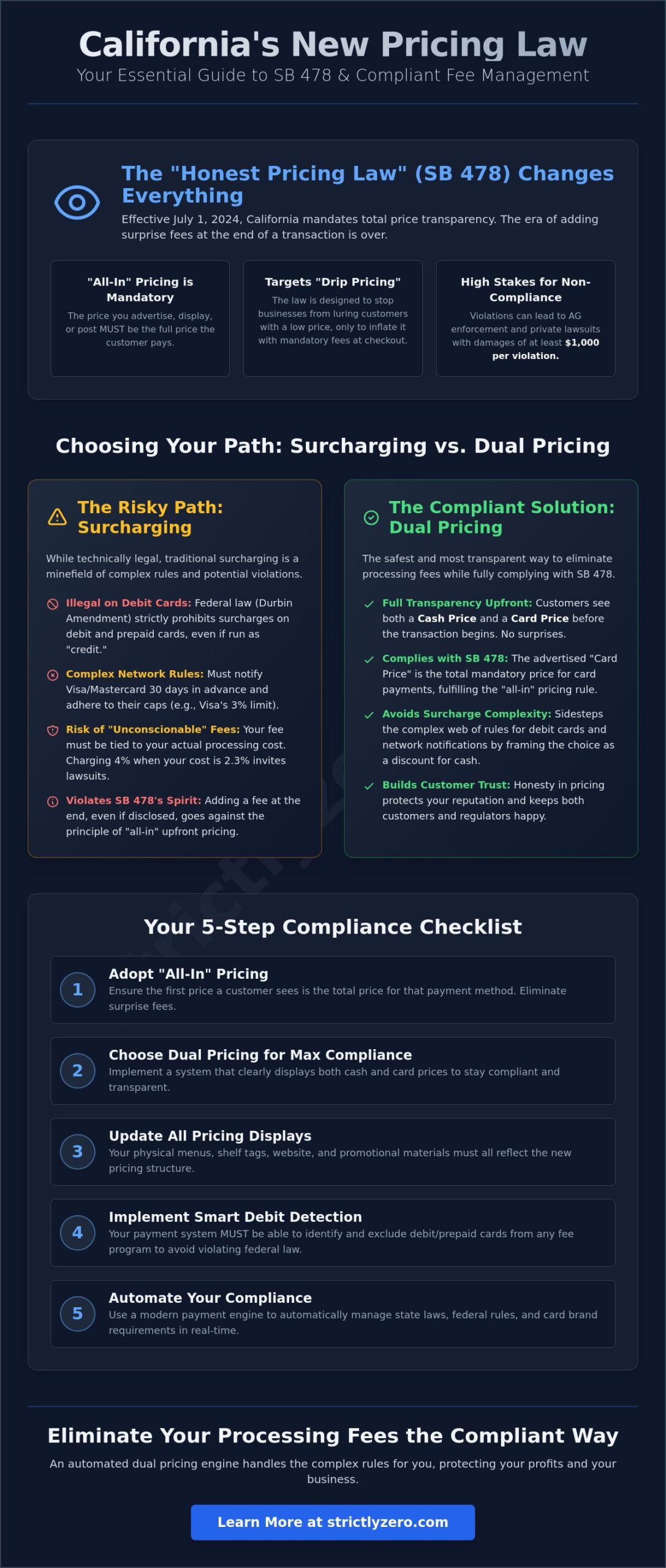
Surcharging and dual pricing might seem like two sides of the same coin, but in California, they sit on opposite sides of the law. Surcharging involves adding a fee to the credit price at the very end of a transaction. Dual pricing shows two distinct prices for every item: one for card and a lower one for cash or debit. While some states have different approaches, the National Conference of State Legislatures notes that state-specific statutes vary widely, making the local context critical. In 2026, the California credit card surcharge rules heavily favor dual pricing because it eliminates the “surprise” factor that regulators despise.
The difference in customer psychology is massive. When a shopper sees a fee added at the register, they feel penalized for their payment choice. It feels like a “junk fee.” In contrast, dual pricing frames the lower cost as a cash discount. This shift in perspective can protect your conversion rates. For a business processing $50,000 per month in credit card sales, moving to a dual pricing model could result in annual savings between $12,000 and $17,000. These aren’t just small margins; they’re the difference between growth and stagnation in a high-cost state.
Why Dual Pricing Wins in California
Dual pricing is the gold standard for compliance because it naturally satisfies SB 478’s requirement for “all-in” pricing. By displaying the credit price as the primary advertised price, you ensure that no customer ever pays more than what they saw on the tag or menu. This transparency removes the legal “hook” that the Attorney General uses to go after businesses for hidden fees. You can dive deeper into these models in our Zero Fee Credit Card Processing Guide. It’s the most effective way to eliminate fees while keeping your California credit card surcharge rules compliance bulletproof.
Surcharging Risks in the 2026 Market
Implementing a traditional surcharge model in 2026 is a technical and legal nightmare. Most standard POS systems aren’t built to handle the “all-in” requirements of SB 478 across every digital and physical touchpoint. If your website shows one price and your terminal adds a 3% fee later, you’re technically in violation. This gap is exactly what class-action lawyers look for. Beyond the legal risk, consumer backlash is at an all-time high. California shoppers are increasingly vocal about “drip pricing,” and a surprise fee at checkout is the fastest way to lose a repeat customer. Surcharging remains the primary target for enforcement because it’s the easiest “hidden fee” to prove in court.
How to Implement a Compliant Program in California
Transitioning to a new pricing model requires a precise, technical approach to stay within the lines of the law. You can’t simply flip a switch and hope for the best. To satisfy both the card networks and the strict California credit card surcharge rules, you must follow a structured implementation plan. The process starts with a deep dive into your current technology. Your system has to distinguish between credit and debit cards instantly. Because surcharging debit cards is a federal violation under the Durbin Amendment, a failure here can lead to immediate fines and merchant account termination.
Follow these five steps to ensure your business remains protected:
- Step 1: Hardware and Software Audit. Verify that your system has built-in debit detection. If your terminal treats every “swipe” the same, it isn’t compliant for a surcharge program.
- Step 2: Card Brand Registration. You must notify Visa and Mastercard at least 30 days before you begin surcharging. Skipping this step is a direct violation of your merchant agreement.
- Step 3: Update Price Displays. Every digital and physical price tag must show the “all-in” price to satisfy SB 478. If you use dual pricing, ensure the card price is the most prominent.
- Step 4: Staff Training. Your team is your first line of defense. They should be able to explain that the pricing model covers the cost of card acceptance while offering a lower price for cash or debit users.
- Step 5: Receipt Transparency. The transaction details must be crystal clear. Your receipts should show the base price and the specific surcharge or dual pricing adjustment as a separate line item.
Signage and Disclosure Requirements
California law doesn’t allow for “fine print” when it comes to fees. You need clear signage at the point of entry and the point of sale. The wording must be explicit, stating that a surcharge is being applied and that it does not exceed your cost of acceptance. Font size matters; the disclosure must be easily readable and placed where a customer cannot miss it before they decide to buy. For more specific tips on setting this up for your company, read our Small Business Credit Card Processing Guide.
The 3% Cap and Card Brand Compliance
While state law gives you the framework, the card brands set the ceiling. Visa currently caps surcharges at 3% of the transaction amount. Even if your Mastercard agreement allows up to 4%, you’re effectively limited to 3% because most merchants accept both brands. You can’t treat the surcharge as a profit center. It must only cover your “effective rate,” which was 2.3% on average in 2025. If a customer disputes the fee through a chargeback, having a documented “cost of acceptance” is your only real defense. To avoid these manual headaches, consider using a Surcharge & Dual Pricing Engine that automates these calculations and keeps you within California credit card surcharge rules automatically.
Automating California Compliance with Strictly
Keeping up with the California credit card surcharge rules doesn’t have to be a manual burden that slows down your operations. Strictly’s Smart Pricing Engine takes the guesswork out of SB 478 compliance by calculating the “all-in” price before your customer ever reaches the final checkout screen. This automation ensures that your advertised prices always reflect the total cost, protecting you from the “hidden fee” allegations that have become a primary focus for state regulators in 2026. By integrating these rules directly into your payment flow, you can focus on growth instead of constant legal monitoring.
If your business sells nationwide, you’re likely dealing with a patchwork of regulations that change without notice. Strictly provides real-time state-by-state rule updates that go beyond the Golden State. Our system recognizes the location of the transaction and automatically adjusts the pricing model to match the specific legal requirements of the buyer’s jurisdiction. For our partners, the ClearSplit™ advantage provides automated residuals and fee management, ensuring that everyone in the payment chain stays compliant and profitable without manual reconciliation. This level of precision is why Strictly is the trusted choice for Zero Fee Merchant Services.
Smart Debit Detection Technology
The risk of illegal debit surcharging is one of the biggest threats to your merchant account. Our platform uses AI-driven card identification to analyze the Bank Identification Number (BIN) of every card the moment it’s presented. If the system detects a debit or prepaid card, it instantly switches from a surcharge model to a dual pricing or discount model. This happens in milliseconds, ensuring you never violate federal Durbin Amendment rules or trigger a card brand audit. It’s a fail-safe that protects your ability to accept payments while maintaining your margins.
Omni-Channel Transparency
Compliance shouldn’t stop at your front door. Whether you’re processing payments through a virtual terminal, a mobile app, or an e-commerce checkout, Strictly maintains total transparency across every channel. Our API-first approach means our Surcharge & Dual Pricing Engine integrates seamlessly with your existing California business workflow. You get a unified view of your transactions and compliance status without having to manage multiple disconnected systems. This consistency is vital for building customer trust and avoiding the technical gaps that class-action lawyers often exploit. You can scale your payments business with Strictly today and leave the complexities of 2026 regulations behind.
Secure Your Margins and Stay Compliant
The shift toward total price transparency in California represents a permanent change in how you do business. Relying on manual disclosures or outdated POS setups is a risk that could lead to costly legal battles or brand damage. By now, you know that dual pricing and “all-in” advertised rates are the gold standards for meeting the 2026 requirements. You’ve seen how the right technology can turn these complex California credit card surcharge rules into a simple, background process that protects your bottom line.
Taking control of your overhead doesn’t have to mean inviting regulatory scrutiny. You can eliminate your processing fees legally with Strictly’s Smart Surcharge Program. Our SB 478 Compliant Smart Pricing Engine and automated debit detection provide the peace of mind you need as a business owner. As a leading US payment processor, we’re here to help you navigate this landscape with confidence. You’ve got the tools to succeed; now it’s time to put them to work and build a more profitable future for your team.
Frequently Asked Questions
Is it legal to surcharge credit cards in California in 2026?
Yes, surcharging is legal in California in 2026, though it is heavily regulated by the Attorney General’s transparency mandates. You must ensure that any fee you add is disclosed upfront rather than being hidden until the final checkout screen. Following the California credit card surcharge rules requires a careful balance between card brand caps and state transparency laws. If your system isn’t setup for “all-in” pricing, you could face significant legal risks.
What is the SB 478 ‘Hidden Fees’ law and how does it affect my business?
SB 478 is the Honest Pricing Law that prohibits businesses from advertising a price that doesn’t include all mandatory fees. This law directly impacts how you display prices on your website, menus, and marketing materials. It effectively bans “drip pricing,” where fees are added one by one during the checkout process. To stay compliant, the price a customer first sees must be the total amount they’ll eventually pay for the transaction.
Can I charge a fee for debit card transactions in California?
No, you cannot legally charge a fee for debit card transactions in California or any other state. Federal law, specifically the Durbin Amendment, strictly prohibits surcharging on debit and prepaid cards. This rule applies even if the customer chooses to process the transaction as “credit” at the terminal. Failing to distinguish between card types is a common mistake that leads to heavy fines and merchant account termination.
What is the difference between a surcharge and a cash discount in CA?
How much can I legally charge as a credit card surcharge?
You can legally charge up to your actual cost of card acceptance, but this is effectively capped at 3% by card brand regulations. Visa and Mastercard have strict limits to prevent merchants from profiting off these fees. If your average processing rate in 2025 was 2.3%, your surcharge should stay within that range. Charging more than your documented cost can trigger audits and potential lawsuits from consumers or the state.
Do I need to put up signs if I have a dual pricing model?
Yes, clear signage is required regardless of whether you use a surcharge or a dual pricing model. You must post notices at your store entrance and at the point of sale to inform customers of the different price points. For digital businesses, this disclosure must happen before the customer adds an item to their cart. Proper signage prevents “surprise” claims and ensures you are following the state’s strict disclosure mandates.
What happens if I don’t follow the California surcharge disclosure rules?
Failing to follow disclosure rules can result in statutory damages of at least $1,000 per violation under California law. The Attorney General has been active in enforcing SB 478, and private right of action allows customers to sue for non-compliance. Beyond the financial penalties, you risk losing your ability to process credit cards if card brands determine you’re violating their specific merchant agreements or state statutes.