
Compliant Surcharge Signage Requirements: The 2026 Merchant Guide
Published:

Did you know that in April 2024, nearly 43% of small and medium-sized businesses couldn’t pay their rent in full or on time? With financial pressures mounting, it’s no surprise that many owners are looking for ways to reclaim their margins. However, simply adding a fee at checkout isn’t enough. If you fail to meet the compliant surcharge signage requirements, you risk heavy fines from card networks or even legal trouble in states like Connecticut or Maine. It’s a high-stakes balancing act that most merchants find overwhelming.
You’ve probably felt the frustration of trying to decode varying state laws while worrying about how customers will react to a new fee. We understand that you want to eliminate processing costs without the constant fear of a surprise audit. This guide is designed to give you total peace of mind. We’ll provide a definitive checklist for both your physical and digital signage, ensuring your surcharge program is 100% legal. By the end of this article, you’ll know exactly how to communicate fees transparently to your customers while maintaining a zero-fee processing model that sticks to the rules.
Key Takeaways
- Master the three-pillar rule of disclosure to ensure your business meets all compliant surcharge signage requirements at the entry, register, and on final receipts.
- Identify the exact “First Page” rules for e-commerce sites to keep your digital checkout flow aligned with Visa and Mastercard regulations.
- Avoid costly federal violations by learning why you can’t surcharge debit cards and how to stay within the mandatory 3% fee cap.
- See how a Surcharge & Dual Pricing Engine automates card detection to protect your margins without the risk of manual compliance errors.
Table of Contents
- What Are Compliant Surcharge Signage Requirements?
- Physical Signage: Placement and Design Rules
- Digital Signage: Surcharge Compliance for E-commerce
- The 'No Debit' Rule and Common Compliance Pitfalls
- Automating Compliance with Strictly's Smart Pricing Engine
What Are Compliant Surcharge Signage Requirements?
At its simplest level, What is a credit card surcharge? It’s a fee added to a transaction to cover the merchant’s cost of processing a credit card payment. However, legally implementing this fee isn’t as simple as sticking a post-it note on your register. Compliant surcharge signage requirements are the legally mandated disclosures you must provide to inform customers of these fees before they ever swipe their card. If you don’t follow these rules to the letter, you’re opening your business up to network audits and potential legal action.
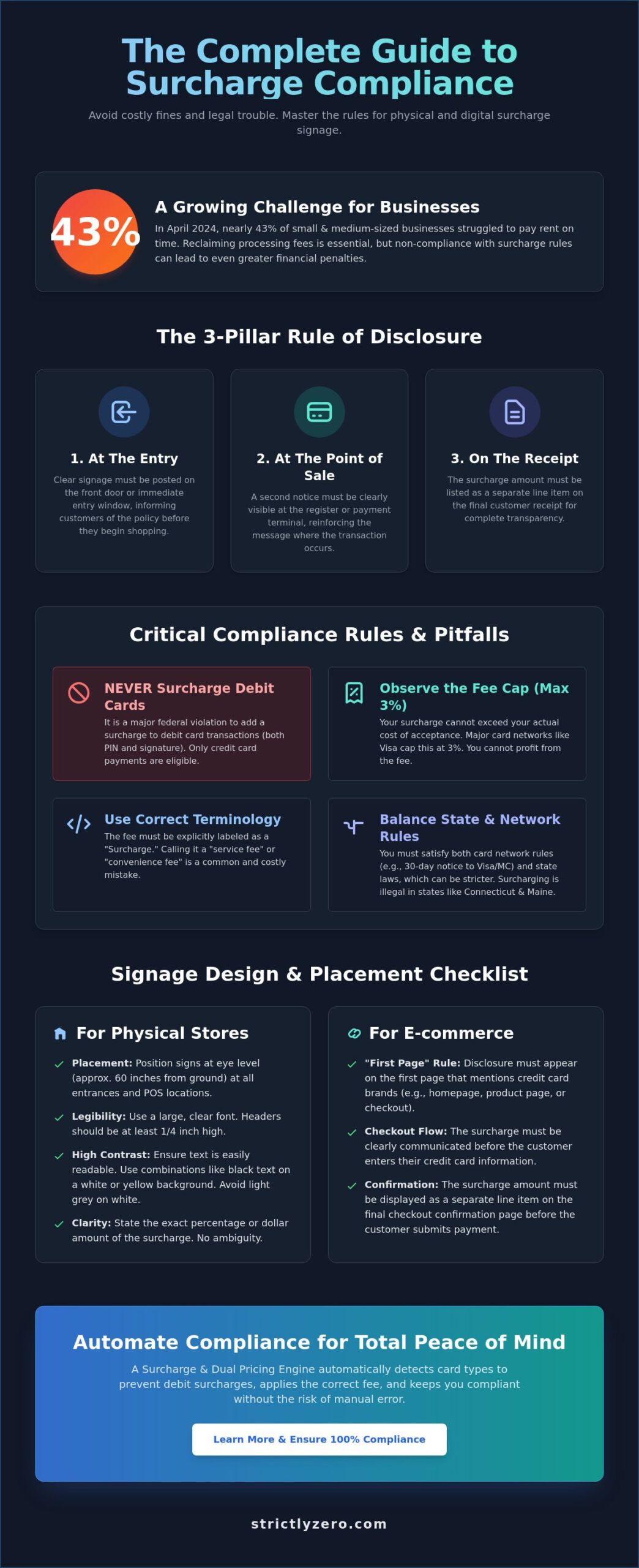
Compliance rests on what experts call the three-pillar rule. You must provide clear disclosure at the entry of your establishment, at the point of sale, and on the final receipt. As of June 2026, regulations have sharpened their focus on “conspicuousness.” This means your signs can’t be tucked away in a corner or written in tiny font. They must be impossible to miss. If a customer can reasonably claim they weren’t warned about the fee before they decided to buy, you’re looking at a potential consumer deception claim that could cost you much more than the processing fees you saved.
To better understand how these laws protect both you and your customers, watch this helpful educational video:
The Core Components of a Compliant Sign
A compliant sign isn’t just about presence; it’s about precision. You must state the exact percentage or dollar amount of the surcharge so there’s no guesswork for the shopper. You also have to adhere to the “No Profit” clause. This means your surcharge can’t exceed your actual cost of acceptance. For instance, Visa caps this at 3% as of April 2023. Additionally, terminology matters. You must label the charge specifically as a “Surcharge.” Calling it a “convenience fee” or “service fee” when it’s actually a credit card surcharge is a common mistake that can trigger a heavy fine during a Mastercard audit.
Network vs. State Compliance
Staying legal requires balancing two different rulebooks. First, the card networks like Visa and Mastercard require a 30-day written notification before you begin surcharging. This is a non-negotiable step to avoid being flagged. Second, state laws vary wildly and often override network rules. In New York, you’re required to display the total price including the surcharge or use a dual pricing model. In states like Connecticut or Maine, surcharging remains illegal entirely. Following Visa’s rules will keep you in good standing with the bank, but it won’t stop a state attorney general from fining you if you haven’t met local compliant surcharge signage requirements.
Physical Signage: Placement and Design Rules
For brick and mortar retailers, meeting compliant surcharge signage requirements is a physical task that requires strategic placement. You can’t rely on a single sticker hidden behind a plexiglass shield. To stay within the lines, you must notify the customer before they even pick up a product. This starts at the entrance. A sign on the front door or the immediate entry window ensures the shopper is aware of your credit card policies before they invest time in your aisles. If an auditor walks into your store and doesn’t see a disclosure until they reach the register, you’re already at risk of a violation.
Design is just as critical as location. Card networks and state regulators use the “average consumer” test to determine if your signage is adequate. This means your font must be legible and large enough to read from a reasonable distance. Generally, the header should be at least 1/4 inch high. Color contrast is another area where merchants often fail. Auditors frequently flag signs with “hidden” text, such as light grey lettering on a white background. To avoid penalties, use high-contrast combinations like black text on a white or yellow background to ensure the fee is “clear and conspicuous.”
Placement Strategy for Maximum Protection
Your entry point sign should be positioned at eye level, roughly 60 inches from the ground, where it’s most likely to be seen. Once the customer reaches the register, the Point of Sale (POS) signage must be visible from their standing position. It shouldn’t be blocked by credit card terminals, impulse-buy displays, or receipt printers. If you operate a large store with multiple checkout lanes, keep in mind that every individual register requires its own sign. You cannot assume a sign at Lane 1 covers Lane 10. For businesses with complex layouts, using a Surcharge & Dual Pricing Engine helps ensure the math on your receipts always matches the physical signs your customers see.
Verbiage and Content Standards
The wording on your signs must be exact. You cannot use vague ranges like “a 1-3% fee may apply.” You must state the specific percentage you’re charging. Furthermore, your signage must explicitly mention the debit card exemption. Since federal law prohibits surcharging debit cards, your sign should state that the fee applies only to credit card transactions. Merchants should regularly consult State-by-state surcharge laws to ensure their wording meets local statutory requirements. In some jurisdictions, if a significant portion of your customer base speaks a language other than English, providing bilingual signage isn’t just a courtesy; it’s a necessity to prevent claims of consumer deception.
Digital Signage: Surcharge Compliance for E-commerce
While physical storefronts manage stickers and posters, digital merchants face a unique set of compliant surcharge signage requirements tailored for the screen. In e-commerce, the timing of your disclosure is everything. You can’t wait until the final “Thank You” page to reveal a fee. Card networks, specifically Visa and Mastercard, enforce the “First Page” rule. This means your surcharge must be clearly disclosed on the very first page where a credit card is presented as a payment option. If your checkout offers a choice between Credit, Debit, or a digital wallet, the notice must appear before the customer makes their selection.
Integration within the checkout flow requires careful design. The disclosure should be placed in close proximity to the payment selection or the final “Pay” button. It isn’t enough to hide this information in a “Terms of Service” popup or a tiny footer link. For mobile app compliance, this challenge intensifies. You must ensure that the disclosure remains “clear and conspicuous” on smaller screens without requiring the user to hunt for it. If you’re using one-click checkout features, the surcharge must still be visible in the final confirmation window before the transaction is processed.
Pre-Transaction Disclosures Online
Transparency online starts in the shopping cart. The surcharge must appear as a separate line item in the order summary, distinct from the subtotal and taxes. This allows the customer to see exactly how much the credit card usage is costing them before they commit. If you use saved payment methods, you don’t get a pass on disclosure. The system must dynamically update the total and show the surcharge line item as soon as a credit card is selected. This level of clarity helps prevent chargebacks and keeps your business in line with compliant surcharge signage requirements across all digital touchpoints.
Virtual Terminals and Invoicing
Compliance extends beyond the standard web store. If you send digital invoices or use a virtual terminal for back-office payments, your disclosures must be just as rigorous. Every digital invoice or payment link sent to a client should include a clear statement about the surcharge percentage. For over-the-phone or Mail Order/Telephone Order (MOTO) transactions, you’re required to provide a verbal disclosure. You must inform the customer of the fee before processing the payment to ensure they’ve consented to the additional cost. For more implementation tips, check out our Virtual Terminal guide to see how to manage these Omni-Channel workflows effectively.
The ‘No Debit’ Rule and Common Compliance Pitfalls
The biggest threat to your compliance isn’t just the wording on your sign. It’s what happens when a customer swipes a debit card. Under the Durbin Amendment, surcharging debit cards is a federal violation. This rule is absolute. It doesn’t matter if the customer chooses “credit” on the terminal or if the card is processed through a major network. If the card is linked to a bank account, you cannot legally apply a surcharge. This is a trap many merchants fall into because they assume “run as credit” changes the card’s status. It doesn’t. Failing to account for this in your compliant surcharge signage requirements can lead to heavy federal penalties and the loss of your processing privileges.
Network rules are equally strict regarding the amount you charge. As of April 15, 2023, Visa capped surcharges at 3% of the transaction total. Even if your own processing costs are higher, you cannot exceed this limit. If your signage displays a 4% fee and a network auditor visits your shop, you’re looking at an immediate compliance failure. Additionally, the surcharge must always appear as a separate line item on the customer’s receipt. Rolling the fee into the total price is a major audit fail that suggests you’re trying to hide the cost from the consumer.
Identifying Debit vs. Credit Automatically
Relying on your staff to manually identify card types is a recipe for a legal disaster. Employees are busy, and modern cards often look identical whether they’re debit or credit. To stay safe, you need a system that uses Bank Identification Number (BIN) lookups. This technology automatically detects the card type the moment it’s swiped or entered online. It ensures the surcharge is only applied to credit transactions, keeping you on the right side of federal law without slowing down your checkout line. If you want to eliminate the guesswork, switch to a Surcharge & Dual Pricing Engine that handles these split-second decisions for you.
Avoiding ‘Double Dipping’ Fines
Another pitfall involves stacking fees. You cannot charge a surcharge and a convenience fee on the same transaction. This “double dipping” is strictly prohibited by card network rules. Furthermore, if you use tiered pricing models, your signage must still reflect the exact percentage charged. You can’t use a generic sign if your actual fee fluctuates based on the card brand. As the regulatory environment tightens in 2026, precision is your only defense. As one industry expert noted, “In 2026, the most common surcharge fine isn’t for the fee itself, but for failing to distinguish debit from credit at the point of sale.” Keeping your signage and your software in sync is the only way to avoid these costly mistakes.
Automating Compliance with Strictly’s Smart Pricing Engine
Managing compliant surcharge signage requirements shouldn’t feel like a full-time legal job. While previous sections highlighted the complexities of state bans and federal debit rules, technology now offers a way to bypass the manual stress. Our Smart Pricing Engine takes the guesswork out of every transaction by instantly identifying card types via BIN lookups. If a customer presents a debit card, the system automatically suppresses the fee. This ensures you never violate the Durbin Amendment. If it’s a credit card, the engine applies the exact percentage allowed by network rules, keeping you well under the mandatory 3% cap.
One of the most powerful tools in our arsenal is Dynamic Signage. As laws shift in places like Illinois or New York, your digital displays can update in real-time to reflect new disclosure mandates. This agility means you don’t have to print new posters every time a state legislature meets. By leveraging professional digital signage solutions like zoney.com, you can ensure your media players are always displaying the most current regulatory information. Our Surcharge & Dual Pricing Engine integrates these logic updates across your entire omni-channel setup, from your physical storefront to your e-commerce checkout. We stand behind our technology with a Compliance Guarantee. It’s a shield against aggressive network audits that could otherwise derail your business.
Zero-Fee Processing Without the Headache
Making the switch to a zero-fee credit card processing model is the most effective way to protect your margins in 2026. We provide pre-approved signage templates for every state, ensuring you meet all compliant surcharge signage requirements from day one. For businesses with complex partner structures, our ClearSplit™ tool manages residuals on surcharge accounts with surgical precision. This ensures everyone gets their fair share without compromising the compliance of the primary merchant account. You get all the benefits of a zero-fee model without the administrative burden.
Getting Started with a Compliant Program
Launching a surcharge program requires a bit of lead time. You must follow the 30-day countdown, notifying the card networks at least a month before you process your first surcharged transaction. During this window, focus on staff training. Your team should be comfortable explaining that the fee is a credit-only surcharge and that debit users pay the standard price. Clear communication at the counter is the best way to prevent customer backlash and ensure transparency. If you’re ready to stop losing money to interchange, it’s time to act. Eliminate your processing fees today with our compliant surcharge program.
Secure Your Margins with Compliant Surcharging
Navigating the landscape of credit card processing doesn’t have to be a gamble with your business’s future. By mastering compliant surcharge signage requirements, you’ve taken the first step toward reclaiming thousands in lost fees while staying firmly on the right side of the law. You now understand that transparency at the entry, the register, and the digital checkout is the only way to protect your business from card network audits and state-level penalties. It’s about more than just avoiding fines; it’s about building trust through clear communication.
Why handle the legal heavy lifting yourself? With automated state-by-state compliance and BIN-level debit detection, you can eliminate the risk of human error entirely. Our systems provide 100% omni-channel integration, ensuring your physical store and e-commerce site stay perfectly in sync. It’s time to stop letting processing costs eat your profits. Switch to Strictly’s Smart Surcharge Program and Stop Paying Processing Fees. Your path to zero-fee processing is clear, and we’re here to help you every step of the way.
Frequently Asked Questions
Is it legal to surcharge credit cards in all 50 states in 2026?
No, surcharging isn’t legal nationwide. As of June 2026, you cannot apply a credit card surcharge in Connecticut, Massachusetts, or Maine. Puerto Rico also maintains a strict ban on these fees. Merchants in Colorado must adhere to a 2% cap or their actual processing cost, whichever is lower. It’s vital to check your specific local statutes because state laws often override general card network policies regarding merchant fees.
Can I surcharge a debit card if the customer chooses ‘credit’ at the terminal?
You cannot surcharge a debit card under any circumstances. Even if a customer selects the “credit” option at your terminal, the card remains a debit product linked to a bank account. Federal law and card network rules are very clear on this point. Surcharging any debit card, including prepaid cards, is one of the fastest ways to trigger an audit and face significant financial penalties from the networks.
What is the maximum percentage I can charge as a surcharge?
For Visa transactions, the maximum surcharge is 3% or your actual discount rate, whichever is lower. This specific cap has been in effect since April 15, 2023. Mastercard generally allows up to 4%, but you’re still limited by your actual cost of acceptance. You can’t use these fees to generate a profit; they are strictly meant to offset the documented costs of credit card processing for your business.
Do I need a physical sign if I only sell products online?
Physical signs aren’t required for e-commerce only businesses, but digital equivalents are mandatory. You must disclose the fee on the first page where a credit card is an option. It also has to appear as a separate line item in the digital shopping cart before the final payment. These compliant surcharge signage requirements ensure online shoppers aren’t surprised by fees at the very last second of the checkout flow.
What happens if a card brand audits my business and finds my signs are non-compliant?
Non-compliance usually leads to a series of escalating fines or the termination of your merchant account. Card brands conduct periodic audits to ensure transparency for consumers. If your signs are missing, illegible, or display incorrect percentages, you’ll receive a violation notice. In severe cases, or with repeat offenses, you could lose your ability to accept credit card payments entirely, which would be devastating for most modern retail operations.
Is there a difference between a surcharge and a convenience fee?
Yes, these are two distinct types of fees with different regulatory rulebooks. A surcharge is a fee for using a credit card instead of cash or debit. A convenience fee is charged for the privilege of using a non-standard payment channel, like paying a bill over the phone rather than in person. You can’t stack them on the same transaction, and they each have their own notification and disclosure rules.
How do I notify Visa and Mastercard that I intend to start surcharging?
You must provide written notice to the major card networks at least 30 days before you begin surcharging. Most merchants handle this through their payment processor’s administrative tools. This notification period gives the networks time to verify your intent and ensures your account is properly flagged for surcharge activity. Skipping this step is a common mistake that can lead to immediate fines once your first surcharged transaction is processed.
Can I use a handwritten sign for my surcharge disclosure?
While no rule explicitly bans handwriting, it’s generally a bad idea for staying compliant. Signs must be “clear and conspicuous,” meaning they need high contrast and readable fonts that the average customer can see easily. Handwritten signs are often messy or use ink that fades, which auditors may flag as a failure to meet compliant surcharge signage requirements. Using professional, printed templates is the safest way to ensure your disclosures pass inspection.