
Dual Pricing vs. Surcharge: Which Zero-Fee Model Wins in 2026?
Published:

What if that 3% to 4% chunk disappearing from every credit card sale wasn’t a mandatory cost of doing business, but an optional one? When comparing dual pricing vs surcharge options, it’s easy to feel overwhelmed by the maze of state-specific bans and the strict prohibition against surcharging debit cards. Over 34% of U.S. small businesses have already adopted zero-fee models to fight back against shrinking margins; yet, the fear of a heavy fine or a frustrated customer often keeps others stuck in the status quo.
We understand that you want to protect your bottom line without risking your reputation or your merchant account. This article explores the critical differences between these models to help you eliminate processing fees while staying 100% compliant with 2026 regulations. You’ll discover how to navigate the latest transparency laws like California’s SB 478, why dual pricing is legal in all 50 states, and how a smart pricing engine can automate your compliance so you can focus on growth instead of red tape.
Key Takeaways
- Learn why dual pricing is legal in all 50 states while surcharging remains prohibited in Connecticut, Massachusetts, and Maine as of 2026.
- Understand how to avoid the “debit card trap” by using automated detection to prevent illegal fees on non-credit transactions.
- Compare the dual pricing vs surcharge models to see which strategy offers the lowest compliance effort for your specific business.
- Explore how a Smart Pricing Engine handles complex state laws and card network caps automatically across online and in-person channels.
- Discover why presenting a clear cash-versus-card price often results in higher customer retention than adding a surcharge at the final checkout step.
Table of Contents
- The Rising Cost of Payments: Why Merchants are Switching to Zero-Fee Models
- Understanding Surcharging: Rules, Caps, and Compliance Pitfalls
- Dual Pricing Explained: The Universal Strategy for $0 Processing Fees
- Dual Pricing vs. Surcharge: The Definitive Comparison for Merchants
- The Strictly Path: Implementing a Compliant Zero-Fee Strategy
The Rising Cost of Payments: Why Merchants are Switching to Zero-Fee Models
Processing costs aren’t just a line item anymore; they’re a significant threat to small business survival. In 2024, merchant discount rate fees reached a staggering $187 billion in the United States. This trend accelerated on January 24, 2026, when Visa increased Level 2 interchange rates for small business credit cards by 0.75%. For many owners, these incremental hikes represent the difference between hiring a new employee or cutting back on inventory. This financial pressure has forced a choice between absorbing costs or finding a compliant way to share them with consumers.
The consumer landscape has shifted as well. While “junk fees” are under intense regulatory scrutiny, shoppers have become increasingly accustomed to seeing payment system surcharges at local restaurants and boutiques. According to J.D. Power, 34% of small businesses were already passing these costs to consumers by 2024. When comparing dual pricing vs surcharge strategies, merchants are looking for the path of least resistance that protects their margins without alienating loyal customers. Both models offer a route to zero fee credit card processing, but they approach the customer experience from different angles.
The Math of Traditional Processing vs. Zero-Fee
Traditional processing models often feel like a “tax” on growth. If your business processes $10,000 a month, you’re likely losing $300 or more to interchange and assessment fees. Over a year, that’s $3,600 in lost revenue. Switching to a zero-fee model allows you to reclaim that capital. By taking control of your margins, you’re essentially giving your business a 3% raise. The modern approach involves using a Smart Pricing Engine to handle the heavy lifting. This logic identifies the card type in real time, ensuring that the business only recovers costs where it’s legally permitted.
The Role of Technology in Compliance
Trying to manage these programs manually is a recipe for disaster. If an employee accidentally surcharges a debit card, you’ve violated the Durbin Amendment, which could lead to your merchant account being shut down. Automation is the only way to ensure 100% compliance across all sales channels. Omni-channel processing is a unified system that applies consistent pricing rules whether you’re taking a payment on your website, via a mobile app, or through a virtual terminal. This technology removes the guesswork, allowing you to run your business while the software handles the complex state-by-state regulations automatically.
Understanding Surcharging: Rules, Caps, and Compliance Pitfalls
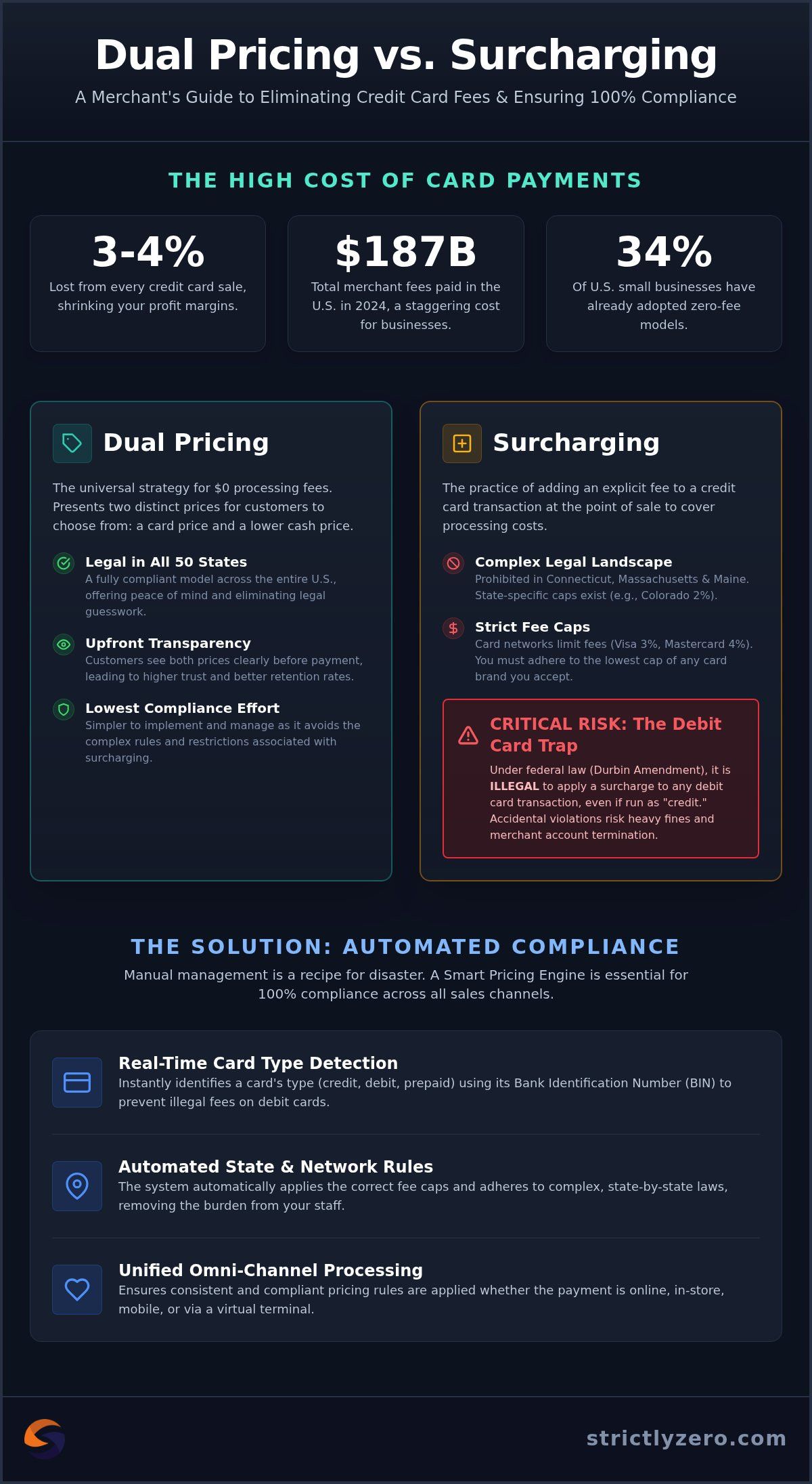
Surcharging is the practice of adding an explicit fee to a credit card transaction at the point of sale to cover processing costs. While it’s a popular choice in the dual pricing vs surcharge debate, it comes with strict guardrails. As of 2026, the card networks have set firm limits: Visa caps surcharges at 3%, while Mastercard allows up to 4%. If your business accepts both, you must adhere to the lower 3% threshold to remain compliant. This ensures you aren’t profiting from the fee, but simply recovering the merchant discount rate.
Legality isn’t universal across the country. Several states, including Connecticut, Massachusetts, and Maine, still prohibit the practice entirely. Other regions have specific price ceilings, such as Colorado’s 2% cap or Illinois’ 1% limit. You can review the latest state-by-state surcharge laws to ensure your local operations meet current statutes. Violating these rules can lead to heavy fines or the loss of your processing privileges. Perhaps the most dangerous pitfall is the “No-Debit” rule. Under the Durbin Amendment, it’s illegal to apply a surcharge to a debit card transaction, even if the customer chooses to run the card as “credit” at the terminal. This is a common source of accidental non-compliance that triggers automatic network audits.
The Debit Card Detection Challenge
Identifying a card type instantly is harder than it looks. Every card has a Bank Identification Number (BIN), typically the first 6 to 8 digits, which classifies the card as credit, debit, or prepaid. Strictly’s Smart Pricing Engine automates this detection in milliseconds. This technology ensures that if a customer swipes a debit card, the surcharge is never applied, protecting you from accidental violations. Without this automation, you risk network fines that far outweigh any potential savings. If you’re unsure about your current setup, you can evaluate your compliance tools with a modern processing partner.
Customer Transparency and Signage
Transparency is a cornerstone of the surcharge model. Merchants must provide clear disclosure at the entrance of their business and at every point of sale. Surcharge notification is the legal requirement to inform customers before they pay, ensuring there are no surprises at the bottom of the bill. For digital transactions, the fee must be clearly itemized on virtual terminals and receipts. Failing to provide this visibility is one of the fastest ways to trigger a customer dispute or a regulatory inquiry. Consistency across your omni-channel platform is essential to maintain trust and stay within the law.
Dual Pricing Explained: The Universal Strategy for $0 Processing Fees
Dual pricing is a transparent pricing model where a merchant displays two distinct prices for every item: a “Cash Price” and a “Card Price.” Unlike the surcharge model, which adds a fee at the final stage of a transaction, dual pricing builds the cost of processing into the advertised card price while offering a lower rate for those paying with cash or equivalents. When comparing dual pricing vs surcharge options, the primary advantage of dual pricing is its universal legality. While we previously looked at the complex state laws on credit card surcharges that restrict fees in places like Connecticut and Maine, dual pricing is legal in all 50 states. This is because it’s classified as an incentive for cash payments rather than a penalty for card usage, a distinction protected under the Durbin Amendment.
The terminology often gets confused with “Cash Discounting,” but there’s a vital difference in implementation. Traditional cash discounting often involves a single price on the shelf with a discount applied at the register. Dual pricing is more straightforward; it presents both options upfront, removing any ambiguity for the shopper. Finding the best credit card processing for small business in 2026 often means selecting a provider that can handle these two price points automatically across every sales channel.
How Dual Pricing Works in E-commerce
In a digital environment, dual pricing functions by setting the “Card Price” as the default displayed amount. If a customer chooses a cash-equivalent method, such as ACH or a digital wallet linked to a bank account, the system applies the discount instantly. This can be managed through a virtual terminal or a secure payment link sent directly to a client. For developers, a unified API is essential to ensure that dual price points sync perfectly between the website’s front end and the back-office accounting software. This automation ensures that the business recovers 100% of its processing costs without manual calculations.
Customer Perception: Surcharge vs. Dual Pricing
The psychology of a transaction matters as much as the math. Customers generally react more positively to the idea of “saving with cash” than “paying a fee for card.” One feels like a reward, while the other feels like a penalty. To make this shift successful, merchants should follow this 3-step guide:
- Update Inventory: Set your base prices to reflect the “Card Price” to ensure all processing costs are covered.
- Configure Automation: Use a pricing engine to calculate and display the corresponding “Cash Price” discount accurately.
- Train Your Team: Ensure staff can explain that the cash price is a way for the business to pass savings directly back to the customer.
By framing the conversation around savings, you maintain high customer satisfaction while effectively reaching a $0 processing cost. This approach eliminates the anxiety of potential backlash often associated with traditional surcharging.
Dual Pricing vs. Surcharge: The Definitive Comparison for Merchants
Choosing between these two models depends on your specific business structure and customer base. When evaluating the dual pricing vs surcharge frameworks on a compliance effort scale, surcharging requires significantly more oversight. You must constantly monitor the 3% network cap and ensure your software never accidentally applies a fee to a debit card. Dual pricing, by contrast, is a “set-it-and-forget-it” solution that works in all 50 states without the same level of regulatory friction.
The “debit card impact” is perhaps the most significant financial differentiator. Since you cannot legally surcharge a debit card, you must still pay the processing fees on those transactions under a surcharge model. However, dual pricing applies the “card price” as the standard rate for both credit and debit cards, allowing you to recover those costs entirely. For ISO partners, managing these residuals becomes seamless with specialized tools like ClearSplit™, which automates compensation regardless of which model a merchant chooses.
Industry-specific needs also dictate the best choice. High-ticket professional services often favor surcharging because explicit fee transparency on B2B invoices is standard. Retail and hospitality businesses usually benefit from dual pricing, as customers respond better to “cash discounts” than “credit penalties.” For high-volume e-commerce, the priority is omni-channel flexibility, ensuring that the pricing logic remains consistent across web stores and mobile apps.
Regulatory Comparison
For multi-state businesses, dual pricing is the safer choice because it bypasses the patchwork of state-level surcharge bans in places like Connecticut and Maine. Card brand audits are more frequent for surcharge users because network rules regarding notification and caps are so specific. Surcharging requires a rigorous audit trail that proves only credit cards were charged the fee, whereas dual pricing compliance focuses on the clear, upfront display of two separate prices for every item. If you want to ensure your business is protected, you can compare zero-fee strategies with a trusted partner.
Operational Impact
Integrating these models into your existing virtual terminal or invoicing software shouldn’t require a total overhaul. Using ChurnIQ™ allows you to monitor merchant retention intelligence and see if customer behavior changes after you implement a new pricing model. The primary advantage of using a Smart Pricing Engine is the ability to switch between these models without changing processors, giving you the flexibility to adapt if local laws or card network rules shift in the future. This unified approach ensures that your accounting remains clean and your customer satisfaction stays high.
The Strictly Path: Implementing a Compliant Zero-Fee Strategy
Deciding between dual pricing vs surcharge models is only the first step toward financial freedom. The second, and more important, step is implementation. You need a system that doesn’t just process payments but actively protects your business from the regulatory pitfalls we have discussed. The Strictly Smart Pricing Engine serves as the central brain of your operation. It handles the complex logic of identifying card types and applying state-specific rules in real time, ensuring that every transaction is 100% compliant without any manual input from your staff.
One of the biggest hurdles for modern merchants is maintaining consistency across different sales environments. Whether you are taking a payment through a mobile app in the field, a virtual terminal in the office, or a web store online, our omni-channel payment processing platform provides a unified dashboard. This single source of truth allows you to manage your entire zero-fee strategy from one place. For ISO partners and developers, this infrastructure is built to scale. By using specialized tools like ClearSplit™, partners can automate compensation and manage residuals across diverse merchant portfolios with absolute precision.
Finding the right model for your specific volume and industry requires a clear look at your current numbers. We recommend requesting a detailed cost analysis to see exactly how much you can save by switching from traditional processing to a zero-fee model. This data-driven approach removes the guesswork, allowing you to choose the strategy that best fits your customer base and your growth goals for 2026.
Why Trust Matters in Payment Processing
Our “Trust as a Payment Processor” philosophy means we take on the burden of compliance so you can focus on your customers. In a 2026 payment environment, PCI compliance and data security are more critical than ever. We integrate AI-driven fraud prevention directly into the platform to monitor transactions for suspicious activity. This layer of protection is essential for zero-fee models, as it ensures that your hard-earned margins aren’t eroded by chargebacks or fraudulent disputes. When your processing software is built on a foundation of security, you can operate with total peace of mind.
Getting Started with Strictly
The onboarding process is designed to be fast and friction-free for both direct merchants and ISO partners. Once your account is active, you can begin using the Virtual Terminal and invoicing tools immediately to start collecting zero-fee payments. There is no need for complex technical configurations or long waiting periods. You simply set your preferences for dual pricing or surcharging and let the engine handle the rest. Ready to reclaim your margins? You can Scale your business with Strictly’s Zero-Fee Platform and eliminate processing costs for good.
Take Control of Your Processing Margins in 2026
The debate between dual pricing vs surcharge models boils down to one goal: protecting your revenue from rising interchange fees. While surcharging offers transparency for credit transactions, dual pricing provides a “set-it-and-forget-it” compliance path that works in all 50 states without the risk of accidental debit card violations. The right choice depends on your specific industry and how you want your customers to perceive their savings.
Staying ahead of network audits and state-level bans requires more than just a sign on the door. It requires a platform designed for the complexities of modern commerce. You can eliminate your processing fees today with Strictly and leverage our Smart Pricing Engine for automated 2026 compliance. Whether you need ClearSplit™ for seamless partner residuals or ChurnIQ™ data-driven retention tools to monitor customer behavior, our unified platform handles the logic so you can focus on scaling. Reclaiming your margins is no longer a luxury; it’s a strategic necessity for your business’s future.
Frequently Asked Questions
Is surcharging legal in my state in 2026?
Surcharging is legal in 47 states, but it remains prohibited in Connecticut, Massachusetts, and Maine as of September 2026. Puerto Rico also maintains a ban on the practice. If you operate in a state like New York or New Jersey, you must limit the surcharge to your actual processing cost. Because laws change, many businesses prefer dual pricing to avoid the risk of non-compliance in restricted regions.
Can I surcharge a debit card if the customer runs it as credit?
No, you cannot legally surcharge a debit card transaction regardless of how the customer chooses to process it at the terminal. The Durbin Amendment strictly prohibits fees on debit cards, including those run as “credit” to bypass PIN entry. Violating this rule can lead to significant network fines or the termination of your merchant account. This is a primary reason why automated detection technology is essential for compliant surcharging.
What is the maximum surcharge fee allowed by Visa and Mastercard?
As of 2026, Visa caps credit card surcharges at 3%, while Mastercard allows up to 4%. However, if your business accepts both card brands, you are effectively limited to the lower 3% cap to remain in compliance with network rules. These caps are designed to ensure merchants only recover their actual processing costs rather than generating a profit from the transaction fees passed to the customer.
Do I need to notify my payment processor before I start surcharging?
Yes, you are required to notify both your payment processor and the card networks at least 30 days before you begin surcharging. This notification period allows the networks to ensure your business meets all transparency and signage requirements. Many modern platforms handle this registration process for you, but you should always verify that your processor has officially logged your intent to implement a surcharge model to avoid service interruptions.
How does dual pricing differ from a cash discount program?
Dual pricing displays two separate prices for every item, showing the “Cash Price” and “Card Price” upfront. A cash discount program typically lists one price and applies a reduction at the point of sale for cash users. In the dual pricing vs surcharge comparison, dual pricing is often preferred because it provides total transparency from the start. This model is legal in all 50 states because it rewards cash usage.
What happens if I surcharged a customer accidentally in a restricted state?
Accidental surcharging in a restricted state like Connecticut or Maine can result in heavy financial penalties from state regulators and card networks. You may also face a mandatory audit of your merchant account, which could lead to a permanent loss of processing privileges. To prevent these errors, businesses often use a Smart Pricing Engine that automatically disables surcharging features based on the business’s registered location and the specific card type being used.
Is dual pricing legal for online e-commerce transactions?
Yes, dual pricing is perfectly legal for e-commerce and digital transactions. In an online environment, you typically display the “Card Price” as the standard rate and offer a “Cash/ACH Discount” for customers who pay via bank transfer or other cash-equivalent methods. This approach allows web-based merchants to eliminate processing fees while maintaining full compliance with the Durbin Amendment and state-level price transparency laws like California’s SB 478.
How does the Strictly Smart Pricing Engine handle debit card detection?
The Strictly Smart Pricing Engine uses the first 6 to 8 digits of a card, known as the Bank Identification Number (BIN), to identify the card type in milliseconds. If the engine detects a debit or prepaid card, it automatically blocks the surcharge from being applied to that specific transaction. This automation removes the risk of human error, ensuring your business stays compliant with federal laws while maximizing your fee recovery on eligible credit transactions.