
Flat Rate vs. Interchange Plus Pricing: Which Is Better in 2026?
Published:

What if the simplicity of your flat-rate merchant statement is actually a mask for some of the highest fees you’ve ever paid? It’s a common trap. Most business owners choose flat-rate pricing because they’re tired of squinting at confusing monthly statements filled with cryptic codes. When weighing interchange plus vs zero fee processing, you might find that the “simple” option is actually draining your revenue through hidden markups. We agree that your billing should be predictable, but convenience shouldn’t come at the expense of your profit margins.
In this article, you’ll discover the real differences between these models to find the most cost-effective solution for your business. We’ll break down the latest 2026 interchange rates, explore how AI-driven fraud prevention protects your bottom line, and show you exactly where every cent of your processing fee goes. Whether you need a virtual terminal for invoicing or a robust surcharge engine to offset costs, you’ll learn how to choose a partner that values transparency as much as you do. By the end, you’ll know exactly which model will help you keep more of what you earn.
Key Takeaways
- Learn why the “convenience tax” of flat-rate pricing can significantly erode your margins as your business scales.
- Discover how interchange plus pricing provides total transparency by separating wholesale card costs from processor markups.
- Evaluate interchange plus vs zero fee processing to determine if a surcharge or dual pricing engine is a better fit for your profitability.
- Identify the exact transaction volume and card-mix thresholds that signal it’s time to move away from bundled rates.
- Understand how to implement compliant surcharge programs that protect your revenue without alienating your customers.
Table of Contents
- Understanding Payment Processing: Flat Rate vs. Interchange Plus in 2026
- Flat Rate Pricing: The Illusion of Simplicity
- Interchange Plus Pricing: Unmasking the Wholesale Costs
- Direct Comparison: Which Model Actually Saves You More?
- Beyond the Debate: Eliminating Fees with Surcharge and Dual Pricing
Understanding Payment Processing: Flat Rate vs. Interchange Plus in 2026
Choosing a pricing model isn’t just a technical detail. It’s the single most important factor in your business’s net profit. By 2026, with digital payment volumes projected to exceed $15 trillion, even a tiny percentage difference in fees can represent thousands of dollars lost. When comparing interchange plus vs zero fee processing, the first step is understanding the core mechanics of how money moves from your customer’s wallet to your bank account.
Flat rate pricing bundles every expense into one predictable number. It’s attractive because it’s simple. However, unbundled models like interchange plus pull back the curtain. They show you exactly what the banks charge versus what your processor keeps. With Visa and Mastercard updating their schedules in April 2026, knowing these differences is vital for long-term survival. To see how these models look in action, watch this quick comparison:
The Anatomy of a Credit Card Transaction
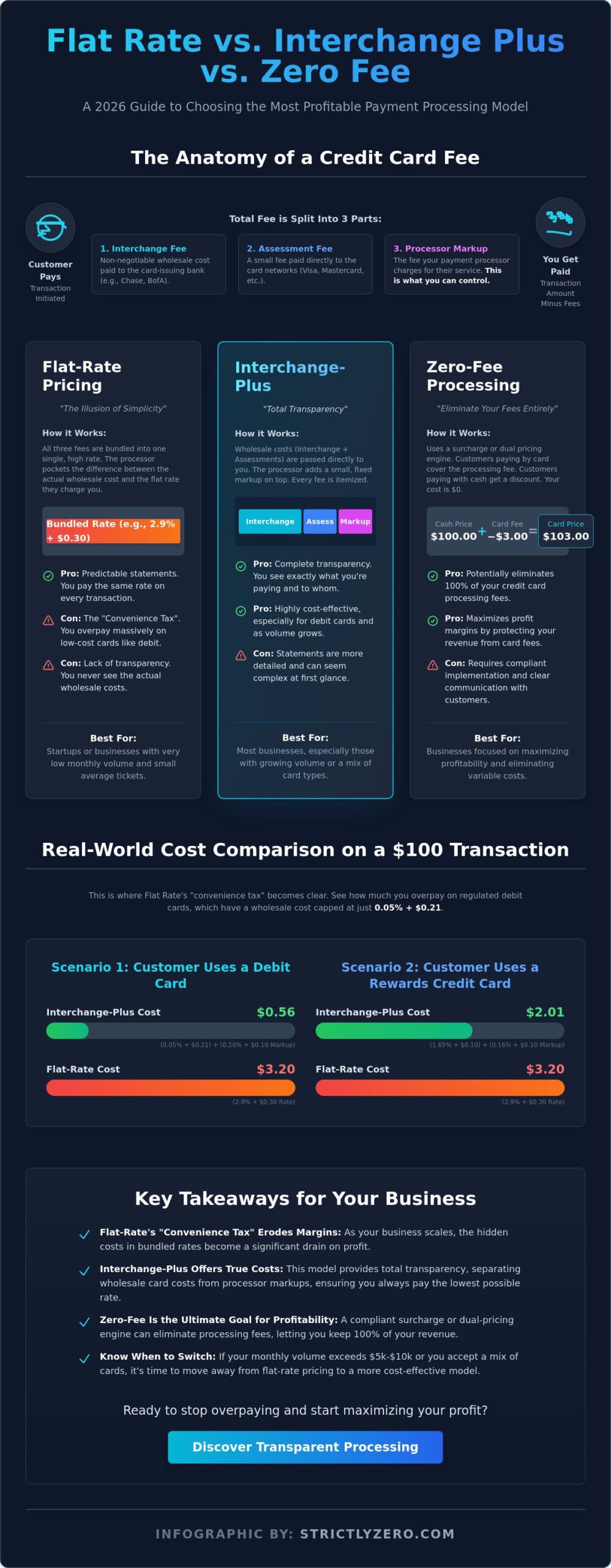
Every swipe involves a non-negotiable Interchange fee. This is the wholesale cost paid to the card-issuing bank. For instance, as of April 18, 2026, a standard Visa credit retail transaction carries a rate of 1.51% + $0.10. Mastercard’s Merit III Core rate sits at 1.65% + $0.10 for consumer cards. Beyond this, you pay assessment fees to the card networks and a markup to your payment processor. In an interchange plus model, these costs are listed line-by-line. In a flat rate model, they’re hidden behind a single, higher percentage that often overcharges you for low-cost debit transactions.
Why One Size Doesn’t Fit All
Your business type dictates which model wins. A B2B company dealing with high-ticket invoices has different needs than a local coffee shop. High average transaction values often make interchange plus the clear winner because it prevents the processor from taking a massive cut of large sales. For those just starting out, credit card processing for small business requires a strategic approach. You shouldn’t settle for “simple” if it means paying 3% on a debit card transaction that actually costs the processor less than 1%. Deciding between interchange plus vs zero fee processing depends on whether you want to pay the wholesale cost or use a surcharge engine to eliminate those costs entirely.
Flat Rate Pricing: The Illusion of Simplicity
Flat rate models offered by popular payment aggregators provide a single percentage for every transaction. It’s predictable. However, this predictability comes with a “convenience tax.” Processors set their flat rate high enough to cover the cost of premium rewards cards and international transactions. If the actual cost of a specific card is 1.51%, but you’re paying a much higher bundled rate, the processor keeps the difference. This is the processor skim. You’re effectively subsidizing the processor’s risk on every swipe.
When analyzing interchange plus vs zero fee processing, it’s clear that flat rate is rarely the most cost-effective path for growing businesses. It’s a bundled product where you pay for the worst-case scenario even when customers use basic cards. Most merchants reach a liability point where the simplicity of a single rate no longer justifies the high cost. You have to decide if a clean monthly statement is worth the thousands of dollars you’re leaving on the table. For many, a surcharge engine offers a more transparent way to protect your margins.
The Hidden Cost of Flat Rates
This model hurts most when you process debit cards. Thanks to the Durbin Amendment, regulated debit card interchange fees are capped at just 0.05% + $0.21 as of May 2026. If you’re on a bundled flat rate, you’re paying a massive markup on a low-cost transaction. You never see these wholesale costs on a flat-rate statement. This lack of transparency makes it impossible to know if you’re getting a fair deal. You’re essentially paying credit card prices for debit card transactions, which can erode your net profit by 1% or more on those specific sales.
Who Should Use Flat Rate Pricing?
Interchange Plus Pricing: Unmasking the Wholesale Costs
Interchange plus pricing operates on a simple philosophy: transparency. Unlike the bundled rates of flat-rate models, this structure separates the wholesale cost of the transaction from the processor’s profit. You pay exactly what the card networks charge, plus a small, fixed markup. This approach is why many high-volume merchants prefer this model over flat rates. When you evaluate interchange plus vs zero fee processing, you’re essentially deciding between paying the raw cost or shifting that cost entirely to the cardholder.
Under this model, no two transactions look the same on your statement. A regulated debit card processed in person costs significantly less than a premium travel rewards card keyed in manually. By passing these savings directly to you, interchange plus ensures you aren’t overpaying for low-risk swipes. It removes the “padding” that flat-rate processors use to protect their own margins, giving you a clearer picture of your true overhead.
The “Plus” in Interchange Plus
The 2026 Interchange Landscape
Staying informed about the 2026 landscape is vital because interchange rates are updated biannually. As of April 18, 2026, Visa’s regulated debit rate for card-present transactions is 0.05% + $0.21. Meanwhile, a standard Visa credit retail transaction sits at 1.51% + $0.10. Mastercard follows a similar pattern, with its Merit III Core credit rate at 1.65% + $0.10. Seeing these fluctuations in real-time allows you to adjust your strategy. The best credit card processing for small business often starts with this level of detail. It provides the data needed to decide if you should stick with wholesale costs or move toward a surcharge model to eliminate fees entirely.
Reading these statements doesn’t require an accounting degree. You simply look for the “Interchange” section to see the pass-through costs and the “Service Fee” or “Markup” section to see what you’re paying the processor. If you see dozens of different rates, don’t panic. It means you’re getting the actual wholesale price for every individual card type rather than a generic, marked-up average.
Direct Comparison: Which Model Actually Saves You More?
The math doesn’t lie, but it does vary based on how you run your business. Most merchants reach a tipping point around $5,000 in monthly processing volume. Below this, the simplicity of a flat rate might save you administrative headaches. Above it, the “skim” taken by flat-rate processors starts to look like a second rent payment. When evaluating interchange plus vs zero fee processing, you have to look at your specific transaction mix. If your customers primarily use debit cards, staying on a flat rate is a massive strategic error because you’re forfeiting the low wholesale rates guaranteed by federal law.
Beyond the percentage, you must account for “hidden” costs that flat-rate providers often bake into their services. PCI compliance fees, gateway costs, and statement fees can quietly add $30 to $100 to your monthly bill. An interchange plus model usually lists these clearly, allowing you to see the true cost of every dollar you process. If you want to stop guessing about your margins, our Surcharge & Dual Pricing Engine can help you move past these comparisons by eliminating the merchant’s share of the fee entirely.
A Tale of Two Merchants: Mathematical Case Study
Consider a local coffee shop with a $10 average transaction value. If they process $20,000 a month, mostly via debit cards, a 2.9% flat rate costs them $580. On an interchange plus plan, that same volume might cost only $320 because debit interchange is so low. That’s $260 back in their pocket every month. Conversely, a consultant invoicing $5,000 once a month for corporate services deals with high-cost cards. While interchange plus is still cheaper, the gap is smaller. The winner is always the model that doesn’t force you to pay for a “worst-case scenario” card on every transaction.
The Decision Matrix for 2026
Before you sign a new merchant agreement, run your most recent statement through this checklist. If you see the terms “Qualified,” “Mid-Qualified,” or “Non-Qualified,” you’re actually on a tiered pricing plan disguised as something else. This is a major red flag. Ask your potential processor these three questions:
- Is the markup on top of interchange fixed, or does it vary by card type?
- Are there separate fees for the virtual terminal and invoicing tools?
- Does the contract include a “liquidated damages” clause for early termination?
True transparency means knowing exactly what the processor earns. If they can’t give you a single basis-point figure for their markup, they’re likely hiding additional margin. By choosing a partner that offers omni-channel payment processing with clear reporting, you can ensure your business isn’t just surviving the 2026 fee hikes but thriving despite them.
Beyond the Debate: Eliminating Fees with Surcharge and Dual Pricing
Debating the merits of different pricing models is a helpful exercise, but it misses the most important shift in the 2026 payment landscape. While transparency is great, zero cost is better. When you evaluate interchange plus vs zero fee processing, you’re essentially choosing between paying a fair price or paying nothing at all. The rise of zero fee credit card processing has made the markup debate secondary for many high-growth businesses. By using a surcharge or dual pricing engine, you can shift the burden of processing costs away from your margins entirely.
Strictly’s Smart Pricing Engine automates this transition. It ensures your business stays compliant while providing the tools to reclaim your revenue. Whether you use a virtual terminal for invoicing or need omni-channel payment processing for a retail setup, this technology renders the old “flat rate vs. interchange” argument irrelevant. You no longer have to decide which fee is more palatable when you can eliminate the fee altogether.
How Surcharge Programs Change the Math
The mechanics are straightforward. A surcharge program adds a small fee to credit card transactions at the point of sale. As of May 2026, card network rules like Visa’s 3% cap dictate how much you can pass on. It’s vital to remember that surcharges cannot be applied to debit or prepaid cards. This is where our Surcharge & Dual Pricing Engine excels. It automatically detects the card type and applies the correct fee, or offers a cash discount in dual pricing models. Compliance is complex because states like Colorado cap surcharges at 2%, while Illinois restricts them to 1%. Strictly manages these regional variations for you, making this the ultimate evolution of the interchange plus strategy.
Transitioning to a Zero-Fee Model
Moving to a zero-fee model requires a clear communication strategy. Most customers understand that processing costs have risen. They often value the choice between a credit card convenience fee or a lower price for cash or debit. This shift has an immediate impact on your cash flow. Instead of waiting for a monthly statement to see how much was deducted, you keep the full value of every credit sale. It’s time to stop managing fees and start eliminating them. You can scale your business with Strictly’s zero-fee platform and focus your resources on growth rather than overhead. Trust as a payment processor means providing you with the most profitable path forward, and in 2026, that path is fee-free.
Take Control of Your Processing Profitability
Managing the shift in 2026 card network fees requires more than just a simpler statement. While flat-rate models offer predictability, they often hide the wholesale savings you’re entitled to under federal law. On the other hand, interchange plus provides the transparency needed to see where every cent goes, but it still leaves your margins vulnerable to rising costs. When you weigh interchange plus vs zero fee processing, the choice becomes clear. You can either manage your fees or eliminate them entirely.
The most successful businesses this year are moving beyond the markup debate. By leveraging a real-time 2026 compliance engine and omni-channel support for all your sales channels, you can protect your bottom line from unpredictable fluctuations. It’s time to stop letting processing costs dictate your growth. You can Calculate your potential savings with our Zero-Fee Surcharge Program and discover how to eliminate up to 100% of your processing fees. Your revenue belongs to you; let’s make sure you keep more of it.
Frequently Asked Questions
What is the main difference between flat rate and interchange plus pricing?
Flat rate pricing bundles all processing costs into a single, fixed percentage for every transaction. In contrast, interchange plus separates the wholesale cost set by card networks from the processor’s markup. This unbundled approach provides total transparency, allowing you to see exactly what the banks charge versus what your payment provider earns. It’s the difference between a bundled “all-you-can-eat” price and an itemized receipt.
Is interchange plus always cheaper than flat rate for small businesses?
Interchange plus is generally cheaper for businesses processing more than $5,000 per month. For micro-merchants with very low volume, the monthly service fees of an interchange plus account might outweigh the per-transaction savings. However, because this model passes through the lower costs of debit cards, most scaling businesses find it significantly more cost-effective than a high flat rate that pads every transaction.
Why do some processors only offer flat rate pricing?
Processors often favor flat rates because the “skim” on low-cost transactions, like regulated debit cards, generates higher profit margins for them. It also simplifies their billing and support systems. While they market this as a convenience for the merchant, the lack of transparency usually means the processor is keeping the difference between the wholesale cost and your fixed rate.
Can I switch from flat rate to interchange plus without changing my hardware?
Yes, in many cases you can switch without replacing your current devices. Many merchants avoid hardware issues entirely by using a virtual terminal and invoicing system to handle payments. If you use physical equipment, you should check if your current devices are “unlocked” and compatible with other providers. Switching is often a software-level change rather than a physical one.
What are the typical markups for interchange plus in 2026?
Markups in 2026 are typically quoted as a fixed number of basis points plus a small per-transaction fee. These are added to the non-negotiable wholesale rates, such as the Visa credit retail rate of 1.51% + $0.10. Because the markup is fixed, your processor doesn’t make more money just because a customer uses an expensive rewards card, which builds long-term trust.
How does a surcharge program differ from these traditional pricing models?
A surcharge program shifts the cost of processing from the merchant to the cardholder. When evaluating interchange plus vs zero fee processing, the surcharge model is designed to eliminate your processing overhead entirely on credit transactions. While traditional models focus on which fee you pay, a surcharge engine automates compliance and shifts that cost to the point of sale.
Are there any businesses that should avoid interchange plus pricing?
Businesses with very low monthly volumes or those that prefer a single, predictable number on their statement regardless of the cost might stick with flat rates. If you don’t want to review itemized statements that list different costs for every card type, the simplicity of a bundled rate might be preferable. However, you should be aware that you are likely paying a premium for that simplicity.
What is a “basis point” and how does it affect my processing cost?
A basis point represents 1/100th of one percent, or 0.01%. In an interchange plus agreement, your processor’s profit is often defined by these points. For example, a 25 basis point markup means you pay 0.25% on top of the wholesale interchange rate. Understanding this term allows you to compare different processor markups with mathematical accuracy and ensures your billing remains predictable.