
Hidden Fees in Credit Card Processing: The 2026 Merchant Audit Guide
Published:

Why does your monthly statement always feel like a complex puzzle where the only certain outcome is a shrinking profit margin? You were likely promised a competitive rate, yet once the “non-qualified” downgrades and mysterious service charges hit, your actual costs tell a different story. It is exhausting to feel trapped by opaque contracts and hidden fees in credit card processing that seem to multiply every time you look away from your ledger.
We understand that unpredictable costs and unreadable statements are more than just a nuisance; they are a direct threat to your business’s sustainability. This 2026 audit guide will unmask the predatory charges draining your margins and show you exactly how to transition to a transparent, zero-fee processing model. You don’t have to accept the “cheap rate” trap that hides the true cost of doing business while your revenue disappears into a black hole of administrative markups.
We will provide a clear list of fees to audit, explain how new regulations like the Illinois Interchange Fee Prohibition Act impact your bottom line, and show you how a modern surcharge and dual pricing engine can simplify your billing forever. You will learn how to identify every unnecessary cost and leverage omni-channel processing tools to regain control over your merchant account.
Key Takeaways
- Learn how to identify the specific hidden fees in credit card processing that inflate your monthly statements, including PCI non-compliance and administrative surcharges.
- Discover why your effective rate is the only metric that matters for your bottom line and how to calculate it accurately across all payment channels.
- Understand the “cheap rate” trap where missing transaction data like zip codes can triple your costs through expensive downgrades.
- Explore how a surcharge and dual pricing engine can automate state-by-state compliance while shifting processing costs away from your margins.
- Find out how to consolidate fragmented technology into a unified virtual terminal and invoicing system to eliminate redundant gateway and maintenance fees.
Table of Contents
- The Architecture of Opacity: Why Hidden Fees Persist in 2026
- The 7 Most Common Hidden Fees in Credit Card Processing
- The 'Cheap Rate' Trap: Downgrades and Fragmented Tech
- How to Audit Your Merchant Statement for Hidden Costs
- Beyond Fee Reduction: Moving to a Zero-Fee Processing Model
The Architecture of Opacity: Why Hidden Fees Persist in 2026
Merchant statements aren’t just complex; they’re strategically designed to be unreadable. Legacy processors benefit from your confusion. If you can’t decipher the line items, you can’t challenge the costs. This lack of transparency allows hidden fees in credit card processing to thrive, often buried under acronyms and technical jargon that obscure the true cost of acceptance. The goal is to make the merchant feel that the fees are inevitable, fixed by the card brands, and beyond negotiation.
To better understand how these sales tactics work in the real world, watch this helpful video breakdown of common industry traps:
Most businesses deal with an Independent Sales Organization (ISO) rather than the processing bank directly. These middlemen add layers of markups to the base Interchange Fees Explained by the card networks. By using tiered pricing models, processors group transactions into buckets that favor their own margins. They might advertise a “low” rate for basic cards, but then route the majority of your sales into “mid-qualified” or “non-qualified” tiers with much higher costs. This architecture ensures that even as technology improves, your costs remain artificially high.
The Quoted Rate Illusion
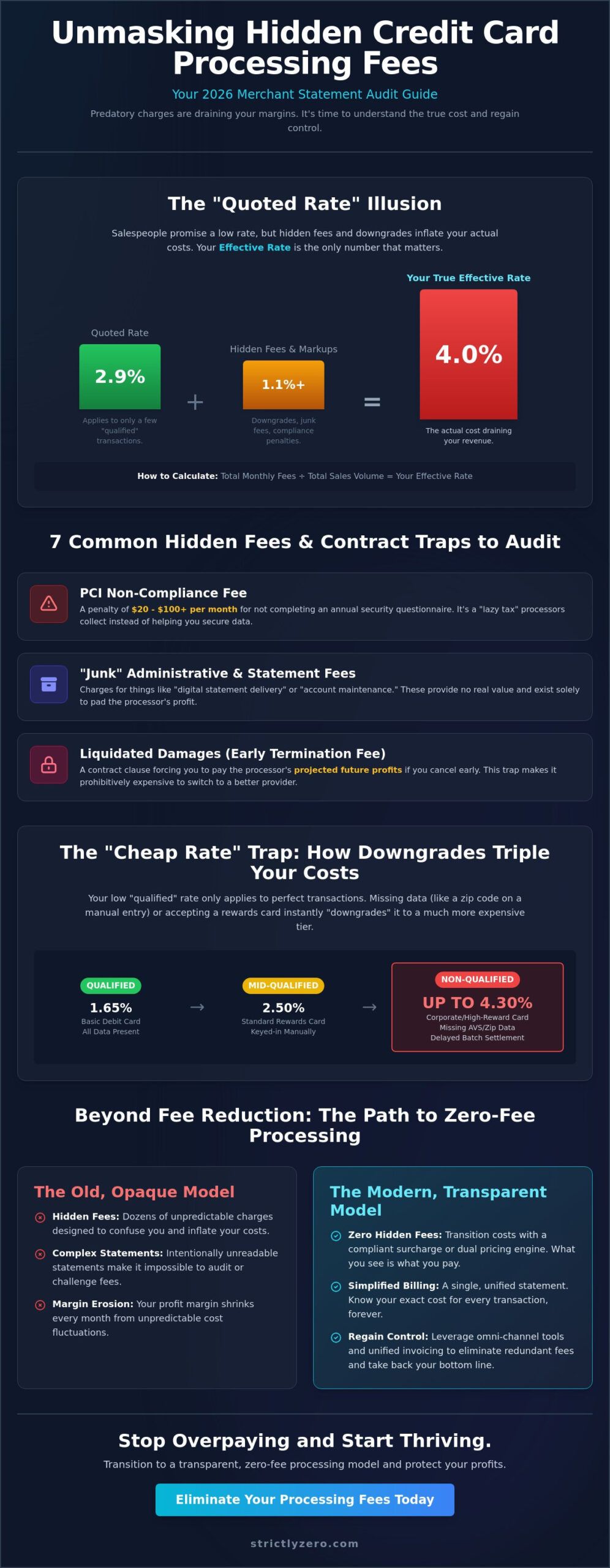
A salesperson might quote you a rate of 2.9%, but your month-end statement often reveals a 4% effective rate. This happens because the “quoted rate” typically only applies to basic, non-rewards debit cards. In the modern B2B and retail environment, rewards cards and corporate cards are the norm. These are frequently “downgraded” to non-qualified status, which carries a significantly higher markup. To find your true cost, divide your total monthly fees by your total sales volume. That’s your effective rate; it’s the only metric that matters for your bottom line.
Contractual ‘Gotchas’ to Watch For
Fine print often contains “liquidated damages” clauses that force you to pay the processor’s projected profit if you try to leave your contract early. These hidden fees in credit card processing are designed to trap you in a cycle of overpayment. Other common pitfalls include:
- Automatic rate escalators that quietly increase your markup after the first six months of service.
- Exclusivity clauses that prevent you from using more efficient omni-channel payment processing or virtual terminal tools from other providers.
- Administrative “junk fees” for digital statement delivery or PCI compliance “maintenance” that provide no actual value.
By understanding these structural traps, you can begin to audit your statements with a critical eye and demand a simplified, transparent billing model that respects your margins.
The 7 Most Common Hidden Fees in Credit Card Processing
While the headline rate on your contract might look attractive, the real cost of your merchant account is often buried in the fine print. These hidden fees in credit card processing act as a slow leak in your revenue stream, siphoning off profits before they ever hit your bank account. The most common offender is the PCI Non-Compliance fee. Processors often charge between $20 and $100 per month if you haven’t completed your annual self-assessment questionnaire. It is essentially a “lazy tax.” They would rather collect the penalty than provide the tools necessary to help you secure your data.
As we move through 2026, a new wave of “security escalation” fees has emerged. Legacy processors are leveraging the rise of AI-driven fraud as a pretext to increase their margins. They often add vague line items like “Network Security Surcharges” or “Integrity Fees” that don’t actually fund better protection. Instead of paying for empty labels, merchants should look for a partner that offers genuine AI-driven fraud prevention as part of a unified platform. This ensures you are actually protected rather than just being taxed for the risk. For companies looking to deepen their strategic approach to these challenges, you can visit Versapien for expert risk management and regulatory compliance consulting.
Operational and Administrative Fees
Don’t overlook the “paper” trail that persists even in a digital world. Many processors still tack on a “Statement Fee” of $10 to $15 just for the privilege of accessing a PDF you download yourself. IRS reporting fees for 1099-K processing and annual “membership” or “club” fees are other common profit centers that provide zero operational value. For a detailed breakdown of how these components are structured, consult this Guide to Credit Card Processing Fees. These administrative costs are almost entirely processor markup and are frequently negotiable or entirely avoidable with the right provider.
Transaction-Level Hidden Costs
Beyond the monthly overhead, micro-costs trigger with every swipe, tap, or click. These small amounts add up quickly across thousands of transactions. Key fees to watch for include:
- Batch Header Fees: A charge applied every time you close out your terminal, which usually happens daily.
- AVS (Address Verification Service) Fees: Charging you $0.05 to $0.10 per transaction just to verify a billing zip code.
- Gateway Access Fees: Hidden markups for the “bridge” between your website and the processor, often charged even if the processor owns the gateway.
- Minimum Processing Fees: A penalty charged if your monthly sales volume dips below a specific threshold, ensuring the processor hits their profit target regardless of your performance.
If these line items are cluttering your statement and draining your margins, it might be time to switch to a simplified, transparent billing model that eliminates the guesswork. Understanding the difference between a necessary network access fee and a processor’s opportunistic markup is the first step toward reclaiming your profit.
The ‘Cheap Rate’ Trap: Downgrades and Fragmented Tech
The lowest rate on paper is often the most expensive in practice. Many processors lure merchants with a “teaser” rate that only applies to a tiny fraction of their actual volume. When a transaction doesn’t meet specific data requirements, it triggers a downgrade. These downgrades represent some of the most expensive hidden fees in credit card processing because they are often invisible until the end of the month. If your staff forgets to enter a zip code or if a customer uses a corporate rewards card, the cost of that single swipe can triple instantly. You aren’t just paying for the transaction; you’re paying a penalty for “missing” data that your processor’s legacy system failed to capture.
In 2026, omni-channel businesses are particularly vulnerable to these costs. Data inconsistency across different sales channels often leads to higher risk profiles and increased markups. While a processor might claim to offer a low base rate, they often make up the difference through fragmented technology. If you use a separate gateway, a third-party virtual terminal, and a legacy processor, you’re likely paying three different sets of fees for a single transaction. This “double-dipping” is a hallmark of the legacy processing model that drains your margins through administrative bloat.
The Mechanics of a Downgrade
B2B merchants are hit hardest by the lack of Level 2 and Level 3 data. These data tiers require detailed information like sales tax amounts and invoice numbers. Without this info, corporate and government card transactions are downgraded to the highest possible cost bracket. An API-first platform like Strictly prevents these data-related downgrades automatically by ensuring the necessary fields are populated before the transaction is sent to the network. This automation is far more valuable than a low base rate. It ensures you always qualify for the best possible interchange tier, especially for Card-Not-Present (CNP) transactions which already carry naturally higher markups than in-person swipes.
Fragmented Tech Stack Costs
The “Gateway Split” is a common way processors hide extra profit. You might pay $25 per month plus an extra $0.10 per transaction just to connect your software to the payment network. When you add in “Integration Support Fees” for connecting a legacy POS to modern apps, the costs become unsustainable. Modern ecommerce payment processing requires a unified stack to avoid these redundant charges. By consolidating your virtual terminal, invoicing, and processing into a single engine, you eliminate the middleman markups. AI-driven fraud prevention tools further protect your bottom line by stopping high-risk transactions before they can trigger expensive chargeback fees or security-related downgrades.
How to Audit Your Merchant Statement for Hidden Costs
Auditing your merchant statement isn’t a one-time task; it’s a financial necessity. To get a clear picture of how hidden fees in credit card processing are impacting your revenue, you need to gather at least three months of statements. This range helps you identify seasonal fee spikes or quarterly “integrity” charges that might be missed in a single month’s snapshot. Look past the summary page and dive into the “Miscellaneous” or “Service” section. This is where 90% of non-essential fees reside, often disguised as “Admin Support” or “Security Tiers.”
If you’re on a flat-rate model, you’re likely paying for convenience with extreme obfuscation. Flat rates blend the interchange cost with the processor markup, making it impossible to see if you’re overpaying. By contrast, an Interchange-Plus model separates these costs, showing you exactly what the card brands take versus what your processor keeps. Benchmarking your costs against 2026 standards is vital. With average rates for Visa and Mastercard hovering around 2.35%, any effective rate significantly higher suggests your margins are being drained by unnecessary markups.
The 3-Step Math Check
To perform a quick audit, follow these three steps to see where your money is going:
- Step 1: Divide your “Total Fees” by your “Total Sales Volume.” This gives you your Effective Rate, which is the only number that accounts for every hidden charge.
- Step 2: Subtract the known interchange average (typically 1.8% to 2.2%) from that rate.
- Step 3: Identify the “Processor Spread.” If this remaining number is higher than 0.50%, you’re likely overpaying for basic service and should flag the account for negotiation.
Negotiating with Your Current Provider
Armed with your math, call your processor’s retention department. Use specific phrases like “I am requesting a move to Interchange-Plus pricing” to signal that you understand the industry’s architecture. Demand a fee waiver for any PCI non-compliance charges or seasonal “membership” fees you’ve identified. If they refuse to provide a transparent breakdown or insist on keeping you in a tiered model, it’s a clear sign they’ll never be transparent. You can also use the “RFP trick” by showing them a fresh quote from a competitor to force a more honest conversation about your rates.
Don’t let legacy providers hide behind complex paperwork. You can request a transparent merchant audit today to reclaim your profit and eliminate the guesswork from your monthly billing.
Beyond Fee Reduction: Moving to a Zero-Fee Processing Model
Auditing your statement reveals the damage, but switching to a zero-fee model stops the bleeding permanently. While traditional processors focus on slightly lowering your markup, they rarely address the underlying problem: you shouldn’t have to pay for your customers’ choice of luxury rewards cards. Moving to zero fee credit card processing allows you to reclaim your margins by passing the cost of convenience to the cardholder. This shift effectively eliminates the impact of hidden fees in credit card processing because your effective rate becomes a net zero.
Trust is the most valuable currency in 2026. A transparent processor doesn’t just send a bill; they act as a long-term business partner. By moving away from the “cheap rate” trap, you gain access to a unified platform that prioritizes your business health over its own per-transaction profit. Customers in 2026 are increasingly accepting of small convenience fees, especially when they understand it supports the businesses they value. Transitioning doesn’t mean losing customers; it means gaining the financial freedom to serve them better.
The $0 Processing Fee Revolution
Surcharging and dual pricing are the two main pillars of this revolution. Surcharging applies a small percentage to credit card transactions only, which is legally prohibited on debit cards. Dual pricing is even more transparent, showing a “cash price” and a “card price” upfront. This ensures you stay compliant with evolving state-specific regulations in places like Oklahoma or California without manual updates. Modern consumers appreciate having the choice, and your bottom line reflects the immediate savings from day one.
Strictly’s Unified Solution
Strictly’s Smart Pricing Engine takes the guesswork out of compliance. It automatically detects the card type and the merchant’s location to apply the correct fee structure in real-time. Instead of managing a fragmented mess of gateways and terminals, you get a consolidated dashboard for all your omni-channel payment processing. You can use ChurnIQ™ and ClearSplit™ to monitor your business health and manage partner distributions without worrying about hidden fees in credit card processing creeping back into your invoices. By consolidating your virtual terminal and invoicing into one transparent system, you eliminate the middleman markups that legacy ISOs rely on.
Ready to see how much you’re actually paying? Audit your fees with Strictly.
Take Control of Your Profit Margins in 2026
You’ve now identified the structural traps legacy processors use to inflate their margins at your expense. By focusing on your effective rate rather than teaser quotes, you can strip away the complexity and see the real cost of your merchant account. The transition from auditing statements to implementing a zero-fee model is the most effective way to protect your business from the “Architecture of Opacity” that has defined the industry for decades.
You don’t have to accept hidden fees in credit card processing as an unavoidable business expense. Modern tools allow you to automate compliance and shift the cost of convenience back to the cardholder with total transparency. It’s time to demand a processing partner that offers clarity instead of confusion. Your business deserves a unified platform that prioritizes your bottom line over its own markups.
Eliminate hidden fees today with Strictly’s Zero-Fee Processing Platform. Our AI-Driven Smart Pricing Engine and ClearSplit™ Transparent Residuals provide the visibility you need, while our system handles automated state-by-state compliance for you. Reclaiming your profit starts with a single audit. Your business has worked hard for its revenue; now it’s time to keep it.
Frequently Asked Questions
How do I identify hidden fees on my credit card processing statement?
Scan the “Miscellaneous” or “Service” sections for line items that don’t correlate with your transaction volume. These often include statement fees, regulatory product fees, or security surcharges. To spot hidden fees in credit card processing, compare your total monthly fees against your total sales volume to see if the math matches your signed contract. If the numbers don’t align, you’re likely paying for undisclosed processor markups.
What is a PCI non-compliance fee and is it mandatory?
A PCI non-compliance fee is a penalty charged by processors when a merchant fails to complete their annual security questionnaire. While the security standards are mandatory for data safety, the fee itself isn’t a government tax. It’s a processor-imposed charge that you can eliminate by becoming compliant. Some modern processors help you avoid these by providing the tools needed to maintain compliance automatically.
Are credit card processing fees tax-deductible for my business?
What is the difference between a surcharge and a hidden fee?
A surcharge is a transparent, disclosed fee passed to the customer at the point of sale to cover processing costs. In contrast, hidden fees in credit card processing are back-end charges applied by the processor directly to your merchant account. Surcharging is a legal way to offset costs, whereas hidden fees are often buried markups designed to increase the processor’s profit without your knowledge.
Why is my ‘Effective Rate’ so much higher than my ‘Discount Rate’?
Your discount rate is usually just the base percentage for qualified transactions, while your effective rate includes every single cost, fee, and downgrade on your statement. The gap exists because your processor likely routes many transactions into “non-qualified” tiers with much higher costs. Dividing your total monthly fees by your total gross volume reveals the true cost of acceptance for your business.
Can I negotiate my credit card processing fees with my current bank?
You can certainly attempt to negotiate, but most traditional banks use legacy models that limit their flexibility on markups. Instead of asking for a lower percentage, request a move to Interchange-Plus pricing. This model forces transparency by separating the base cost from the processor’s markup. If they refuse to waive administrative or statement fees, it’s usually a sign that switching providers is necessary.
Is zero-fee credit card processing legal in all 50 states in 2026?
Surcharging is legal in most states, but specific regulations vary significantly by jurisdiction. For example, Oklahoma capped surcharges at 2% in late 2025, while California requires these fees to be included in upfront advertised prices. Using an automated surcharge and dual pricing engine ensures your business stays compliant with these evolving state-level laws while effectively eliminating your processing liability.
What are ‘downgrade fees’ and how can I avoid them?
Downgrades occur when a transaction doesn’t meet the data requirements for the lowest interchange rate, such as missing zip codes or using corporate rewards cards. You can avoid these by using a virtual terminal that supports Level 2 and Level 3 data processing. Providing more transaction detail proves to the networks that the sale is low-risk, which lowers your overall cost of acceptance.