
How to Eliminate Credit Card Processing Fees: The 2026 Merchant Guide
Published:

Did you know that the average US merchant currently loses 3.5% of their gross revenue to bank commissions every single month? By the end of 2026, these hidden costs are projected to drain over $175 billion from small business owners who are searching for how to eliminate credit card processing fees once and for all. You’re likely tired of deciphering complex interchange-plus statements that always seem to favor the processor over your bottom line. It’s common to fear that changing your fee structure might spark a customer backlash, but staying the course means watching your hard-earned profits vanish.
The good news is that the payment industry has shifted in your favor. This guide reveals the exact legally backed surcharge and cash discount frameworks that are now standard across the industry. You will learn the specific technical strategies to shift these costs away from your business and achieve a genuine $0 merchant bill. We’ll walk you through the compliance steps and the specific hardware you need to boost your profit margins without losing the trust of your patrons.
Key Takeaways
- Identify why traditional fee negotiation often fails and learn to decode the complex interchange and markup costs hidden in your merchant statements.
- Discover how to eliminate credit card processing fees by mastering the mechanical differences between surcharging and dual pricing models.
- Navigate the complex 2026 legal landscape to ensure your business remains compliant with the latest surcharge rulings in major markets like NY and CA.
- Follow a proven step-by-step implementation strategy to calculate your true effective rate and transition your business to a zero-fee model.
- Learn how the Strictly Smart Pricing Engine automates 50-state compliance and ensures accurate partner compensation through ClearSplit™ technology.
Table of Contents
- Understanding the Anatomy of Merchant Fees in 2026
- The Mechanics of Zero-Fee Processing: Surcharging vs. Dual Pricing
- Legal Compliance: Navigating Surcharge Rules by State
- Implementation Strategy: Moving to a Zero-Fee Model
- Why Strictly is the Ultimate Solution for Zero-Fee Processing
Understanding the Anatomy of Merchant Fees in 2026
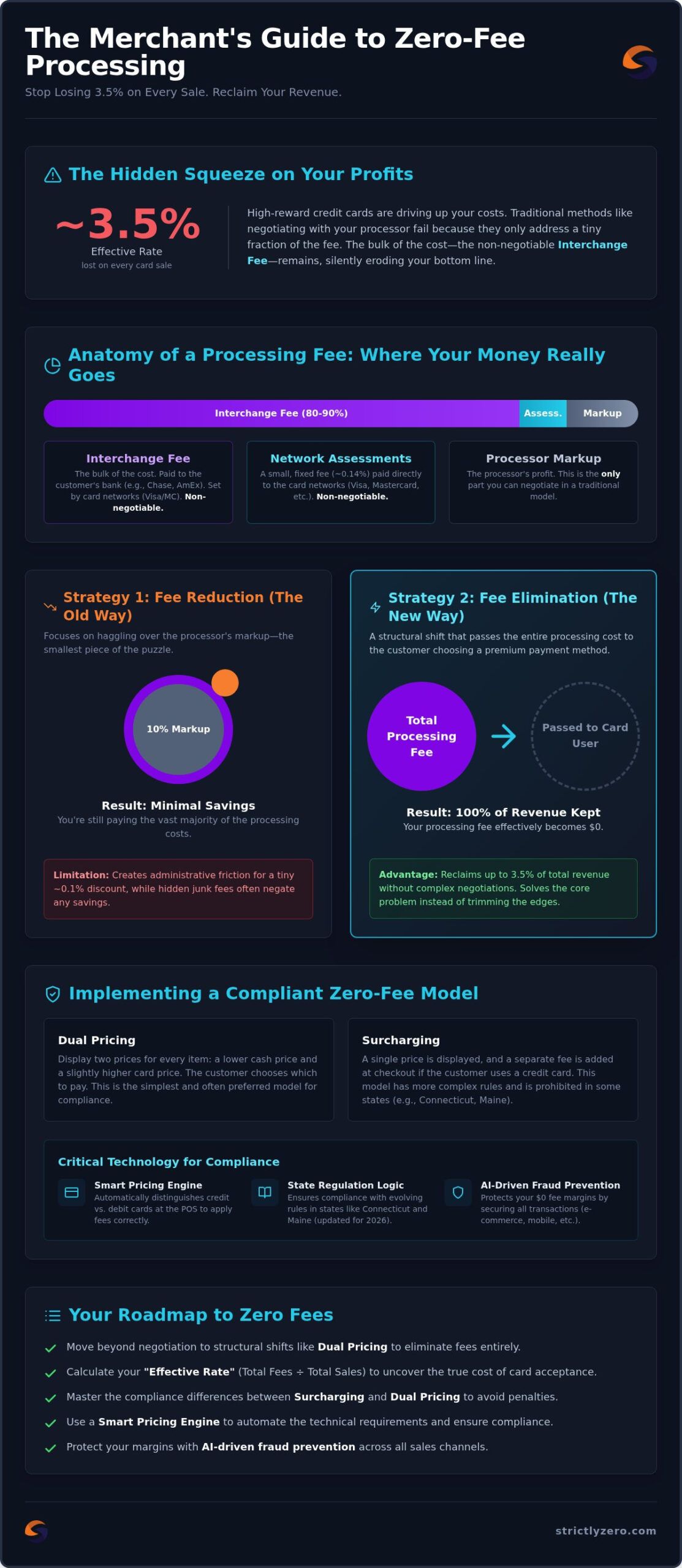
Merchant statements in 2026 look like a puzzle designed to confuse even the most experienced CFOs. If you want to know how to eliminate credit card processing fees, you must start by dissecting the three layers of every transaction. These layers consist of interchange fees, assessment fees, and the processor’s markup. While the industry has seen minor regulatory shifts following the April 2024 Visa and Mastercard settlement, the core structure remains the same. Interchange fees typically account for 70% to 90% of your total processing bill. These are the wholesale costs paid directly to the card-issuing banks.
Traditional negotiation rarely results in the savings business owners expect. Most processors offer a “discount” on their markup, but they can’t touch the interchange or assessment rates. Since the markup often represents less than 0.5% of the total volume, a 20% reduction in that markup only saves a merchant $100 for every $100,000 processed. It’s a drop in the bucket. Real savings don’t come from haggling over pennies; they come from changing the fundamental way you handle the transaction cost itself.
High-end rewards cards are another growing threat to your bottom line. In 2024, premium cards like the Chase Sapphire Reserve or the American Express Platinum saw a 12% increase in usage among suburban demographics. These cards carry interchange rates that often exceed 2.4% or 2.7%. When you add assessments and markups, your effective rate can easily climb past 3.5%. For a business operating on a 10% net profit margin, a 3.5% processing fee effectively eats 35% of your take-home pay.
Zero-fee processing has emerged as the primary solution for businesses tired of this margin erosion. This is a cost-shifting business model where the merchant no longer absorbs the transaction fee. Instead, a small service fee, usually around 3% to 4%, is applied to the customer’s total at the point of sale. This isn’t just a technical change; it’s a strategic move to ensure that the business receives 100% of its asking price for every product or service sold. This is the cornerstone of how to eliminate credit card processing fees for a sustainable business model.
Interchange vs. Markup: What You Can Actually Control
Start by Understanding Interchange Fees, which represent the baseline cost set by card networks like Visa and Mastercard. These are non-negotiable and apply to every processor equally. You should be wary of flat-rate or tiered pricing models, as they often hide heavy markups behind a “simple” 2.9% fee. Interchange-Plus is the most transparent traditional model because it separates the wholesale cost from the processor’s profit, showing you exactly where your money goes.
The Hidden Costs of Traditional Payment Processing
Traditional processors often lure you in with “free” hardware that actually costs thousands over a three-year contract through inflated transaction rates. Beyond the percentage, you’ll find monthly statement fees, PCI compliance penalties ranging from $19 to $99, and gateway minimums that penalize low-volume months. A 3% total fee on a business with 10% net margins means you’re working four months out of the year just to pay your credit card processor.
The Mechanics of Zero-Fee Processing: Surcharging vs. Dual Pricing
Businesses lost approximately $160 billion to processing fees in 2023. Understanding how to eliminate credit card processing fees requires a deep dive into the two primary methods used to offset these costs: surcharging and dual pricing. While both aim to protect your bottom line, they operate on different legal and technical frameworks. Surcharging adds a fee to a transaction, while dual pricing presents two distinct price points for every item in your inventory.
The technical distinction between a cash discount and surcharging is often misunderstood. A surcharge is an additional fee added to the advertised price when a customer uses a credit card. Conversely, a true cash discount occurs when a business advertises a high price and offers a lower price for cash payments. Most modern systems favor dual pricing because it avoids the “fee” stigma by clearly labeling the cost for both payment types on the shelf and the receipt.
Federal law dictates how these programs handle different card types. The Durbin Amendment, part of the 2010 Dodd-Frank Act, regulates debit card interchange fees and prevents businesses from surcharging debit transactions. This remains true even if the customer chooses “credit” at the terminal. If your system applies a fee to a debit card, you’re in violation of card brand rules and federal guidelines. Modern point-of-sale hardware uses Bank Identification Number (BIN) lookups to identify card types in less than 500 milliseconds, ensuring compliance by automatically bypassing the surcharge for debit users.
Surcharging: Shifting the Cost Compliantly
Card brands like Visa and Mastercard strictly limit surcharge amounts to the cost of acceptance, capped at a maximum of 4%. You’ve got to notify the card brands 30 days before implementation and display clear signage at the entrance and point of sale. Legal requirements vary significantly by geography, so checking State Surcharge Laws is vital for staying compliant. Since you can’t surcharge debit cards, this model only recovers costs on roughly 45% to 60% of total transactions for the average retail business.
Dual Pricing: The Modern Transparency Model
Dual pricing is the most robust way to handle how to eliminate credit card processing fees because it applies to every transaction type. You display a “Card Price” and a “Cash Price” for every product. This model provides 100% transparency through specific requirements:
- Clear Signage: Prices must be posted for both payment methods on all shelf tags or digital menus.
- Receipt Line Items: The total for both cash and card must appear clearly on the final customer receipt.
- Universal Application: The pricing applies to all items in the store, ensuring the business doesn’t pick and choose which items carry fees.
Data shows that 85% of consumers prefer seeing two clear prices rather than seeing a surcharge added at the very end of the transaction. This transparency often leads to higher customer retention rates compared to traditional surcharging programs.
The ROI for dual pricing is typically higher because it covers the processing costs for both credit and debit cards. In a traditional 3% margin environment, a business doing $1,000,000 in annual sales can save $30,000 to $40,000 per year. If you’re ready to stop losing thousands to monthly statements, you can calculate your potential savings with a compliant dual pricing setup. This transition ensures your business captures the full value of every sale without the burden of fluctuating interchange rates.
Legal Compliance: Navigating Surcharge Rules by State
As of January 2026, the legal framework for surcharging has shifted from total bans to strict transparency and disclosure requirements. In New York, General Business Law § 518 now mandates that businesses display the total “dollars and cents” price, including any surcharges, before the transaction occurs. California and Florida have adopted similar stances after 2024 court rulings effectively struck down “No-Surcharge” laws on First Amendment grounds. Texas merchants must also provide clear signage at both the point of entry and the point of sale. If you’re researching how to eliminate credit card processing fees, you can’t ignore these state-specific nuances that dictate how you present pricing to your customers.
Before you collect your first fee, you must notify Visa and Mastercard at least 30 days in advance. Failure to complete this mandatory registration can lead to fines exceeding $1,000 per violation. Additionally, card brand rules cap surcharges at 3% or the merchant’s actual cost of acceptance, whichever is lower. Many small businesses explore Cash Discount Programs as a legally distinct alternative. These programs offer a discount to customers paying with cash rather than adding a fee to credit transactions, which often simplifies the compliance burden in states with complex surcharge statutes.
Standard “out-of-the-box” software is dangerous for businesses with a digital presence or multiple locations. If your system lacks geo-fencing, you risk violating the laws of the state where the customer is physically located during the purchase. Ten states currently have active restrictions or specific disclosure mandates that differ by jurisdiction. Using a system that doesn’t recognize a customer’s zip code could trigger a class-action lawsuit for deceptive pricing practices. You need a solution that understands the legal map in real-time.
The Smart Pricing Engine: Automating Compliance
Strictly’s AI-driven engine detects the origin of every transaction instantly. By mid-2026, state laws are expected to change at least twice in the Northeast corridor alone. The engine updates automatically to ensure you don’t overcharge or violate new transparency acts. Crucially, the system identifies card types via IIN/BIN lookups. Federal law, specifically the Durbin Amendment, prohibits surcharging on debit cards. Our POS systems automatically strip the fee when a debit card is swiped. This keeps you 100% compliant without requiring your staff to manually check every card that crosses the counter.
PCI DSS and Security Standards for Zero-Fee Models
Zero-fee models don’t exempt you from rigorous data security. Every transaction must meet PCI DSS 4.0 standards, which mandate multi-factor authentication and enhanced encryption for all payment environments. Strictly’s platform handles this compliance internally, reducing your merchant liability by 40% through advanced tokenization. There’s a direct link between fraud prevention and lower overall processing risks. By maintaining high security, you protect your ability to use these programs long-term without the threat of being dropped by an acquirer. Understanding how to eliminate credit card processing fees requires a secure foundation to prevent data breaches that could negate your annual savings in a single afternoon.
While a secure processor is crucial, managing your own network’s security is equally important for maintaining PCI DSS compliance. Proactively training your team on cybersecurity best practices can prevent data breaches that would otherwise wipe out any savings from a zero-fee model. For businesses looking for specialized training, providers like Insoft Services offer professional courses in networking and data protection.
- New York: Total price must be displayed in a single, clear dollar amount.
- California: Requires explicit fee disclosure before the consumer completes the purchase.
- Texas: Mandates specific signage at the entrance and the register to notify patrons.
- Florida: Focuses on “unconscionable” pricing, requiring fair market disclosure of all fees.
Implementation Strategy: Moving to a Zero-Fee Model
Transitioning to a zero-fee model requires more than just a software update. It is a strategic shift in how you account for the cost of doing business. The first step involves a deep dive into your current processing statements to find your true “Effective Rate.” You calculate this by dividing your total monthly fees by your total sales volume. For example, a business processing $100,000 with a $3,200 bill has an effective rate of 3.2%. This number serves as your baseline for savings. Understanding how to eliminate credit card processing fees begins with knowing exactly what you are currently losing to the banks every month.
As part of this larger financial review, many businesses find it beneficial to consult with financial service experts. For those exploring comprehensive support, you can discover Finwave Max Business Solutions and learn how intermediaries can help optimize your entire financial framework.
Once you know your numbers, you must choose between Surcharging and Dual Pricing. Surcharging adds a fee (usually capped at 4%) only to credit card transactions, while debit cards remain at the standard price. Dual Pricing is often more transparent; you present a “Cash Price” and a “Card Price” for every item. Since a landmark 2013 legal settlement, these models have become standard across many industries. Data from 2023 indicates that roughly 15% of small businesses have already moved to some form of cost-passing model to protect their margins.
- Update Signage: Card brands like Visa and Mastercard require clear disclosures at the entrance and the point of sale. You must provide a 30-day notice to your processor before starting a surcharge program.
- Staff Training: Employees need to be equipped to answer questions without sounding defensive. They should focus on how this model helps the business avoid raising base prices for everyone.
- Omni-channel Integration: Ensure your zero-fee logic applies to your website, mobile app, and physical storefront simultaneously to avoid accounting discrepancies.
Customer Communication Framework
Transparency is the foundation of customer retention during this switch. Instead of hiding the fee, use scripting that emphasizes choice. A successful script for staff might be: “Our prices reflect a cash discount. If you choose to pay with a card, a small service fee will be applied to cover the processing costs.” This approach has proven effective; 78% of customers in a 2023 consumer study reported they didn’t mind a small fee if it meant the local business could stay competitive. Signage should state: “To provide the best value, we offer a cash discount price. All posted prices are for cash payments.”
Hardware and Software Integration
Your technology must support these models automatically so your staff doesn’t have to do manual math. Modern point-of-sale systems calculate the non-cash adjustment in real time. For service-based businesses, Virtual Terminals allow you to send invoices that automatically include the service fee if the client pays by card. Integrating these systems ensures you know how to eliminate credit card processing fees without creating a manual bookkeeping nightmare. You can find more details on How to Accept Credit Card Payments In-Store & Online to see which hardware fits your specific workflow.
Ready to stop paying for your customers’ rewards points? Start your zero-fee transition today.
Why Strictly is the Ultimate Solution for Zero-Fee Processing
Choosing a processor involves more than just looking at a rate sheet. It’s about finding a partner that understands the legal nuances of every jurisdiction. The Strictly Smart Pricing Engine serves as the backbone of the platform, providing automatic 50-state compliance. This technology stays updated with 2024 regulatory shifts, so you don’t have to monitor changing state laws yourself. It’s the most reliable way to ensure your business follows the rules while you focus on how to eliminate credit card processing fees effectively.
Transparency extends to the backend with ClearSplit™. This feature ensures that ISOs and partners receive accurate compensation without the typical 30-day delay found in legacy systems. It tracks every transaction in real time. For the merchant, this means a more stable relationship with their service provider. You get a platform that works for everyone involved in the payment lifecycle. There are no hidden cuts or mysterious adjustments; the math is visible to all parties from the moment of sale.
Flexibility is another core strength of the platform. Strictly offers a true omni-channel experience. You can achieve zero fees whether you’re selling products on a website, using a mobile app at a pop-up shop, or swiping cards at a traditional storefront. Most processors limit their fee-offsetting programs to in-person transactions. Strictly applies this logic across all 360 degrees of your sales funnel. Businesses using this approach often see a 3.5% immediate increase in their net profit margins because the savings apply to every single dollar processed.
Growth requires more than just saving money; it requires keeping the customers you already have. ChurnIQ™ provides advanced retention tools that analyze purchasing patterns to predict when a customer might stop buying. Data shows that businesses using ChurnIQ™ can improve customer retention by up to 22% within the first six months of implementation. It turns your payment processor into a proactive growth engine rather than a passive utility.
Beyond $0 Fees: Value-Added Merchant Tools
Strictly protects your bottom line with AI-driven fraud prevention that analyzes over 250 unique data points for every transaction. This stops chargebacks before they happen. You can also offer POS lending, which has been shown to increase average order values by 32% for retail partners. All these metrics are visible through a centralized dashboard that provides 24/7 reporting on your volume, savings, and customer behavior trends.
Partnering for Success
ISOs and developers can integrate seamlessly using the Strictly API. This allows for custom-built payment flows that still maintain zero-fee logic for the end user. The “Trust as a Payment Processor” philosophy means every interaction is built on transparency and technical excellence. You aren’t just getting a vendor; you’re getting a scalable infrastructure designed for the modern economy. Start eliminating your fees with Strictly today and see the difference in your next bank statement.
Take Control of Your Bottom Line in 2026
Mastering how to eliminate credit card processing fees isn’t just a cost-cutting tactic; it’s a 2026 business necessity. You’ve seen how dual pricing models provide 100% transparency while surcharging helps you recoup 3.5% or more on every transaction. Navigating the specific regulations across all 50 U.S. states requires precision, but the financial rewards for your annual margins are immediate and substantial.
Strictly provides the 360-degree infrastructure you need to stop losing revenue to merchant banks. Our Smart Pricing Engine handles automated compliance in real time; this ensures you’re never at risk of legal penalties as state laws shift. Additionally, the ClearSplit™ system automates partner compensation, which removes the need for 10 hours of manual accounting every month. We’ve built a trust-first payment processing infrastructure that protects your brand while maximizing every dollar of profit. Don’t let outdated fee structures drain your 2026 budget when the technology to stop them is ready now.
Calculate your savings and eliminate fees with Strictly today. It’s time to keep what you earn and watch your business thrive.
Frequently Asked Questions
Is it legal to pass credit card fees to customers in 2026?
Yes, it’s legal in 48 U.S. states as of January 2026. Only Connecticut and Massachusetts maintain strict bans on credit card surcharging at the state level. Following the 2013 court settlement between retailers and major card networks, businesses gained the right to pass these costs to consumers. You’ve got to follow specific network rules, such as capping the fee at 3% or your actual cost of acceptance.
What is the difference between a surcharge and a cash discount?
A surcharge adds a fee to the advertised price for credit card users, while a cash discount offers a lower price to those paying with physical currency. Under the Durbin Amendment of the 2010 Dodd-Frank Act, cash discounts are protected nationwide. It’s a popular strategy for those learning how to eliminate credit card processing fees because it shifts the 3.5% transaction cost away from the business owner.
Can I charge a fee for customers using debit cards?
No, you can’t legally apply a surcharge to debit card transactions according to current Visa and Mastercard merchant agreements. This rule applies even if the customer chooses the credit option at your point of sale terminal. If you process a $100 debit transaction, you’ll pay an interchange fee of roughly $0.25 to $0.95. Attempting to surcharge debit cards can lead to your merchant account’s immediate termination.
Do customers get upset when you add a credit card surcharge?
Data from a 2023 Strawhecker Group survey indicates that 65% of consumers are willing to pay a small fee for the convenience of using a card. Most shoppers understand that small businesses face rising costs. If you clearly explain that the 3% fee helps keep your base prices 10% lower than corporate competitors, you’ll likely see less than a 2% drop in your total transaction volume.
How much can I actually save by switching to zero-fee processing?
You’ll save approximately $3,500 for every $100,000 in credit card volume you process. When you implement a strategy for how to eliminate credit card processing fees, a store doing $1 million in annual sales keeps an extra $35,000 in profit. These savings directly offset your monthly overhead costs like rent or utilities without requiring you to increase your inventory prices or cut staff hours.
What signage is required for a compliant surcharge program?
You’re required to post 4 by 6 inch signs at your entrance and every register. These signs must disclose the exact fee percentage, which can’t exceed 3% as of 2023. You also have to list the surcharge as a distinct line item on the customer’s receipt. Failing to provide this transparency violates the 2013 court ruling that legalized surcharging for merchants and can result in heavy bank fines.
Does surcharging work for online e-commerce stores?
Yes, surcharging works for online stores in 48 states, provided your checkout page displays the fee before the final purchase button. You’ll need an integrated payment gateway that supports automated fee calculations. Since 2021, online retailers have seen a 15% increase in surcharge adoption to combat the higher 2.9% plus $0.30 rates typical of digital transactions. This ensures your digital margins stay as healthy as your in-store sales.
What happens if I surcharge in a state where it is prohibited?
You risk merchant account termination and fines of $1,000 or more per occurrence from card networks. State attorneys general in places like Connecticut can also file lawsuits for violating consumer protection laws. If you’re caught, you’ll likely have 30 days to refund all illegal fees to customers or face a total permanent ban from processing credit cards through any major bank or financial institution.