
Merchant Account Underwriting Process Explained: A 2026 Guide
Published:

What if the invasive questions and piles of paperwork required for your business aren’t actually hurdles, but the only thing standing between you and a share of the $66.4 billion projected to be lost to eCommerce fraud in 2026? Having your merchant account underwriting process explained shouldn’t feel like a trip to the principal’s office. You’ve likely felt the frustration of waiting weeks for an answer or the anxiety of handing over sensitive personal financial data without knowing why it’s needed. Since the PCI DSS v4.0.1 standards became mandatory on March 31, 2025, the bar for security and compliance has never been higher.
You probably think underwriters are just looking for reasons to say “no” to your application. We agree that the traditional “black box” approach is outdated and adds unnecessary stress to your business growth. This guide promises to pull back the curtain on modern risk assessment, showing you how to turn your compliance into a competitive advantage. You’ll learn exactly how to organize your documents to secure fast approval and how to position your business for a zero-fee processing model. We’ll also cover the impact of the April 2026 PACE Act and why AI-driven fraud monitoring is now a core requirement for any serious merchant.
Key Takeaways
- Discover why processors view every transaction as a credit risk and how this perspective dictates their scrutiny of your financial profile.
- Identify the five critical factors underwriters prioritize, including your industry’s risk classification and the health of your processing history.
- Get the merchant account underwriting process explained through every stage, from initial data entry to the automated AI fraud scoring that determines your approval speed.
- Use our essential document checklist and website audit guide to ensure your digital presence and paperwork are optimized for immediate approval.
- Learn how integrating AI-driven fraud prevention and a smart surcharge engine can help your business qualify for a zero-fee processing model.
Table of Contents
- What is Merchant Account Underwriting?
- The 5 Critical Factors Underwriters Evaluate
- The Merchant Underwriting Process: A Step-by-Step Breakdown
- How to Prepare Your Business for Smooth Approval
- Navigating Underwriting with Strictly: Speed, Trust, and Zero Fees
What is Merchant Account Underwriting?
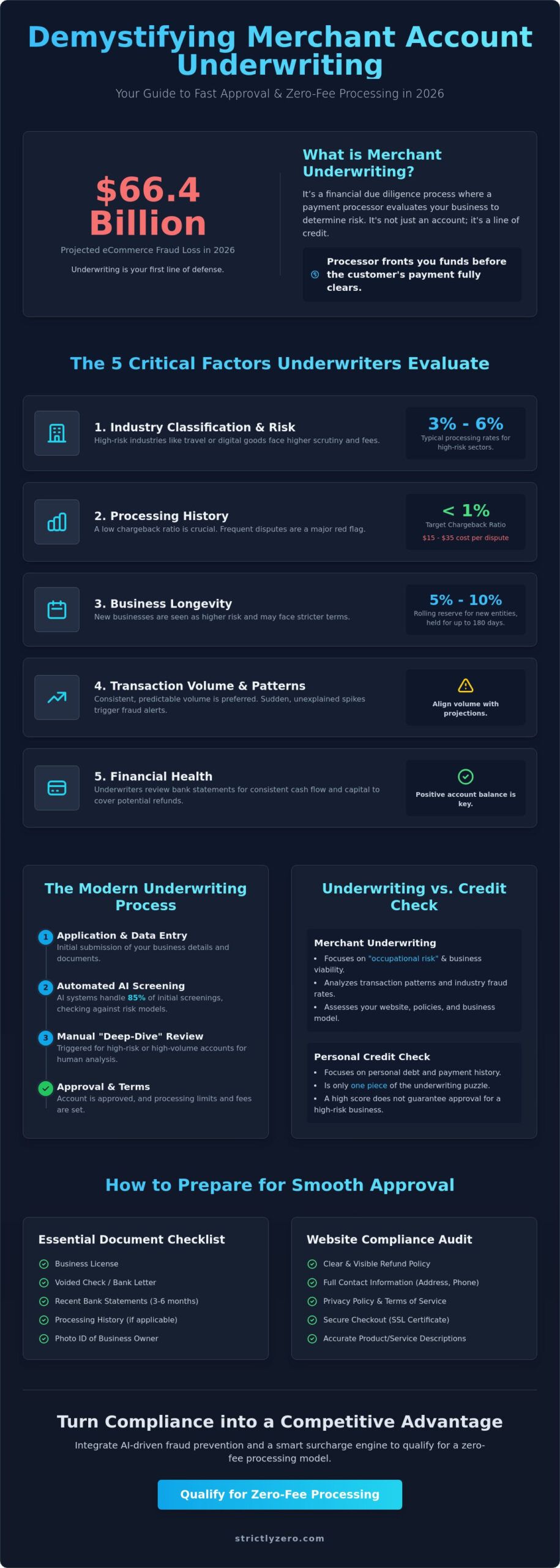
At its core, merchant account underwriting is a form of financial due diligence. It’s the process where a Payment Processor evaluates your business to determine the level of risk they’re assuming by facilitating your transactions. Unlike a standard bank account, a merchant account is essentially a line of credit. When you accept a payment, the processor fronts the funds to you before the customer’s money is fully cleared and the window for a chargeback has closed. If your business fails or disappears after a massive wave of disputes, the processor is legally and financially responsible for those losses. This is why having the merchant account underwriting process explained clearly is vital for any business owner who wants to avoid unexpected delays.
To better understand this concept, watch this helpful video:
In 2026, this process has evolved from a one-time event into a continuous cycle of monitoring. While some competitors might claim underwriting is a “one-and-done” check, the reality is that the PCI DSS v4.0.1 standards and the NACHA rules effective March 20, 2026, require ongoing oversight. Underwriters act as the gatekeepers of the payment ecosystem, ensuring that every merchant on the network follows strict fraud prevention protocols. This protects not just the bank, but every other business and consumer in the digital economy. The merchant account underwriting process explained through a modern lens shows that automated systems now handle 85% of initial screenings, but manual “deep-dives” are still triggered for high-volume or high-risk industries.
The Role of the Underwriter
Underwriters function as financial detectives for the acquiring bank. They don’t just look at numbers; they analyze the viability of your entire business model. They balance the processor’s risk tolerance with your need for growth. In 2026, they use AI-driven tools to predict future chargeback ratios based on your specific industry. They look at the business entity and the individual owner’s history because, in the eyes of the bank, the person behind the business is just as important as the revenue it generates.
Underwriting vs. Credit Checks
You shouldn’t confuse a merchant underwriting review with a simple credit check. While a personal credit score is a factor, it’s only one piece of the puzzle. Merchant underwriting focuses on “occupational risk” and transaction patterns. For example, a business with a 750 credit score might still be rejected if their industry has a high fraud rate or if they lack a clear refund policy. Additionally, while most initial inquiries are “soft” and won’t hurt your score, some high-risk applications may require a “hard” inquiry that shows up on your credit report for up to two years.
The 5 Critical Factors Underwriters Evaluate
Underwriters don’t just guess your risk level. They use a standardized set of criteria to determine if your business is a safe bet for the processor. Having the merchant account underwriting process explained means looking at these five specific pillars of risk:
- Industry Classification: In 2026, high-risk sectors like travel or digital goods face processing rates between 3% and 6% because these industries historically have higher dispute rates.
- Processing History: Underwriters look for a chargeback ratio below 1%. History showing frequent disputes, which currently cost high-risk merchants between $15 and $35 per occurrence, makes you a liability.
- Business Longevity: New entities often face more scrutiny. They may be required to hold a rolling reserve of 5% to 10% for up to 180 days to mitigate the risk of sudden closure.
- Transaction Volume: Sudden spikes in revenue can trigger automated fraud alerts if they don’t align with your projected monthly volume.
- Financial Health: Underwriters assess your bank statements for consistent cash flow to ensure you have enough capital to cover potential refunds or fees.
Merchant Category Codes (MCC) and Their Impact
Every business is assigned a four-digit Merchant Category Code (MCC) based on the types of goods or services sold. This code is the foundation of your risk profile. It dictates your base interchange rates and determines your compliance requirements under Mastercard’s official rules. If you’re misclassified, you might pay higher fees than necessary or face account termination. Choosing the right MCC is also essential if you want to implement zero fee credit card processing, as some codes have specific restrictions on surcharging.
Financial Stability and KYC Compliance
In 2026, Know Your Customer (KYC) requirements have become more rigorous due to the PACE Act introduced in April 2026. Underwriters now verify identities against a global database, as 4.8 billion people are forecasted to have digital identity cards by the end of this year. They’ll scrutinize your bank statements for consistent cash flow and verify that your business isn’t involved in money laundering. If you’re unsure where your business stands, you can consult with a payment expert to review your profile before submitting an application. This ensures your Anti-Money Laundering (AML) checks are cleared without delay.
The Merchant Underwriting Process: A Step-by-Step Breakdown
Modern underwriting has moved away from slow, paper-based reviews toward a sophisticated, multi-stage digital journey. Having the merchant account underwriting process explained step-by-step helps you anticipate where delays might happen and how to prevent them. In 2026, the entire flow is designed to balance speed with the heavy security requirements of PCI DSS v4.0.1.
- Step 1: Application Submission: You provide your business Tax ID, owner information, and financial history. This initial data entry sets the foundation for your risk profile.
- Step 2: Automated Screening: Within seconds, AI-driven systems scan your data against global fraud databases. With eCommerce fraud projected to cost $66.4 billion this year, this step is more rigorous than ever.
- Step 3: Document Verification: Underwriters perform a “deep dive” into your bank statements and processing history. They verify your compliance with the NACHA rule changes effective March 20, 2026, specifically looking for standardized payment descriptions like “PURCHASE.”
- Step 4: Conditional Approval: If you’re in a high-risk category, you might receive approval with specific conditions, such as a rolling reserve or a lower initial processing limit.
- Step 5: Final Boarding: Once terms are accepted, your account is activated across all omni-channel platforms, from virtual terminals to mobile invoicing.
Automated vs. Manual Review
Most applications in 2026 are processed through automated workflows that provide near-instant feedback. However, certain triggers like a high-risk MCC or a lack of processing history can shift your file to a manual review. You shouldn’t panic if this happens; it’s simply an underwriter performing a more nuanced risk assessment. This hybrid approach is exactly how credit card processing for small business has become so streamlined. AI handles the routine data validation while humans step in to evaluate complex business models that don’t fit into a standard box.
Understanding “Conditional Approval”
Receiving conditional approval means the processor is willing to work with you, but they want a safety net. This often takes the form of a merchant reserve. A rolling reserve is the most common type in 2026, where the processor holds 5% to 10% of your daily revenue for 90 to 180 days. This fund covers potential chargebacks, which typically cost high-risk merchants between $15 and $35 per dispute. You can often negotiate these terms down after six months of clean processing history with low dispute ratios. Demonstrating consistent volume and strict adherence to fraud prevention protocols is the fastest way to regain full access to your funds.
How to Prepare Your Business for Smooth Approval
Success in securing a merchant account depends on how well you present your business as a stable, low-risk partner. While we’ve already had the merchant account underwriting process explained as a risk assessment, your job is to provide the evidence that mitigates that risk. Underwriters in 2026 are looking for organized, transparent data that aligns with current security standards like PCI DSS v4.0.1. If your paperwork is messy or your website is vague, you’ll likely face long delays or a flat rejection.
Start by gathering your essential document package. You’ll need at least three months of recent bank statements showing healthy cash flow and two forms of government-issued identification. With 4.8 billion people forecasted to have digital identity cards by the end of 2026, many processors now prefer verified digital IDs for faster KYC compliance. You should also be prepared for the personal guaranty conversation. Unless you’re running a large, publicly traded corporation, underwriters usually require the business owner to personally back the account. This ensures you’re committed to maintaining a low dispute ratio and covering any potential losses.
Optimizing Your Digital Presence
Your website is often the first place an underwriter looks to verify your business model. They aren’t just checking your products; they’re looking for compliance. Your Refund Policy, Privacy Policy, and Terms of Service must be clearly visible in the footer of every page. It’s also vital that your “Doing Business As” (DBA) name matches exactly what you put on your application. If a customer sees a charge from “Strictly” on their statement but your website says “Zero Fee Payments,” they might initiate a chargeback out of confusion. Displaying a clear phone number and email address on every page of your site reduces the chance of a customer filing a chargeback simply because they couldn’t reach you, which gives underwriters confidence in your customer service model.
Managing Your Chargeback Profile
Underwriters prioritize your processing history above almost everything else. If you’ve processed payments before, you must provide your last three to six months of processing statements. They’re looking for a chargeback-to-transaction ratio well below 1%. If your history shows frequent disputes, which cost high-risk merchants between $15 and $35 each in 2026, you’ll need to explain what steps you’ve taken to fix the issue. Implementing AI-driven fraud prevention tools before you apply shows you’re proactive about security. Many partners use a payment processing platform for ISOs to monitor merchant health in real-time, ensuring that any spikes in fraud are caught before they trigger a full account review. To ensure your business is ready for the spotlight, you can start your application with a free pre-underwriting review today.
Navigating Underwriting with Strictly: Speed, Trust, and Zero Fees
Having the merchant account underwriting process explained is one thing, but experiencing it with a partner that prioritizes your growth is another. Strictly transforms the traditional “black box” of risk assessment into a transparent, high-speed onboarding experience. By leveraging AI-driven fraud prevention, we analyze your business data in real-time, matching your profile against the latest 2026 security benchmarks. This technology allows us to bypass many of the manual delays that plague traditional processors, helping you get to market while others are still stuck in the queue.
Our approach is built on trust and omni-channel flexibility. Whether you’re using our virtual terminal for invoicing or setting up a dual-pricing engine for a retail storefront, our underwriting team looks at the big picture. We understand that a modern business needs to accept payments everywhere. By consolidating your documentation through our unified platform, we eliminate the need for redundant paperwork. Our support team acts as your advocate, guiding you through the nuances of the NACHA rule changes and ensuring your application is bulletproof before it ever hits the bank’s desk.
The Strictly Advantage for Partners and ISOs
For ISOs and partners managing high-growth portfolios, speed is the ultimate currency. Strictly provides the tools to scale without the friction. We use ChurnIQ™ to monitor merchant health long after the initial onboarding is complete, identifying potential risk spikes before they lead to account freezes. We also specialize in the complex underwriting required for multi-state merchants, a task that has become increasingly difficult since the PACE Act was introduced in April 2026. Our partner management tools provide a clear view of every application’s status, so you’re never left guessing about your merchants’ progress.
Unlocking Zero-Fee Processing
The most significant benefit of our detailed underwriting is the ability to qualify for a zero-fee processing model. While competitors often shy away from surcharging due to compliance fears, our Smart Surcharge Engine is built directly into the underwriting workflow. We verify that your business model and MCC are eligible for a compliant surcharge program, ensuring you keep 100% of your transaction revenue. This proactive verification protects you from the $15 to $35 chargeback fees that often hit merchants who use poorly configured pricing models. Ready to start? Apply for your Strictly merchant account today! and see how our AI-driven process can eliminate your processing costs for good.
Secure Your Financial Future with Smart Underwriting
The merchant account underwriting process explained in this guide serves as your roadmap to a more secure and profitable business model. By treating risk assessment as a collaborative effort rather than a hurdle, you position your brand to handle the projected $66.4 billion in eCommerce fraud threats while staying compliant with the latest PCI DSS v4.0.1 standards. You now have the tools to audit your digital presence and organize your financial data to secure the fast approvals necessary for modern growth.
It’s time to stop paying for your customers’ rewards points and start reinvesting that capital back into your operations. Strictly provides the infrastructure to make this possible with our Smart Pricing Engine, which ensures 50-state compliance for surcharge programs. Our platform includes AI-driven fraud prevention to safeguard every transaction and ClearSplit™ to automate partner compensation without the manual headaches. Apply Now for Zero-Fee Processing with Strictly and join the thousands of merchants who have eliminated their processing overhead. Your business is ready for a partner that values speed and transparency as much as you do.
Frequently Asked Questions
How long does the merchant underwriting process usually take?
In 2026, approximately 85% of applications receive an automated decision within minutes. If your business model triggers a manual review, the window typically extends to 24 to 72 hours. Complex entities operating across multiple states may take up to five business days as underwriters verify compliance with the PACE Act requirements. Providing your tax IDs and three months of bank statements in a single upload is the most effective way to stay within the faster automated window.
Can I get a merchant account with bad personal credit?
Yes, you can still secure an account, though you might face a rolling reserve of 5% to 10% for the first 180 days of processing. Underwriters in 2026 prioritize your business’s cash flow and industry risk over a single personal credit score. Most processors will require a personal guaranty to mitigate their risk. Demonstrating a clean processing history with a chargeback ratio below 1% is often more influential than your specific credit score during the review.
What is a “high-risk” merchant account and do I need one?
A high-risk account is designed for industries with high dispute rates or complex regulations, such as travel, digital goods, or subscription services. You need one if your Merchant Category Code (MCC) falls into these buckets. While typical processing rates for these accounts range from 3% to 6% in 2026, they provide essential stability. These accounts are less likely to be frozen during sudden volume spikes because the underwriter has already accounted for your industry’s specific volatility.
Why does the underwriter need my personal social security number?
Underwriters require this data to comply with federal Know Your Customer (KYC) and Anti-Money Laundering (AML) laws. The PACE Act of April 2026 reinforced these requirements to prevent financial crimes and identity theft. Your SSN allows the processor to verify that you are a legitimate business owner and not on any global sanctions lists. It’s a standard security measure that protects the payment ecosystem and ensures the processor can fulfill its legal reporting obligations.
What are the most common reasons for merchant account rejection?
The primary reasons for rejection include a past chargeback ratio exceeding 1%, being listed on the MATCH database, or failing to meet PCI DSS v4.0.1 security standards. Rejections also occur when an underwriter finds “hidden” high-risk products on a website that weren’t disclosed in the application. In 2026, incomplete documentation or a lack of clear refund policies on your homepage account for nearly 30% of all application declines during the initial screening phase.
How can I speed up the underwriting process for my business?
To have the merchant account underwriting process explained simply: speed is a result of total transparency. Conduct a website audit to ensure your contact info and terms of service are visible before you submit. Using a digital identity card, which 4.8 billion people now possess, can also cut KYC verification time by 50%. Disclosing any previous processing issues upfront prevents underwriters from discovering them later, which usually triggers a lengthy and skeptical manual investigation.
Do I have to go through underwriting again if I switch processors?
Yes, you must undergo a new underwriting review every time you switch processors. Each processor is a separate financial entity that assumes 100% of the risk for your transactions. They cannot rely on a previous processor’s due diligence because their own risk tolerance and compliance engines are unique. However, providing six months of clean processing statements from your current provider can significantly shorten the “deep-dive” phase and help you secure better terms with the new processor.
What happens if my business model changes after I am approved?
You are contractually obligated to notify your processor if you change your products, services, or delivery methods. Underwriters approve you based on a specific risk profile; if you were approved as a low-risk consultant but start selling high-risk digital goods, your account will trigger a fraud alert. This often leads to an immediate account freeze or a 10% rolling reserve. Being proactive about reporting changes allows the underwriter to update your MCC and pricing without interrupting your cash flow.