
Merchant Retention Strategies for ISOs: The 2026 Portfolio Growth Playbook
Published:

If you’re still competing on basis points in 2026, you’ve already lost the retention battle. It’s exhausting to watch a merchant you’ve nurtured for years walk away because a competitor promised to shave off a fraction of a percent. You likely agree that shrinking residuals and high attrition rates feel like a leak you can’t quite plug, especially when you lack the visibility to see which accounts are at risk before they send a cancellation notice. This article provides the master plan to reverse that trend by implementing merchant retention strategies for ISOs that turn your services into an essential business utility.
You’ll learn how to leverage AI-driven tools like ChurnIQ for predictive intelligence and ClearSplit for automated residual management to protect your portfolio. We’ll also examine why compliant surcharge and dual pricing engines are the ultimate retention tools in a year where credit card processing fees typically range between 1.5% and 3.5%. By the end of this guide, you’ll have a tech stack that eliminates the price objection entirely and significantly increases your merchant lifetime value. We’re moving beyond basic processing to a future where your ISO is the most valuable partner a merchant has.
Key Takeaways
- Learn how to eliminate the price objection entirely by implementing compliant surcharge and dual pricing models that offer merchants zero-fee processing.
- Discover how to transition from reactive to proactive portfolio management using ChurnIQ™ predictive intelligence to identify at-risk merchants before they switch.
- Master advanced merchant retention strategies for ISOs that focus on providing high-value tech stacks rather than just competing on basis points.
- Understand the link between agent loyalty and merchant stability by automating residual splits with ClearSplit™ to build a transparent, high-performing partner network.
- Build a sustainable competitive advantage by positioning your ISO as a tech-forward partner that offers omni-channel infrastructure and AI-driven fraud prevention.
Table of Contents
- The Economics of Attrition: Why ISOs Lose Merchants in 2026
- Eliminating the Price Objection with Surcharge and Dual Pricing
- Leveraging AI and Predictive Intelligence: The ChurnIQ™ Advantage
- Operational Excellence: ClearSplit™ and the Agent Retention Loop
- Scaling Your ISO with a Retention-First Partner
The Economics of Attrition: Why ISOs Lose Merchants in 2026
Understanding attrition in 2026 requires looking beyond the spreadsheet. We’ve entered the “Value-Added Services” era, where merchants expect their payment provider to function as a software partner. They don’t just want a merchant account; they want a business ecosystem that solves operational headaches. If you’re still selling on price alone, you’re vulnerable to every competitor with a slightly lower rate.
Passive churn happens when a business fails or closes its doors. It’s often unavoidable. Active churn, however, is when a merchant chooses to fire you for a competitor. In 2026, active churn is the real threat because it’s usually driven by a gap in technology or service. Implementing modern merchant retention strategies for ISOs means identifying these gaps before the merchant does.
Traditional price-matching is a trap that leads to a “Race to Zero.” When everyone offers “low rates,” your margins vanish. The only way to win this game is to change the rules. By moving toward surcharge and dual pricing models, you remove the fee objection entirely while protecting your residuals. This shifts the conversation from “how much can I save you” to “how can I eliminate your processing costs.”
The Churn Threshold for an ISO portfolio is the break-even point where the cost of merchant acquisition equals the cumulative lifetime residual value lost to competitor switching.
The Hidden Costs of Replacing a Merchant
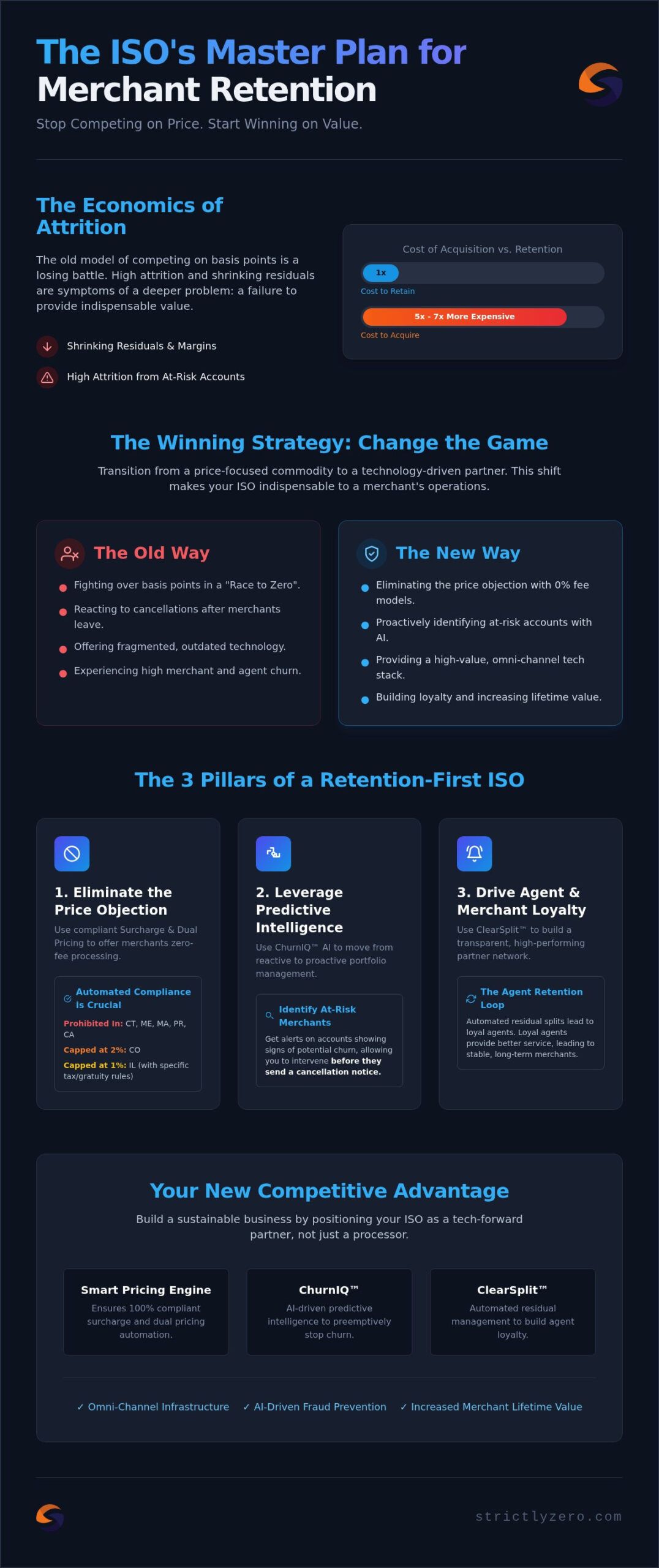
Acquisition is expensive. Industry data suggests it’s five to seven times cheaper to keep a customer than to find a new one. If a merchant leaves, you don’t just lose their monthly volume. You lose the long-term residual value that dictates your ISO’s valuation. High churn also signals instability to sponsoring banks, which can lead to tighter oversight or less favorable terms. Protecting your existing book is the most direct path to scaling your organization without burning through capital.
Why Merchants Switch: Beyond the Basis Points
Most ISOs think merchants leave for lower rates. In reality, technical debt is the silent killer. If your platform can’t handle omni-channel processing, including mobile and online invoicing, merchants will find a processor that can. They need a unified experience, not a fragmented mess of different systems. Additionally, the first 90 days of boarding are a high-risk period. If support is non-existent during this window, the merchant will start looking for the exit before their first statement even arrives. Effective merchant retention strategies for ISOs prioritize tech integration and early-stage support over simple rate cuts.
Eliminating the Price Objection with Surcharge and Dual Pricing
The “Race to Zero” doesn’t have to end in zero profit for your organization; it should end in zero fees for your merchant. By offering zero fee credit card processing, you flip the script on competitors. Instead of arguing over basis points, you’re providing a solution that effectively pays for itself. This is one of the most powerful merchant retention strategies for ISOs because it makes your service a permanent fixture in their business model. When the cost of acceptance disappears, the reason to shop for a new processor disappears with it.
Compliance is the cornerstone of this strategy in 2026. As of September, surcharging is prohibited in Connecticut, Maine, Massachusetts, and Puerto Rico. California’s ban, which took effect in July 2024, remains a critical factor for West Coast portfolios. Other states have specific caps, such as Colorado at 2% and Illinois at 1%. Additionally, Illinois now prohibits charging interchange on tax and gratuity under specific conditions. Strictly’s Smart Pricing Engine automates these state-by-state nuances, ensuring your merchants remain compliant without manual oversight. You can see how our surcharge engine handles these regulations to keep your portfolio protected.
Surcharging as a Loyalty Driver
When a merchant stops seeing processing as a painful expense and starts seeing it as a utility, their loyalty shifts. Merchants who pay $0 in fees are significantly less likely to switch because the primary driver for attrition—price—has been removed. The psychological shift is profound. Processing becomes like electricity; as long as it’s running and costs nothing, there’s no reason to look elsewhere. To handle the “Customer Experience” objection, provide clear signage and explain that surcharging allows the merchant to keep their prices stable for everyone rather than raising them to cover card fees.
Dual Pricing: The Flexible Alternative
Dual pricing shows two distinct prices at the point of sale: one for cash and one for card. It’s often considered more future-proof than surcharging because it avoids the “fee” label that triggers specific regulations in certain states. This model is particularly effective in retail environments where price transparency at the terminal is vital. Professional services, such as law firms or accounting practices, often prefer surcharging on virtual terminals or invoices. Offering both options allows you to tailor your merchant retention strategies for ISOs to the specific needs of each vertical in your portfolio.
Leveraging AI and Predictive Intelligence: The ChurnIQ™ Advantage
Waiting for a merchant to call and cancel is a strategy for the past. By the time they reach out, they’ve usually already signed a contract with a competitor. Modern merchant retention strategies for ISOs rely on staying two steps ahead through predictive intelligence. This is where ChurnIQ™ serves as the essential intelligence layer for your portfolio. It doesn’t just collect data; it interprets merchant behavior to find patterns that humans often miss.
Machine learning models identify specific “Red Flag” behaviors that correlate with attrition. Sudden drops in transaction volume, a spike in support tickets, or even a lack of portal activity can signal a merchant is looking elsewhere. ChurnIQ™ leverages machine learning to predict potential merchant departures up to 30 days before a cancellation request is ever filed. This window gives your team the critical time needed to intervene and save the account.
Automating the Intervention Workflow
Manual follow-ups are too slow for the 2026 payment environment. You need a system that triggers automated workflows the moment a red flag appears. When AI detects a high-risk score, it can automatically send a “Check-in” email or alert an agent to make a personal call. Integrating this intelligence with your CRM ensures that every touchpoint is informed by data. Sentiment analysis in support interactions can also flag frustrated merchants who haven’t voiced their intent to leave yet, allowing you to resolve issues before they escalate.
Data-Driven Portfolio Optimization
Intelligence isn’t just for saving accounts; it’s for building a better portfolio from the start. You can use ChurnIQ™ data to identify which merchant segments are most profitable and least likely to churn. This allows you to spot “Poaching Patterns” from specific regional competitors who might be targeting your base with aggressive short-term offers. By understanding these trends, you can refine your ecommerce payment processing marketing to attract high-quality leads that fit your long-term growth profile. When your top-of-funnel strategy is informed by retention data, your entire ISO becomes more resilient.
Operational Excellence: ClearSplit™ and the Agent Retention Loop
Your merchants don’t just have a relationship with your brand; they have a relationship with your agents. If your top-performing partners feel neglected or face opaque residual reporting, they’ll take their entire book of business to a competitor. Effective merchant retention strategies for ISOs must therefore prioritize agent retention. By providing partners with real-time visibility into their earnings, you eliminate the friction that leads to agent churn. When your agents are happy and well-informed, your merchant portfolio remains stable.
ClearSplit™ serves as the foundation for this transparency by automating residual reporting and owner split calculations. In a competitive 2026 landscape, agents won’t tolerate waiting weeks for manual spreadsheets or error-prone calculations. They need immediate access to performance data. When agents can see exactly what they’ve earned without waiting for monthly statements, trust becomes a built-in feature of your partnership. This level of operational excellence requires a unified payment processing platform for ISOs that handles the complexities of 2026 finance in the background. It’s about making it impossible for an agent to imagine a more reliable partner than your organization.
Frictionless Boarding and Onboarding
The first 48 hours of a merchant relationship often determine the next 48 months of loyalty. If the boarding process is bogged down by manual paperwork or slow underwriting, you’re already losing. Using API-first infrastructure to automate “Know Your Customer” (KYC) and underwriting allows for near-instant approvals. Reducing the “Time to First Transaction” is a critical retention metric that you should track closely. The faster a merchant sees money flowing through their system, the more confident they feel in their choice. You can streamline your partner operations today with Strictly’s automated management tools.
Building a “Sticky” Tech Stack
Processing is just the entry point to a merchant relationship. To build a sticky partnership, you must integrate value-added services that solve daily business problems. Features like virtual terminals, payment links, and recurring billing turn your ISO from a vendor into a consultant. This is especially true for credit card processing for small business, where owners need omni-channel support to compete with larger retailers. When your merchants rely on your tech stack for their invoicing and lending needs, switching processors becomes an operational nightmare they’d rather avoid. You’re no longer just moving money; you’re providing the infrastructure they need to grow. Positioning yourself as a business consultant who offers POS lending and AI-driven fraud prevention makes you indispensable.
Scaling Your ISO with a Retention-First Partner
Scaling a portfolio in 2026 requires more than a high-volume sales team; it requires a foundation that prevents the back-door drain of attrition. When you choose a partner, you aren’t just looking for a gateway. You’re looking for an ecosystem that treats your merchants as long-term assets. Strictly is built specifically for this type of growth, moving away from the predatory models of the past toward a “Trust as a Payment Processor” philosophy. This means we don’t compete with our partners; we provide the enterprise-level tools you need to remain the primary point of contact for your merchants.
Portfolio stability is also deeply tied to security. AI-driven fraud prevention is no longer a luxury for large banks; it’s a necessity for any ISO that wants to protect its residuals. By integrating advanced fraud detection at the transaction level, you reduce the chargebacks and disputes that often lead to merchant frustration and account closures. These merchant retention strategies for ISOs ensure that your portfolio remains healthy and profitable, allowing you to focus on expansion rather than constant damage control.
The Strictly Partner Ecosystem
Our platform gives you immediate access to specialized tools that were once reserved for the industry’s largest players. The Smart Pricing Engine handles the heavy lifting of state-by-state surcharge compliance, while ChurnIQ™ provides the predictive intelligence needed to spot at-risk accounts. Because we are an API-first platform, your developers can build custom integrations that make your offering unique in a crowded market. Whether you’re an ISO, an MSP, or a software developer, you receive dedicated support designed to help you navigate the complexities of 2026 payment regulations. This collaborative approach turns your processing service into a comprehensive business management solution.
Next Steps: From Defense to Offense
Transitioning your existing portfolio to a zero-fee model is the most effective way to move from a defensive posture to an offensive growth strategy. When you remove the cost of processing, you remove the merchant’s primary reason to listen to a competitor’s pitch. We invite you to request a demo of the ChurnIQ™ and ClearSplit™ dashboards to see how real-time data can transform your operations. Stop reacting to cancellations and start predicting them while providing your agents with the transparency they deserve. You can partner with Strictly to scale your payments business today and build a portfolio that is truly future-proof.
Future-Proofing Your Portfolio for 2026 and Beyond
Competitive survival in the payments industry has moved from a price-sensitive game to an intelligence-driven ecosystem. Success in 2026 requires moving beyond defensive rate-matching to a proactive model that prioritizes merchant and agent loyalty. By implementing advanced merchant retention strategies for ISOs, you can transform your organization from a simple vendor into an indispensable business consultant. This transformation relies on removing the price objection entirely through compliant zero-fee processing and using data to anticipate churn before it happens.
Leveraging tools like ChurnIQ™ Predictive Intelligence and ClearSplit™ Automated Residuals allows you to focus on growth while the technology handles the complexities of compliance and reporting. You don’t have to wait for a cancellation notice to know your portfolio is at risk; you can act with precision and confidence. It’s time to build a sticky infrastructure that attracts high-quality merchants and keeps your top agents motivated. Take the first step toward a more resilient business and partner with Strictly to scale your ISO business. The future of payments is here, and your growth starts with a retention-first mindset.
Frequently Asked Questions
What is the most effective merchant retention strategy for ISOs in 2026?
The most effective strategy involves removing the primary reason for attrition: the cost of processing. By implementing zero-fee models through surcharge and dual pricing, you eliminate the price objection entirely. This shifts your role from a commodity vendor to a strategic partner. When combined with predictive AI tools, these merchant retention strategies for ISOs create a high-value ecosystem that makes switching to a competitor an operational and financial disadvantage for the merchant.
How does ChurnIQ™ help ISOs identify at-risk merchants?
ChurnIQ™ uses machine learning to analyze patterns like volume drops, portal inactivity, and support ticket spikes. It provides an intelligence layer that predicts potential churn up to 30 days before a merchant files a cancellation request. This proactive window allows your team to intervene with personalized support or specialized offers. Instead of reacting to lost accounts, you can address frustrations early and maintain a stable, predictable portfolio of residuals.
Can a surcharge program actually improve merchant loyalty?
Yes, a surcharge program improves loyalty by removing the financial burden of credit card acceptance. Merchants who reach $0 in processing fees are significantly less likely to shop for new providers because they’ve already achieved the lowest possible cost. Once processing becomes a utility that pays for itself, the incentive to switch for a fraction of a percent disappears. It builds trust by helping the merchant protect their own margins in a competitive market.
What is ClearSplit™ and how does it help with partner retention?
ClearSplit™ is an automated residual management tool that provides real-time commission visibility to your agents and partners. Agent retention is a critical part of merchant retention since merchants often follow their agents to new organizations. By providing transparent, error-free reporting and automated splits, you build a foundation of trust with your sales team. When partners feel confident in their compensation and have instant access to earnings data, they are less likely to leave.
Why is omni-channel processing important for merchant retention?
Omni-channel processing is vital because it creates a sticky tech stack that merchants rely on for daily operations. If you only handle in-person payments, your merchant might look elsewhere for e-commerce or mobile invoicing solutions. Providing a unified platform that handles online, in-person, and mobile transactions makes your ISO an essential part of their business infrastructure. This integration reduces technical debt and makes the prospect of switching processors much more disruptive.
How often should an ISO review its portfolio for churn risks?
ISOs should monitor their portfolios in real-time rather than waiting for monthly or quarterly reviews. In the 2026 landscape, merchant sentiment can shift rapidly due to aggressive competitor poaching or technical issues. Using automated intelligence platforms allows you to receive daily alerts on red-flag behaviors. Continuous monitoring ensures that your merchant retention strategies for ISOs are always active, allowing for immediate intervention the moment a high-risk pattern is detected by the system.
Is dual pricing better than surcharging for merchant retention?
Neither is universally better, but they serve different strategic needs. Surcharging is effective for professional services and B2B, but it faces stricter regulations in states like Connecticut and Massachusetts. Dual pricing is often more future-proof because it avoids the fee label by showing two distinct prices at the terminal. Offering both options ensures you can provide a compliant, zero-fee solution regardless of the merchant’s vertical or geographic location, maximizing your overall retention rates.
How does automated boarding impact merchant churn rates?
Automated boarding significantly lowers churn by reducing the time to first transaction. The first 48 hours are critical for building merchant confidence. If the onboarding process is slow or manual, the merchant may regret their decision and look back at other offers. Using APIs for instant KYC and underwriting ensures a frictionless experience. A fast, professional start sets the tone for a long-term relationship and prevents early-stage attrition before it starts.