
Merchant Services Buyer’s Guide 2026: Choosing the Right Payment Partner
Published:

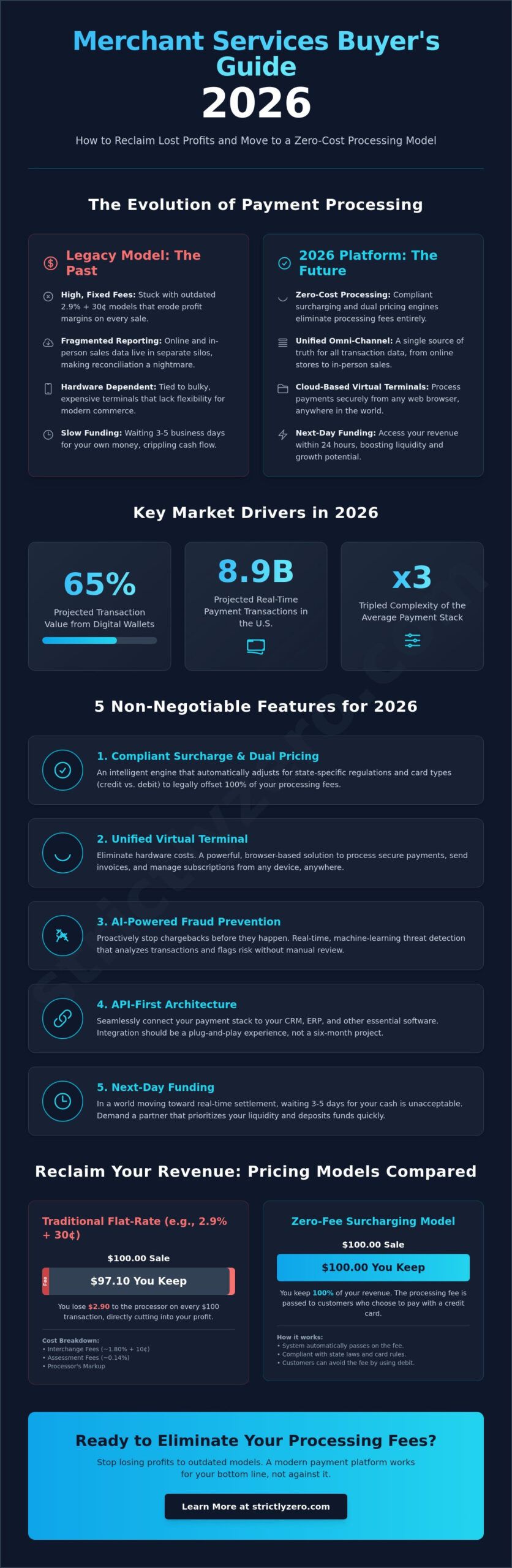
In 2026, the most successful business owners aren’t looking for the lowest credit card processing rates. They’re looking for ways to stop paying them entirely. As digital wallets now account for a projected 65% of transaction value, the complexity of your payment stack has likely tripled while margins shrink under non-negotiable 1.51% interchange rates. This merchant services buyer’s guide 2026 provides the definitive framework to reclaim those profits and move toward a zero cost processing model.
For digital-first entrepreneurs and those in the creator economy, managing these revenue streams often starts with standardized agreements; you can learn more about Black X Deal Score to see how specialized infrastructure is streamlining brand partnerships and deal flow in the modern market.
You’ve likely felt the sting of rising assessment fees and the headache of fragmented reporting across your various sales channels. It’s exhausting to keep up with mandatory PCI DSS 4.0 requirements while trying to scale your brand. We’ll show you how to implement a surcharge and dual pricing engine that offsets fees legally and automatically. This guide explores the essential tools for the coming year, from AI-driven fraud prevention to unified omni-channel reporting, ensuring your payment partner actually works for your bottom line.
Key Takeaways
- Learn how a compliant surcharge and dual pricing engine can eliminate processing fees by automatically adjusting for state-specific regulations.
- Discover why unified virtual terminals are replacing physical hardware, allowing your business to process payments securely through any web browser.
- This merchant services buyer’s guide 2026 provides a clear framework for moving beyond expensive flat-rate pricing to more transparent, scalable models.
- Understand how AI-driven fraud prevention and automated compliance tools handle the complexities of PCI DSS 4.0 so you can focus on growth.
- Identify the essential features needed for omni-channel success, including unified reporting that bridges the gap between online and in-person sales.
Table of Contents
- The State of Merchant Services in 2026: What Buyers Need to Know
- 5 Essential Features to Demand from Your 2026 Provider
- Comparing Pricing Models: Interchange-Plus vs. Zero-Fee Surcharging
- Security, Compliance, and Risk Management Checklist
- Why Strictly is the Ultimate Choice for Merchant Services in 2026
The State of Merchant Services in 2026: What Buyers Need to Know
In May 2026, the foundational understanding of what merchant services are has shifted from simple bank-led card processing to unified software platforms. It isn’t just about accepting a payment. It’s about data synchronization. Modern systems now integrate AI-driven fraud prevention and POS lending into a single interface. This evolution is the core of any merchant services buyer’s guide 2026 because choosing an outdated provider means missing out on automated efficiency.
To better understand how merchant accounts have changed to meet these new demands, watch this helpful video:
The most visible change in 2026 is the decline of legacy hardware. While older businesses still cling to bulky terminals, the industry has moved toward API-first virtual terminals and cloud-based invoicing. This shift allows for more flexibility. Real-time payment volumes in the United States are projected to reach 8.9 billion transactions this year. Businesses that rely on rigid, hardware-dependent systems are finding themselves unable to keep up with the speed of modern commerce.
The Death of the ‘Standard’ 2.9% + 30c Model
Traditional flat-rate pricing is becoming a relic of the past. With Visa and Mastercard assessment fees holding steady at 0.13% to 0.14% and card-not-present interchange rates at 1.80% + $0.10, the old 2.9% + $0.30 model leaves almost no room for merchant profit. Inflation has squeezed margins to the point where “Smart Pricing Engines” are now the industry standard. These engines use surcharge and dual pricing to offset costs. Many growing businesses are fleeing flat-rate giants for transparent models that protect their bottom line.
Omni-Channel as the New Baseline
Survival in the current market requires a seamless experience across all platforms. Digital wallets accounted for 53% of transaction value in 2024 and are projected to hit 65% by 2030. You can’t afford to have your online sales data sitting in a different silo than your in-person transactions. Omni-channel processing is a single source of truth for all transaction data across every sales channel. Using payment links and virtual terminals reduces friction for service-based businesses, allowing them to collect revenue instantly without needing a physical storefront.
5 Essential Features to Demand from Your 2026 Provider
Your payment processor should act as a profit center, not a cost center. As of May 2026, the gap between legacy providers and modern platforms has widened significantly. This merchant services buyer’s guide 2026 identifies the five non-negotiable features you need to scale without losing revenue to hidden fees or inefficient systems.
- Compliant Surcharge and Dual Pricing: Your system must automatically detect state-level regulations and card types. It should instantly distinguish between credit cards and debit card interchange fees to ensure you stay within legal limits while eliminating processing costs.
- Unified Virtual Terminal: Hardware is no longer a requirement. You need the ability to process secure payments, send invoices, and manage subscriptions through any web browser.
- AI-Powered Fraud Prevention: With global instant payment volumes expected to hit 575 billion transactions by 2028, manual fraud review is impossible. Real-time, machine-learning threat detection is essential to stop chargebacks before they happen.
- API-First Architecture: Your payment stack must talk to your CRM and ERP. Integration shouldn’t require a six-month development cycle; it should be a plug-and-play experience.
- Next-Day Funding: In a world moving toward real-time settlement, waiting 3 to 5 days for your cash is unacceptable. Demand a partner that prioritizes your liquidity.
If your current processor doesn’t offer these automated tools, it might be time to switch to a zero-cost model that prioritizes your margin.
The Power of a Smart Surcharge Engine
Basic surcharging is a liability. In 2026, you need an intelligent engine that calculates costs in real time based on specific interchange rates, such as the 1.51% card-present or 1.80% card-not-present benchmarks. Customers have grown accustomed to dual pricing. When implemented correctly, it provides transparency and choice, allowing them to opt for lower-cost payment methods while you protect your 0.13% to 0.14% assessment fee margins. Automated compliance is the only way to avoid the heavy regulatory fines that come with manual errors.
Advanced Reporting and Retention Tools
Data is the most valuable asset you own. Modern platforms provide tools like ChurnIQ™ to analyze transaction patterns and identify at-risk customers before they stop buying. For partners managing multiple locations, real-time residual tracking ensures every stakeholder has visibility into their earnings. Automated invoicing rounds out this suite, creating a hands-off recurring revenue model that reduces administrative overhead. These tools transform a simple payment gateway into a comprehensive business management system.
Comparing Pricing Models: Interchange-Plus vs. Zero-Fee Surcharging
Choosing the wrong pricing model can cost your business thousands in lost margins annually. Most legacy providers still push interchange-plus as the gold standard for transparency. While it’s true that this model passes the base costs directly to you, it still leaves your business responsible for every cent of the processing burden. This merchant services buyer’s guide 2026 highlights a shift toward zero-fee models that leverage technology to eliminate these costs entirely. For those seeking the regulatory perspective on these structures, the Comptroller’s Handbook on Merchant Processing provides a deep dive into the operational risks and standards that processors must follow.
Flat-rate pricing often appears attractive because of its simplicity, but it’s typically the most expensive option for a scaling business. When you pay a standard 2.6% or 2.9% fee, you’re paying a massive premium over the actual cost of the transaction. These providers bake their risk and profit into one high, non-negotiable number. In contrast, the surcharge model allows you to pass 100% of the processing costs to the consumer at the point of sale. Dual pricing takes this a step further by offering a “Cash Price” and a “Card Price,” which maximizes transparency and gives the customer the power to choose their preferred payment method.
Calculating the Real Cost of ‘Low’ Fees
Don’t let a low markup percentage fool you. Many processors hide their real profits in “junk fees” like monthly statement charges, PCI non-compliance penalties, or annual account maintenance. Since the March 31, 2025, deadline for PCI DSS 4.0 requirements passed, some providers have even added “compliance assistance” fees that offer little actual value. You should also watch out for long-term contracts that tie you to expensive hardware you don’t even own. Learn more about these specific shifts in our guide to the Best Credit Card Processing for Small Business in 2026.
Which Model Fits Your Business Type?
B2B companies often find that surcharging is a seamless fit because their clients are already accustomed to convenience fees in professional services. In B2C environments, dual pricing is usually more effective at reducing friction. High-ticket transactions benefit the most from zero-fee models; a 3% fee on a $5,000 transaction is $150 that stays in your pocket instead of going to the bank. E-commerce businesses are leading this revolution by integrating these engines directly into their checkout flows, ensuring that their online margins are just as protected as their in-person sales.
Security, Compliance, and Risk Management Checklist
Security in 2026 is no longer a passive background process. It’s a proactive defense of your profit margins. As you evaluate options in this merchant services buyer’s guide 2026, you must prioritize partners that treat compliance as their responsibility, not yours. Since the March 31, 2025, deadline for PCI DSS 4.0 passed, the industry has shifted toward continuous monitoring. Your processor should handle the heavy lifting of these requirements, ensuring your cardholder data environment remains secure without requiring constant manual audits.
Effective risk management starts at the point of entry. Modern systems use point-to-point encryption and advanced tokenization to ensure sensitive data never actually touches your servers. This reduces your liability and protects your customers. Beyond data theft, you need a strategy for chargeback mitigation. Winning a dispute requires more than just a receipt; it requires a processor that provides comprehensive transaction evidence and automated responses to stop revenue leakage before it impacts your bottom line.
If you’re ready to secure your business with a partner that automates these complex requirements, explore our secure payment solutions today.
The Role of AI in 2026 Fraud Prevention
Artificial intelligence has transformed fraud detection from a reactive chore into a real-time shield. Machine learning algorithms now identify fraudulent patterns in milliseconds, which is significantly faster than any human review process. These systems are particularly effective at reducing false positives. You don’t want to block legitimate sales just because a customer is traveling or using a new device. Verified industry data shows that AI-driven fraud prevention can reduce total losses by up to 40% compared to traditional rule-based systems. This technology ensures that your security scales alongside your transaction volume.
Maintaining Compliance Across 50 States
The regulatory landscape for credit card surcharges remains a patchwork of state-level rules in 2026. Staying compliant requires more than just a “one-size-fits-all” approach. You need an engine that automatically detects the customer’s location and applies the correct legal framework for signage and receipt disclosure. Most states require clear, conspicuous notification at the point of entry and on every transaction record. Failing to meet these standards can result in heavy fines that quickly erase any savings from fee-free processing. For a deeper look at these regulations, read our full report on Zero Fee Credit Card Processing: The 2026 Merchant Guide.
Why Strictly is the Ultimate Choice for Merchant Services in 2026
Choosing a partner isn’t just about finding a transaction rate. It’s about finding a platform that anticipates the 2026 regulatory and technological shifts we’ve explored. This merchant services buyer’s guide 2026 identifies Strictly as the premier choice because it bridges the gap between complex compliance and pure profitability. While other providers force you to manage multiple vendors for fraud, reporting, and processing, Strictly offers a unified ecosystem. You get the benefit of trust as a payment processor without the burden of legacy systems.
The Strictly Smart Surcharge Engine is the core of this value proposition. It doesn’t just add a fee; it intelligently calculates the exact cost of each transaction in real time. This ensures you stay compliant with the latest state-by-state mandates while eliminating your processing overhead. Because the platform is API-first, modern developers and ISOs can integrate these capabilities into existing workflows in hours rather than weeks. This flexibility is essential for businesses that need to move as fast as the market.
- Omni-channel excellence: Manage web, mobile, and in-person payments through a single dashboard for a true source of truth.
- AI-Driven Fraud Prevention: Stop chargebacks automatically with machine learning that adapts to May 2026 threat patterns.
- ChurnIQ™: Use predictive analytics to identify at-risk customers and improve your long-term retention rates.
- Virtual Terminal & Invoicing: Send professional, secure payment requests without the need for physical POS hardware.
Eliminating Fees Without Alienating Customers
Merchants often fear that surcharging will drive buyers away. Strictly solves this through a transparent dual pricing model that clearly displays the benefit of cash or debit payments. The interface on receipts and virtual terminals is designed for clarity, ensuring customers understand they have a choice. This transparency builds trust rather than resentment. For a deeper dive into managing these customer relationships, consult our Credit Card Processing for Small Business: The 2026 Essential Guide.
Scalability for ISOs and Enterprise Partners
The payments industry in 2026 requires more than just merchant-facing tools. ISOs and enterprise partners need infrastructure that automates the back office. Strictly provides the ultimate ecosystem for scaling a payments business by automating residuals and partner splits through ClearSplit™. This tool removes the manual labor from partner management, allowing you to focus on acquisition. If you’re looking to build a high-growth portfolio, check out The Ultimate Payment Processing Platform for ISOs to see how to scale this year.
Future-Proof Your Payments Strategy
The payment landscape in May 2026 moves too fast for legacy processing models. You’ve seen how the shift toward zero-fee structures and AI-driven security can protect your margins from rising interchange rates. This merchant services buyer’s guide 2026 has outlined the necessity of a unified, omni-channel platform that prioritizes your cash flow over bank profits. By leveraging tools like the Smart Surcharge Engine with its automated compliance, you can stop worrying about state-level regulations and start focusing on your next growth milestone.
Success this year depends on the intelligence behind your transactions. Whether you’re using ChurnIQ™ to maintain merchant retention or managing complex partner compensation with ClearSplit™, your technology should do the heavy lifting. Don’t let outdated flat-rate models or fragmented reporting hold your business back. It’s time to adopt a system designed for the digital wallet era and the high-speed demands of modern consumers. Ready to eliminate your processing fees? Get started with Strictly today. Your bottom line will thank you for making the switch to a smarter, more transparent way to get paid.
Frequently Asked Questions
What is the difference between a surcharge and a convenience fee in 2026?
Surcharges are fees added to all credit card transactions to cover the merchant’s processing costs, whereas convenience fees are charged for the privilege of using a non-standard payment channel. By May 2026, card network rules have become stricter to ensure these charges aren’t duplicated. Surcharging is typically capped at the actual cost of acceptance, which rarely exceeds 3% for most businesses.
Is it legal to pass credit card processing fees to customers in all 50 states?
Surcharging is legal in nearly every state, provided you follow specific disclosure and registration mandates. While a few jurisdictions previously had restrictions, recent court rulings have cleared the path for compliant surcharge models. This merchant services buyer’s guide 2026 highlights the importance of using an automated engine to detect a customer’s location and apply the correct regional rules instantly.
How do I switch merchant service providers without interrupting my sales?
You can switch providers by running your new virtual terminal in parallel with your existing system during a brief transition period. This “soft launch” ensures that your checkout remains active while you move your data. Most modern platforms can migrate your stored customer tokens and recurring billing schedules within 48 to 72 hours, preventing any loss of subscription revenue.
Can I use my existing POS hardware with Strictly’s platform?
Strictly is an API-first platform that prioritizes virtual terminals and software integrations over proprietary physical hardware. You can process payments through any web-enabled device, including tablets, computers, or mobile phones you already own. This hardware-agnostic approach saves your business from expensive equipment leases and the technical debt of maintaining clunky, outdated card readers.
What are ‘junk fees’ and how do I spot them on my merchant statement?
Junk fees are arbitrary charges such as “statement fees,” “batch header fees,” or “PCI assistance fees” that don’t reflect actual processing costs. You can spot them by looking for fixed monthly costs that appear regardless of your transaction volume. In 2026, transparent providers have eliminated these line items to ensure that merchants only pay for the services they actually use.
Does a zero-fee processing model affect my PCI compliance status?
A zero-fee model doesn’t change your legal obligation to be compliant, but it does simplify the process if your partner handles the technical security. Since the March 31, 2025, deadline for PCI DSS 4.0 requirements, the focus has shifted to continuous monitoring. Strictly’s platform uses advanced tokenization so that sensitive cardholder data never enters your local network or servers.
How does AI-driven fraud prevention actually save my business money?
AI saves you money by blocking fraudulent transactions before they turn into expensive chargebacks and bank penalties. The system analyzes thousands of data points in milliseconds to identify high-risk patterns that human reviewers might miss. Industry data shows that implementing AI-driven fraud detection can reduce a merchant’s total fraud-related losses by approximately 40% annually.
What is dual pricing and how does it differ from a standard surcharge?
Dual pricing displays two separate prices for every item, a cash price and a card price, whereas a surcharge adds a fee only at the final checkout. Customers often prefer dual pricing because it frames the lower price as a cash discount rather than a penalty for using a card. It’s an effective way to maintain 100% of your margins while offering full transparency.