
Mobile Credit Card Processing for Field Services: The 2026 Guide to Zero-Fee Payments
Published:

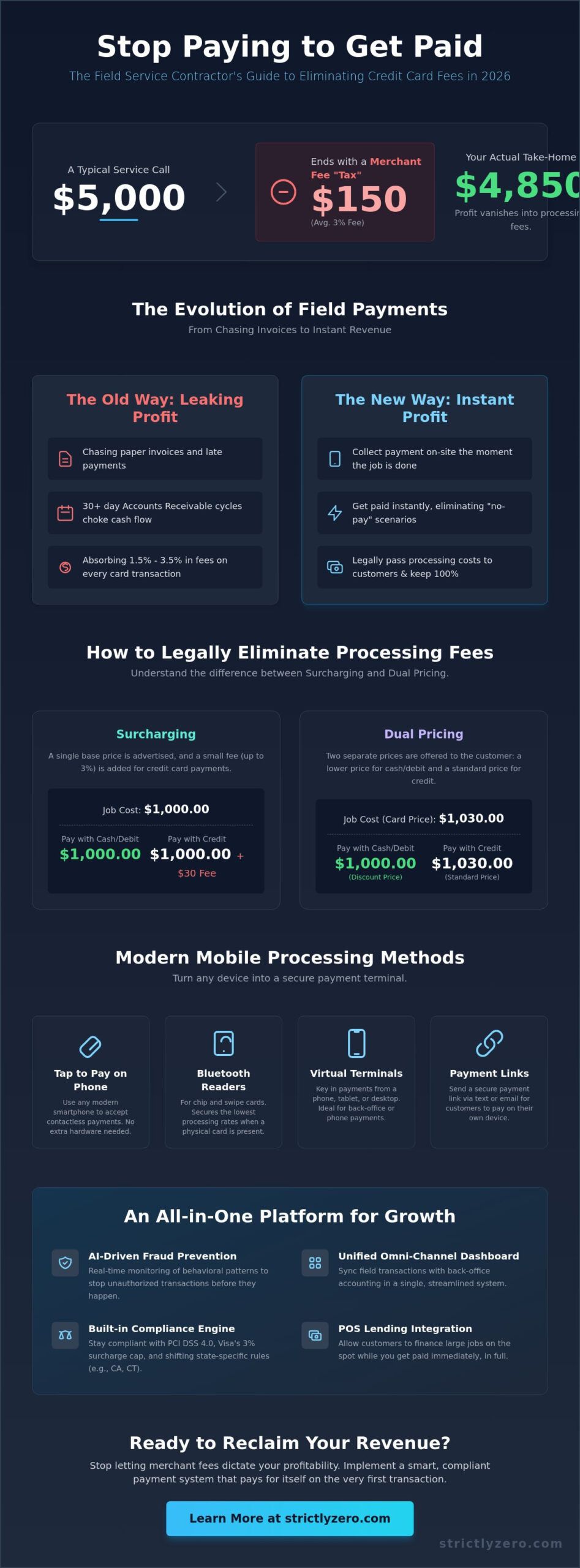
What if every $5,000 service call didn’t automatically end with a $150 “tax” paid to a credit card company? For many contractors, those merchant fees are the difference between a profitable month and just breaking even. You’ve likely spent years accepting these costs as a necessary evil or, worse, spent your weekends chasing unpaid paper invoices. Modern mobile credit card processing for field services has evolved past simple card readers. It’s now about leveraging smart technology to recover overhead instantly and securely.
We understand the frustration of watching hard-earned revenue vanish into processing fees while trying to stay on the right side of shifting state laws. This guide promises to show you how to eliminate those overhead costs using compliant surcharge and dual pricing engines. You’ll learn how to get paid the moment a job is finished, sync those transactions with your back-office accounting, and use AI-driven fraud prevention to protect your bottom line. We will break down the 2026 regulatory landscape, from Visa’s 3% surcharge cap to the specific rules in states like California and Connecticut, so you can stop losing money and start scaling your business.
Key Takeaways
- Learn how modern mobile credit card processing for field services eliminates the delay of paper invoices by enabling instant, on-site payment collection.
- Understand the technical difference between surcharging and dual pricing to legally pass processing costs to customers and protect your margins.
- Discover how to stay compliant with state-specific regulations and PCI DSS 4.0 standards using software-based virtual terminals.
- Streamline your operations by unifying field transactions and back-office accounting into a single, omni-channel dashboard.
- Enhance security on every job site with AI-driven fraud prevention that monitors behavioral patterns to stop unauthorized transactions in real-time.
Table of Contents
- The Evolution of Field Service Payments: Beyond Cash and Checks
- Mobile Processing Methods: Readers, Virtual Terminals, and Payment Links
- Eliminating Overheads: Surcharging and Dual Pricing in the Field
- Navigating Compliance and Security for On-Site Transactions
- Strictly: The Omni-Channel Solution for Field Service Merchants and Partners
The Evolution of Field Service Payments: Beyond Cash and Checks
Transitioning to modern payment methods is a foundational step in credit card processing for small business. It allows companies to scale operations without hiring massive back-office teams to chase down late payments. By automating the payment flow and utilizing AI-driven fraud prevention at the job site, owners focus on service quality rather than collections. Modern platforms even integrate POS lending, allowing customers to finance big-ticket repairs while the merchant gets paid immediately.
To better understand how these systems have changed the landscape, watch this helpful video:
Why On-Site Payments Are Non-Negotiable
Collecting at the point of service eliminates the “no-pay” scenario entirely. When a technician is standing in the driveway, the customer’s intent to pay is at its highest point. Integrating a modern Mobile payment strategy ensures that labor-heavy trades, like plumbing or electrical work, have the capital needed for the next day’s materials. Beyond the money, it’s about the customer experience. With digital wallet adoption expected to surpass 5.2 billion users globally by 2026, offering tap-to-pay and instant digital receipts isn’t just convenient; it’s a standard expectation that builds trust.
The Hidden Cost of Convenience
While digital payments solve the speed problem, they often introduce a margin problem. Standard fees typically range from 1.5% to 3.5% per transaction. On a $10,000 roofing job, that’s $350 gone instantly. Many field service owners feel trapped between high-fee flat-rate processors and the risk of losing jobs by asking for cash. This “processing overhead” often prevents businesses from growing because it eats into the profit meant for equipment upgrades or new hires. However, by using a dedicated surcharge and dual pricing engine, merchants can finally offer the convenience of card payments without sacrificing their profit margin to the bank.
Mobile Processing Methods: Readers, Virtual Terminals, and Payment Links
Choosing the right method for mobile credit card processing for field services depends on your operational speed and the specific environment of the job site. While many legacy providers focus strictly on bulky hardware, the 2026 landscape favors software-driven agility. Modern technicians now use Tap to Pay technology on standard smartphones, turning a regular iPhone or Android device into a secure terminal without needing external attachments. This flexibility ensures that a broken or forgotten card reader never stands between your business and a completed transaction.
When a physical card is present, using a Bluetooth reader often secures the lowest processing rates, which typically range from 1.8% to 2.6% plus a small flat fee. However, software-only solutions like virtual terminals allow your team to process payments via tablet or phone without any hardware at all. This is particularly useful for back-office teams or technicians who need to key in a payment when a physical card is not available. Regardless of the method, maintaining Payment Card Data Security Standards (PCI DSS) is mandatory under the v4.0 requirements that took full effect in 2025. These standards emphasize continuous monitoring to ensure that cardholder data remains encrypted throughout the entire mobile transaction lifecycle.
Hardware vs. Software-Only Solutions
Physical card readers are excellent for high-volume days where speed is a priority, but they are no longer the only way to get paid. Tap to Pay on mobile devices has matured into a reliable standard, allowing customers to pay with digital wallets or contactless cards directly against a technician’s phone. For remote job sites with spotty cellular service, it is vital to check if your software supports offline processing modes. These tools store encrypted transaction data and upload it once a connection is restored, preventing work stoppages in rural areas. If you want to simplify your tech stack, you can explore our omni-channel payment dashboard to manage every field transaction in one place.
The Power of Text-to-Pay for Field Service
Payment links have become a game changer for field service deposits and change orders. Instead of waiting for a customer to find their wallet, you can send a secure SMS link directly to their phone. This method of using payment links as part of an omni-channel strategy reduces friction and keeps your technicians moving to the next job. It also shifts the data entry to the customer. When a customer enters their own payment details on their own device, it enhances security and reduces your team’s liability for handling sensitive information. This shift to customer-entered data is a key trend in 2026, as it aligns with the move toward “invisible” and embedded payments that make the checkout process feel seamless.
Eliminating Overheads: Surcharging and Dual Pricing in the Field
Many contractors spend hours researching the best mobile credit card readers to simplify their workflow, but hardware is only half the battle. The true hurdle is the 3% to 4% margin loss that accompanies every digital transaction. In 2026, the most successful trades are moving toward a zero fee credit card processing model. This strategy isn’t about hidden fees; it’s about using a surcharge and dual pricing engine to recover the cost of credit card acceptance at the point of sale. When you’re managing a service van, every dollar of overhead recovered is a dollar that goes back into your fuel, equipment, or payroll.
Effective mobile credit card processing for field services relies on a smart pricing engine that works behind the scenes. This technology is critical because card brand rules are strict. For instance, Visa caps surcharges at 3%, while Mastercard allows up to 4%. More importantly, you cannot legally surcharge a debit card. A smart engine automatically detects the card type in milliseconds. If it’s a credit card, the surcharge is applied. If it’s a debit card, the system bypasses the fee to keep you compliant with the Durbin Amendment and card brand regulations.
The Math Behind the Savings
Consider a $5,000 HVAC installation. With traditional flat-rate processing, you lose roughly $150 to merchant fees before you even leave the driveway. Over the course of twenty similar jobs, that is $3,000 in lost profit. Surcharging covers the cost of the merchant services platform by passing the transaction cost to the customer who chooses the convenience of credit. This allows business owners to reinvest “found money” into high-efficiency tools or better service vehicles without raising their base prices for everyone.
Dual Pricing: The “Amazon” Experience for Field Services
Dual pricing is often the most customer-friendly path, especially in states with restrictive surcharge laws like California, Connecticut, or Massachusetts. Instead of adding a fee at the end, your mobile POS app displays two clear options: a “Credit Price” and a “Cash/Check Discount” price. This transparent approach mirrors the experience customers see at major retailers and gas stations. It gives the customer the power of choice. By presenting the discount as a benefit for cash or check payments, you eliminate the psychological barrier of an added fee while still protecting your business margins on every high-ticket service call.
Navigating Compliance and Security for On-Site Transactions
Compliance is often treated as a “check-the-box” annual task, but for mobile credit card processing for field services, it’s a daily operational requirement. PCI DSS v4.0, which became the mandatory standard on March 31, 2025, requires continuous monitoring and documented proof of security controls. This means field technicians must never handle raw card data or store sensitive numbers on their mobile devices. Using virtual terminals and tap-to-pay technology ensures that data is encrypted at the point of capture, protecting the business from massive data breach liabilities and non-compliance fines.
State regulations add another layer of complexity that can’t be ignored. As of March 2026, you can’t legally surcharge in Connecticut or Massachusetts. In California, SB 478 requires that any mandatory fees be included in the advertised price, which makes a dual pricing model the safest path for technicians working in the Golden State. A “set it and forget it” approach to surcharging is dangerous because card brands like Visa and Mastercard strictly enforce caps of 3% and 4% respectively. If your mobile app doesn’t automatically adjust based on geography or card type, you risk losing your merchant account and facing heavy penalties.
The Smart Pricing Engine Advantage
Our surcharge and dual pricing engine solves this by automating the heavy lifting. It identifies the customer’s card type in real-time to ensure you comply with the Durbin Amendment, which prohibits surcharging on debit cards. The system also detects the technician’s location and adjusts the pricing model to match state-specific laws. This automation protects you from expensive regulatory errors while ensuring that disclosures and signage requirements are handled digitally on the mobile invoice. You can partner with Strictly today to secure your field operations with a fully compliant pricing engine.
Chargeback Protection in the Service Industry
Security isn’t just about data encryption; it’s about defending your revenue from “friendly fraud” and disputes. In the service industry, customers often claim a repair wasn’t completed or was unauthorized. To combat this, modern mobile credit card processing for field services uses AI-driven fraud prevention to analyze behavioral patterns during the transaction, such as how the device is held or how the user interacts with the screen. Beyond AI, technicians should use their mobile devices to capture digital signatures, GPS-stamped check-ins, and “after” photos of the repair. These files attach directly to the mobile invoice within an omni-channel platform, providing undeniable proof of service if a dispute arises. This centralized approach to dispute management turns a potential loss into a defensible win for your back office.
Strictly: The Omni-Channel Solution for Field Service Merchants and Partners
Managing a service fleet involves enough complexity without the added burden of juggling multiple payment providers. Strictly provides a unified omni-channel dashboard that brings field, office, and online payments together into one source of truth. Integrating mobile credit card processing for field services into your existing workflow shouldn’t require a degree in software engineering, and for those planning to expand across territories, you can learn more about multi-location business management. Our platform allows business owners to see every transaction in real-time, whether it was keyed into a virtual terminal at the office or captured via tap-to-pay on a technician’s smartphone, with AI-driven fraud prevention monitoring every job-site payment.
For those looking to support the service industry, Strictly stands out as the premier payment processing platform for ISOs. We provide the tools necessary to scale a portfolio of service-based merchants, including ClearSplit™ for transparent revenue sharing and ChurnIQ™ for advanced merchant retention analytics. Our API-first approach also makes us the ideal partner for Field Service Management (FSM) software developers who want to embed a compliant surcharge and dual pricing engine directly into their own applications. This ensures that your users can recover their overhead without ever leaving your app’s interface.
A Better Experience for Field Technicians
Technicians are hired for their skills with a wrench or a circuit tester, not for their ability to navigate complex financial software. Our mobile interface is designed for speed and simplicity, ensuring that workers in the field can process a payment and move to the next call in seconds. The boarding process is equally streamlined. You can get your entire team taking payments in minutes, with instant reporting that allows owners to track technician performance and daily revenue totals without waiting for end-of-day syncs.
The Future of Zero-Fee Field Services
The industry is moving rapidly toward a model where merchants no longer bear the cost of credit card rewards programs. By 2027, $0 processing fees will likely become the standard for high-ticket service industries as more businesses adopt the surcharge and dual pricing models we’ve pioneered. This shift allows you to scale your service fleet and increase your transaction volume without seeing a proportional increase in your merchant service costs. You’ve worked hard to build your reputation; don’t let processing fees eat the profits you need to sustain it. Contact Strictly to eliminate your field service processing fees today and take full control of your business margins.
Take Control of Your Field Service Margins Today
The days of surrendering a significant portion of your hard-earned invoice to merchant fees are over. By embracing mobile credit card processing for field services, you transition from a reactive billing cycle to a proactive, profit-first operation. You’ve seen how modern technology like tap-to-pay and virtual terminals can replace bulky hardware. You’ve also learned how a proprietary Smart Pricing Engine can navigate the complex web of state-level regulations automatically. Whether you’re an independent contractor or managing a large fleet, the goal remains the same: faster payments and zero processing overhead.
Strictly offers a solution that’s compliant in all 50 states, ensuring you never have to worry about the legal nuances of surcharging or dual pricing. For our partners, tools like ClearSplit™ ensure automated residuals and transparent scaling. It’s time to stop letting fees dictate your growth and start reinvesting that capital back into your equipment and team. Switch to Strictly and keep 100% of your field service revenue today. Your business deserves a payment partner that prioritizes your bottom line as much as you do.
Frequently Asked Questions
Is it legal to surcharge for mobile credit card payments in all states?
No, surcharging is not legal in every state. As of March 2026, Connecticut and Massachusetts maintain strict prohibitions against credit card surcharging. Additionally, California’s SB 478 requires merchants to include all mandatory fees in their advertised prices, which effectively makes dual pricing the more compliant choice for businesses in that state. You should use a platform that automatically detects these geographic boundaries to ensure you stay within the law.
Do I need a special card reader to accept mobile payments in the field?
You don’t necessarily need a physical card reader to take payments on a job site. While Bluetooth readers are common for lower card-present rates, many technicians now use Tap to Pay technology directly on their smartphones to accept contactless cards and digital wallets. Alternatively, you can use a virtual terminal to manually enter card details or send a secure payment link via text to your customer’s phone.
What is the difference between surcharging and dual pricing for service businesses?
Surcharging adds a specific fee to a credit card transaction at the final stage of checkout, whereas dual pricing presents two distinct prices from the beginning. Surcharging is strictly regulated and capped at 3% for Visa and 4% for Mastercard. Dual pricing is often preferred by service businesses because it’s federally protected as a cash discount and is generally permissible in all 50 states, including those that restrict traditional surcharging.
How do I handle payments if there is no internet connection at the job site?
You can manage connectivity issues by using a payment application that supports offline processing modes. These tools capture and encrypt transaction data locally on your mobile device and then upload it for authorization once you return to a cellular or Wi-Fi coverage area. This ensures your mobile credit card processing for field services remains functional even when working in remote rural locations or basement mechanical rooms.
Can I integrate mobile processing with my existing HVAC or plumbing software?
Yes, most modern payment platforms provide API-first integrations that connect directly with popular Field Service Management (FSM) software. This connection allows your on-site payments to sync automatically with your back-office accounting and dispatching tools. You should check if your provider offers an omni-channel dashboard, which lets you manage field transactions and office invoicing from a single, unified interface for better reporting.
How does a smart pricing engine distinguish between a debit and credit card?
A smart pricing engine identifies the card type in real-time by analyzing the Bank Identification Number (BIN) during the first few milliseconds of the transaction. This identification is crucial because federal laws, such as the Durbin Amendment, prohibit surcharging on debit and prepaid cards. The engine automatically applies the surcharge to credit cards while bypassing it for debit cards, keeping your business compliant without manual intervention from your technicians.
What are the PCI compliance requirements for mobile field service payments?
Mobile credit card processing for field services must follow PCI DSS v4.0 standards, which became mandatory in 2025. These rules require that your payment environment uses continuous security monitoring and that cardholder data is never stored in its raw form on a technician’s mobile device. Using encrypted virtual terminals or secure payment links helps ensure that sensitive data is handled safely and that your business avoids costly non-compliance penalties.
How long does it take for field service payments to reach my bank account?
Payment settlement typically takes between one and two business days to reach your bank account after a batch is closed. While some payment processors offer accelerated funding options for an extra fee, most standard transfers follow the traditional ACH schedule. It’s important to verify your processor’s daily cutoff times, as transactions processed after a certain hour may be included in the following day’s business batch.