
New York Surcharge Regulations: The 2026 Merchant Compliance Guide
Published:

Are you unknowingly handing the New York Division of Consumer Protection a reason to fine your business $500 today? If you’re still just posting a sign that says a fee will be added at the register, you’re likely out of compliance. Most business owners find the current New York surcharge regulations confusing, especially the strict requirement to display the full “Total Price” including all fees upfront. It’s exhausting to think about manually updating every price tag just to stay on the right side of the law.
We know you want to stop eating credit card processing fees without the constant fear of a legal audit. You don’t have to choose between your margins and compliance. This guide will show you exactly how to master these complex laws while keeping your business protected. We’ll provide a clear checklist for staying legal and explain how a modern surcharge and dual pricing engine handles the math automatically, so you can focus on growth instead of calculating fees.
Key Takeaways
- Learn why New York General Business Law § 518 requires you to display the full credit card price upfront rather than adding a fee at checkout.
- Understand the mandatory “Total Price” rule to keep your business safe from consumer complaints and costly state penalties.
- Compare the benefits of surcharging versus dual pricing to find the best way to eliminate processing fees legally.
- Identify why you must never surcharge debit or prepaid cards and how to distinguish them at the point of sale.
- Discover how a surcharge and dual pricing engine can automate the complex math required by New York surcharge regulations.
Table of Contents
- Understanding New York Surcharge Regulations in 2026
- The Do’s and Don’ts of NY Surcharge Compliance
- Surcharging vs. Dual Pricing: Which Works for NY?
- Merchant Checklist for NY Compliance Implementation
- Automating NY Compliance with Strictly’s Smart Engine
Understanding New York Surcharge Regulations in 2026
New York General Business Law § 518 underwent a massive transformation on February 11, 2024. This update fundamentally changed how every merchant in the state handles credit card transactions. Before this shift, the legal landscape was a confusing mix of bans and court challenges regarding free speech. Today, the rules are clear. You can pass on your processing costs, but you must do it with absolute transparency. The primary goal of the current New York surcharge regulations is to eliminate the “surprise” factor at the point of sale.
The NYS Division of Consumer Protection actively monitors businesses to ensure they aren’t just slapping a fee on at the end of a transaction. If a customer sees one price on a shelf and a higher price on their receipt, the state considers that a violation. These aren’t just suggestions. The New York Attorney General has made enforcement a priority in 2026, and a single mistake can lead to a civil penalty of up to $500 per violation. For a busy retailer, these fines can quickly wipe out any savings gained from surcharging in the first place.
The “Total Price” Mandate Explained
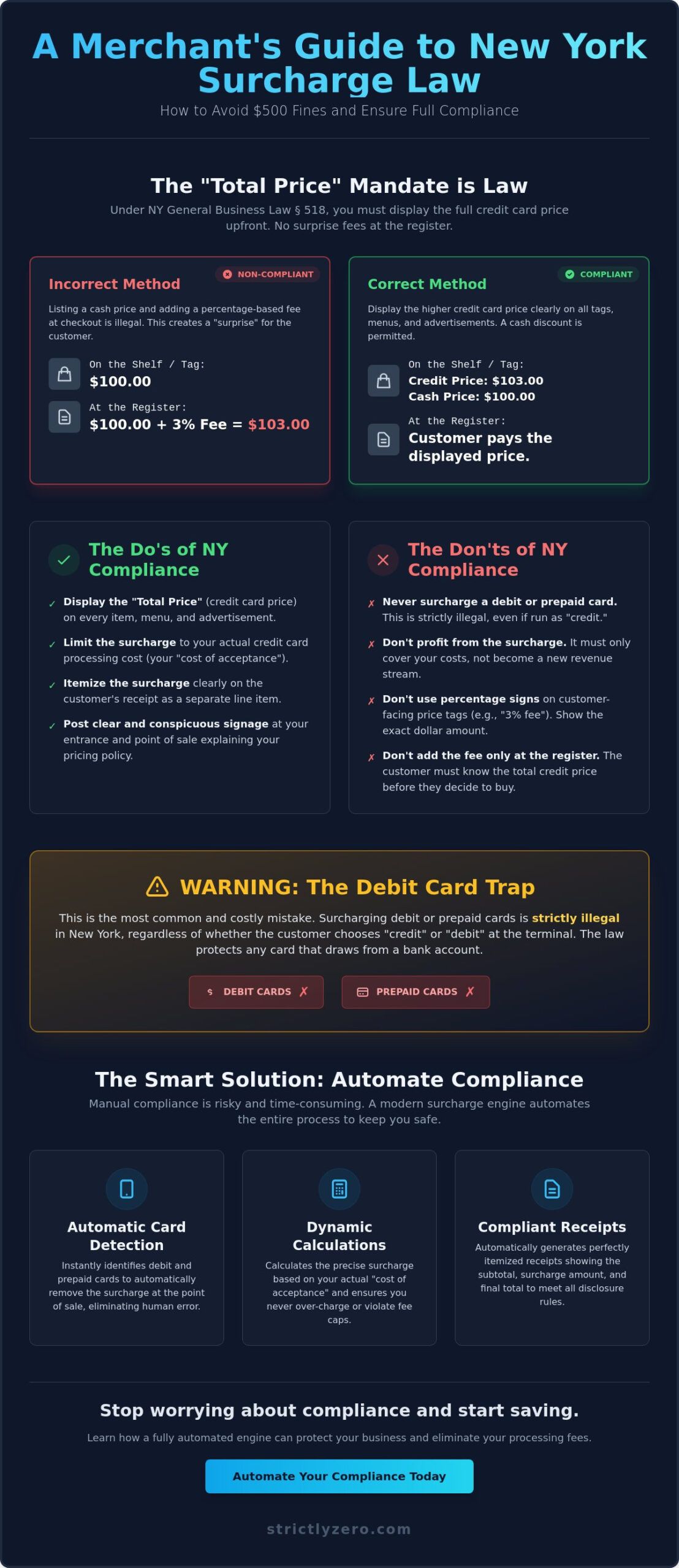
The most critical part of the law is the “Total Price” requirement. You must show the customer the exact dollar amount they’ll pay if they use a credit card. You can’t rely on percentages or math equations. For a deeper look at how these fees work globally, you can check out this Payment Surcharge Overview. This ensures that every shopper knows their final cost before they ever reach the counter.
Imagine you sell a product for a base price of $100. A compliant price tag would list the credit card price as $103.00 and the cash price as $100.00. Alternatively, you could simply list the price as $103.00 and offer a discount for cash. What you cannot do is list the item at $100.00 and place a sign at the register saying “a 3% surcharge applies to credit cards.” This protects consumers from sticker shock. It ensures the price they see while browsing is the highest price they’ll actually pay.
Legal History: From Bans to Transparency
New York used to strictly prohibit credit card surcharges. That changed as the state recognized that businesses need a way to manage rising processing costs. The 2024 legislative update moved the focus from prohibition to disclosure. The state doesn’t care if you charge more for credit; it only cares if you’re honest about it from the start. In 2026, enforcement has expanded to include digital storefronts and mobile invoicing. If your website doesn’t display the total credit card price before the final checkout screen, you’re at risk. Transparency isn’t just a best practice anymore. It’s the law.
The Do’s and Don’ts of NY Surcharge Compliance
Compliance isn’t a one-time setup. It’s a daily commitment to transparency. To stay aligned with New York surcharge regulations, you must treat the surcharge as a pass-through cost, not a source of revenue. The state is incredibly strict about this distinction. If you collect more in surcharges than you pay to your processor, you’re essentially creating a “hidden fee” that the New York Attorney General is eager to penalize. You must also ensure your signage is “clear and conspicuous,” meaning it’s placed exactly where the customer makes their buying decision.
Your receipts need to tell the full story. A compliant receipt should show the subtotal, the specific surcharge amount as a dollar value, and the final total. If you just lump everything into one line item, you’re inviting a consumer complaint. Most merchants find that the easiest way to manage this is through automated software. If you’re looking for a way to streamline this, a surcharge and dual pricing engine can ensure every receipt meets state standards without manual entry errors. This level of detail keeps your business off the radar of the Division of Consumer Protection.
The Debit Card Trap
Surcharging a debit card is the most common mistake New York merchants make. It’s also the most expensive. Under state law, you cannot add a surcharge to any debit or prepaid card transaction. This rule holds true even if the customer chooses the “credit” option on your terminal. Because the transaction draws from a bank account, it’s legally a debit payment. The Federal Durbin Amendment already regulates these fees, and New York’s specific rules make surcharging them a primary target for enforcement. You don’t want to rely on your cashiers to spot a debit card. You need a system that detects the card type instantly and removes the fee automatically.
Calculating Your Maximum Surcharge
The law limits your surcharge to your actual “cost of acceptance.” The cost of acceptance is the average effective rate of credit transactions. This isn’t just the flat percentage your processor quotes you; it includes all interchange fees and network costs. While Mastercard allows up to 4% and Visa caps at 3%, New York law takes precedence. If your actual cost is 2.8%, that is your legal limit. For more details on these nuances, read NFIB’s surcharge guidelines for businesses to see how peer organizations are handling these shifts. Keeping your records precise is your best defense against an audit.
Surcharging vs. Dual Pricing: Which Works for NY?
Choosing the right model is the difference between a seamless checkout and a consumer complaint. While both methods aim to offset costs, they function differently under New York surcharge regulations. Surcharging is the act of adding a percentage or flat fee to a transaction specifically for credit card users. Dual pricing, on the other hand, involves displaying two separate prices for every item: a cash price and a credit card price. One adds a fee to a base price, while the other presents two distinct options from the start.
New York law doesn’t necessarily favor one over the other, but it does demand absolute transparency. If you choose surcharging, you’re responsible for showing the total dollar amount of the credit price before the sale happens. If you choose dual pricing, that total price is already listed on the tag or menu. This subtle difference in presentation can significantly impact how your customers perceive your business and how easily you can prove compliance during an inspection.
The Dual Pricing Advantage in New York
Dual pricing is often viewed as the gold standard for compliance in the Empire State. Because you’re showing two distinct prices, you naturally satisfy the state’s mandate to display the highest possible price a consumer might pay. It transforms the conversation from “Why am I being charged an extra fee?” to “Which of these two prices would I prefer to pay?” This psychological shift reduces friction and makes the checkout process feel more like a choice than a penalty.
This model works exceptionally well for retail environments where every item has a physical tag. For service-based businesses like salons or landscaping companies, dual pricing on a menu or digital estimate provides a clear, upfront choice. It eliminates the friction of a surprise fee at the end of a transaction, which is the primary trigger for complaints to the Division of Consumer Protection. By presenting both prices clearly, you’re being honest with your customers while protecting your margins.
Compliance Comparison
Deciding which model to implement depends on your business structure and your risk tolerance. Each path has specific requirements you must meet to stay legal:
- Surcharging: Requires clear signage at the entrance and point of sale, a total price display for every item, and active debit card detection to prevent illegal fees on non-credit cards.
- Dual Pricing: Requires you to list both the cash and credit prices on every item, shelf tag, or service menu.
Both models are effective at eliminating credit card processing fees, but dual pricing offers the most robust protection against regulatory slip-ups. Since the total price is baked into your pricing display, there’s no math for the customer to do and no room for your staff to forget to mention a fee. It simplifies your operations while keeping you firmly within the bounds of the law.
Merchant Checklist for NY Compliance Implementation
Moving from understanding the law to active implementation requires a systematic approach. You can’t just change one sign and hope for the best. A comprehensive audit of every price point in your business is the first step toward meeting New York surcharge regulations. This includes physical tags, digital menus, and your checkout software logic. You need to verify that every single item listed for sale shows the highest possible price a credit card user will pay. If a customer finds even one discrepancy, it could lead to a state investigation.
Your software must be capable of handling “Total Price” logic dynamically. This means the system must identify the card type and display the correct total before the transaction is finalized. Beyond your own store, you must notify the credit card networks. Visa and Mastercard require merchants to register their intent to surcharge at least 30 days before starting. Failing to do this can result in fines from the networks themselves, even if you are following state law. Finally, conduct a secret shopper test. Walk through your own store or website as a customer would. Ensure the disclosure is “clear and conspicuous” at the entrance, on the shelf, and at the point of sale.
Updating Your Physical and Digital Storefront
Physical shelf talkers and price tags must now reflect the credit price as a total dollar amount. This isn’t just for brick-and-mortar shops. If you sell to New York residents online, your e-commerce checkout must display the total credit price before the user enters their payment details. If the price jumps only after the card is entered, you’re likely in violation of the transparency mandate. For more on setting up these systems correctly, see our guide on zero fee credit card processing. Consistency across all channels is the only way to avoid consumer confusion.
Staff Training and Scripting
Your employees are your frontline defense against consumer complaints. They must be able to explain the pricing model clearly without using misleading terms. For example, staff should never refer to a surcharge as a “tax” or a “government fee.” These are private business decisions based on the cost of acceptance. Providing a simple script helps employees handle objections professionally. They should be trained to point out that the credit price reflects the cost of the payment method while the cash price offers a way to save. To simplify your compliance across all sales channels, consider our omni-channel payment processing solutions.
Automating NY Compliance with Strictly’s Smart Engine
Keeping up with New York surcharge regulations in 2026 isn’t a task you can manage with a calculator and a Sharpie. The law requires dynamic price displays that change based on the transaction type. This is where Strictly’s Surcharge & Dual Pricing Engine becomes an essential tool for your business. Our smart engine handles the complex math of “Total Price” disclosure in real-time. It ensures that the price your customer sees on the screen or receipt is 100% compliant with state mandates, removing the guesswork from your daily operations.
One of the biggest risks for New York merchants is the accidental surcharging of debit cards. As we’ve discussed, this is a primary target for the Division of Consumer Protection. Our technology includes automated debit detection that identifies the card type the moment it’s swiped or entered. If it’s a debit or prepaid card, the system instantly suppresses the surcharge. This level of precision protects you from the $500 per violation penalties that can devastate a small business’s bottom line. For multi-state operators, our engine also provides real-time updates to ensure you’re compliant in every jurisdiction where you do business.
Why Manual Compliance Fails in New York
Relying on manual price updates is a recipe for disaster. Card brand fees and interchange rates fluctuate, and New York’s “Total Price” rule means your shelf tags or digital displays must match the final cost perfectly. If your staff makes a single error at the register, you’re liable for a consumer complaint. Automation removes human error from the equation. High-quality credit card processing for small business should simplify your life, not add a new layer of regulatory stress. By automating the disclosure and calculation process, you ensure that your business stays protected even as rules evolve.
Getting Started with a Compliant Program
Strictly does more than just provide software. We act as your partner in navigating the administrative side of compliance. We assist with the mandatory 30-day card brand registration for Visa and Mastercard and help you design legal disclosures that meet New York’s “clear and conspicuous” standard. Our systems integrate seamlessly with your existing omni-channel payment processing setup, ensuring a consistent experience for customers whether they shop in-person or online. You don’t have to navigate these legal waters alone. Our “Strictly Zero” promise means you can eliminate your processing fees while staying firmly within the law. If you’re ready to stop losing money to fees without risking a state audit, it’s time to switch. Eliminate your processing fees legally with Strictly today.
Protect Your Business and Your Bottom Line
Staying ahead of New York surcharge regulations doesn’t have to be a source of constant stress. Mastering the “Total Price” mandate and avoiding the debit card trap are the two biggest hurdles to staying compliant. Whether you choose a dual pricing model or a traditional surcharge program, success depends on absolute transparency from the first moment a customer looks at a price tag. You’ve worked hard to build your business; don’t let a $500 penalty for a simple math error derail your progress.
You can eliminate processing fees without becoming a legal expert. With our Smart Pricing Engine, you get instant debit card detection and automated NY state compliance built into your workflow. It’s the most reliable way to achieve $0 merchant fees while keeping the Division of Consumer Protection satisfied. It’s time to stop worrying about audits and start focusing on your growth. Switch to a Compliant Zero-Fee Model with Strictly today and take control of your revenue. Your path to a fee-free future is just one simple integration away.
Frequently Asked Questions
Is surcharging legal in New York in 2026?
Surcharging is fully legal in New York as of 2026, provided you follow the strict transparency rules set by General Business Law § 518. You can legally pass on your credit card processing costs to your customers. However, you must disclose the total price in dollars and cents for credit transactions before the customer reaches the point of sale. Simply adding a fee at the end of the transaction is prohibited.
Can I surcharge a debit card in New York if the customer chooses “credit”?
You cannot surcharge a debit card under any circumstances in New York. This rule applies even if the customer chooses the “credit” option on your terminal or if the card lacks a PIN. State and federal laws classify these as debit transactions because the funds come directly from a bank account. Surcharging a debit card is a primary cause of merchant fines and state enforcement actions.
Do I have to show two prices on every item in my New York store?
You aren’t strictly required to show two prices, but you must display the total credit card price for every item. You can choose to list only the higher credit price and offer a discount for cash. Alternatively, you can use a dual pricing system to show both the cash and credit prices side-by-side. The goal is to ensure the customer knows the highest possible cost upfront.
What is the maximum percentage I can charge as a surcharge in NY?
Your surcharge is legally limited to your actual “cost of acceptance,” which is the amount you pay your processor. While card networks like Visa cap surcharges at 3%, New York surcharge regulations take precedence if your processing costs are lower. If your effective rate is 2.7%, you cannot charge 3%. You must keep your surcharge as a direct pass-through of your actual business expense.
What happens if a New York merchant fails to display the total credit price?
Merchants who fail to display the total credit price face civil penalties of up to $500 per violation. These fines are cumulative, meaning a store with hundreds of improperly labeled items could face massive financial liability. Beyond the state-issued fines, non-compliant businesses are often reported to the Division of Consumer Protection, which can lead to more frequent audits and damage to your brand’s local reputation.
Do New York surcharge regulations apply to online businesses?
Yes, New York surcharge regulations apply to any business selling to consumers located in New York, including e-commerce stores. Your digital checkout must display the total credit card price before the customer enters their payment details. If the price increases only after the card is entered, your website is likely in violation of the state’s transparency mandate. Digital compliance is a major enforcement priority in 2026.
How is a “cash discount” different from a “surcharge” under NY law?
A surcharge adds a fee to a base price for credit users, while a cash discount subtracts from a listed higher price for cash users. Both models are legal in New York as long as the “Total Price” for credit is clearly visible. Many merchants prefer the cash discount model because it naturally meets the requirement to show the highest possible dollar amount on every price tag or menu item.
Who enforces credit card surcharge laws in New York?
The New York Attorney General and the New York State Division of Consumer Protection are the primary enforcement bodies. They actively investigate consumer complaints and monitor retail compliance across the state. Local county or city offices of consumer affairs may also conduct their own inspections. If your business is audited, you’ll need to provide documentation proving that your surcharge doesn’t exceed your actual credit card processing costs.