
No Contract Merchant Account: The 2026 Guide to Freedom and Zero Fees
Published:

Why are you still paying a $500 early termination fee for the privilege of ending a service that no longer fits your business? It’s a valid question when you consider that a 2024 industry survey found 67% of small business owners feel trapped by restrictive, multi-year processing agreements. You likely agree that these long-term lock-ins and hidden maintenance costs feel more like a penalty than a partnership. Finding a reliable no contract merchant account shouldn’t feel like searching for a needle in a haystack, yet many providers still bury “gotcha” clauses in thirty pages of fine print.
We’re here to change that narrative by showing you how to reclaim your financial independence. You’ll discover how to secure a dedicated account with month-to-month flexibility and use surcharging to eliminate your processing fees entirely. We’ll walk you through the fast setup process that skips the credit check trap and helps you distinguish between basic aggregators and professional merchant accounts. By the end of this guide, you’ll have a clear roadmap to keep 100% of your sales revenue while maintaining the freedom to walk away whenever you choose.
Key Takeaways
- Escape the industry-standard “3-year trap” by transitioning to a month-to-month agreement that eliminates restrictive early termination fees.
- Learn how to identify a high-quality no contract merchant account by balancing upfront hardware costs against transparent pricing models.
- Uncover hidden expenses like monthly minimums and PCI non-compliance fees that often lurk within supposedly flexible processing deals.
- Follow a proven step-by-step audit process to switch providers seamlessly without triggering renewal penalties or experiencing business downtime.
- Discover how to leverage smart surcharging technology to wipe out credit card processing fees entirely while retaining complete contractual freedom.
Table of Contents
- What Is a No Contract Merchant Account and Why Does It Matter in 2026?
- Comparing the Best No Contract Merchant Services
- The Hidden Costs of "Flexible" Payment Processing
- How to Switch to a No Contract Provider Without Downtime
- Why Strictly is the Ultimate Choice for Merchant Freedom
What Is a No Contract Merchant Account and Why Does It Matter in 2026?
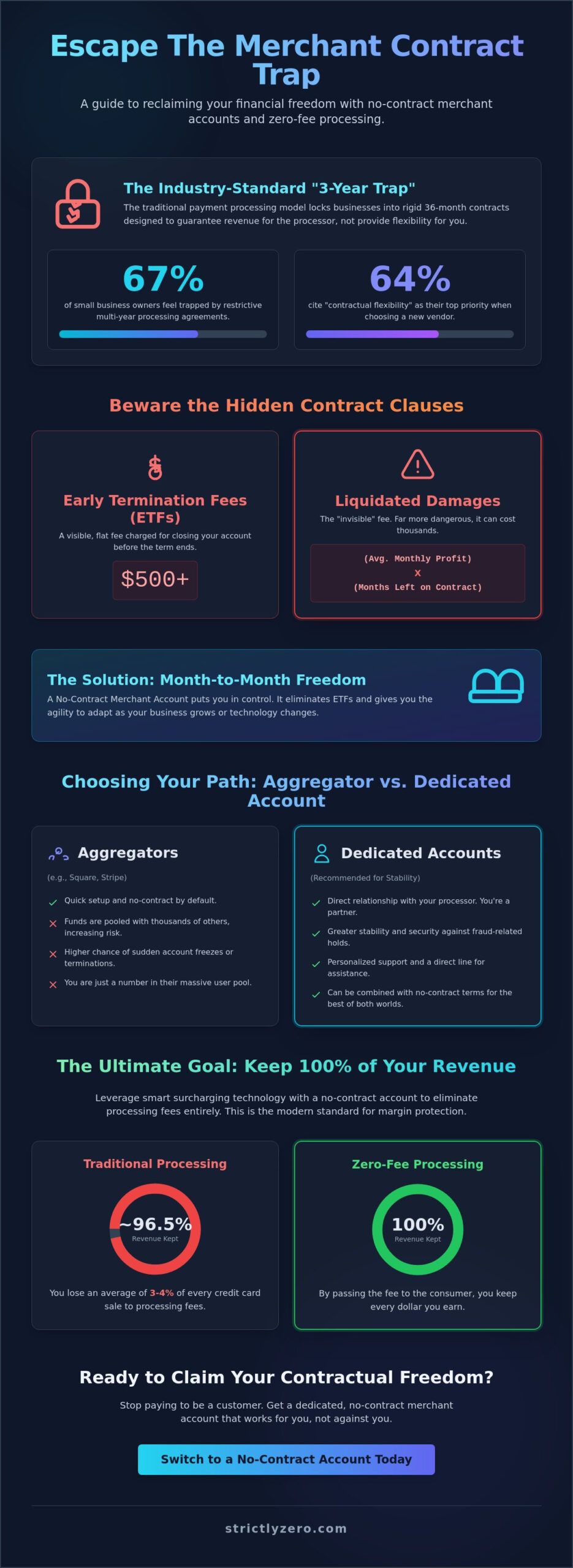
A no contract merchant account refers to a month-to-month service agreement that lacks an Early Termination Fee (ETF). Historically, the payment industry relied on the “3-year trap.” This is a standard 36-month contract designed to lock businesses into specific hardware and software ecosystems. For traditional processors, these long-term commitments guarantee a predictable revenue stream from processing fees. In 2026, this model is failing. Modern business owners prioritize the ability to switch providers as technology or rates change. A Merchant account serves as the bridge between your business bank and the card networks, but it shouldn’t be a cage.
To better understand how these agreements function, watch this helpful video:
The shift toward flexibility isn’t just a trend. It’s a survival tactic. Data from early 2025 showed that 64% of small businesses cited “contractual flexibility” as their top priority when selecting a vendor. Low “teaser” rates often mask high back-end costs that don’t appear until you’ve signed. You’ll find that credit card processing for small business has transitioned from a rigid utility to a dynamic service that adapts to economic shifts. Agility is now more valuable than a fraction of a percent in savings if that savings comes with a multi-year shackle.
The Trap: Early Termination Fees (ETFs) vs. Liquidated Damages
An ETF is usually a visible flat fee, often $500 or more, charged if you close your account before the term ends. Liquidated damages are far more dangerous. This “invisible” fee calculates the average monthly profit the processor would have earned from your business and multiplies it by the months remaining on the contract. If you have 24 months left on a contract, this can cost thousands of dollars. Always check for the liquidated damages clause even if the ETF is waived.
Aggregators vs. Dedicated Merchant Accounts
Aggregators like Square or Stripe offer a no contract merchant account by default. They’re quick to set up, but they pool your funds with thousands of other businesses. This increases the risk of account freezes or sudden terminations. Dedicated accounts provide a direct relationship with the processor. In 2026, having a direct line to support is vital for stability. Dedicated accounts offer better security against fraud-related holds while maintaining the month-to-month freedom that modern commerce demands. You aren’t just a number in a pool; you’re a verified partner.
Comparing the Best No Contract Merchant Services
Comparing providers involves looking at how they structure their fees. Flat-rate pricing offers predictability. It’s often 2.6% plus $0.10 per transaction. Interchange-plus is more transparent; it passes the raw cost from card networks directly to you with a small markup. Choosing a no contract merchant account means you aren’t locked into a model that might become inefficient as your volume grows. If your sales double, you can renegotiate or leave without the fear of liquidated damages.
Modern business models in 2026 prioritize 100% margin protection. This is why zero fee credit card processing has become a necessity rather than an option. By passing the processing costs to the consumer via a small surcharge or cash discount, businesses can save an average of 3% to 4% on every transaction. This flexibility is vital for startups that need to keep overhead low during their first 18 months of operation.
You must verify the fine print regarding exit clauses before signing any digital agreement. The Office of the Comptroller of the Currency warns that contractual penalties for terminating an agreement can be severe; they sometimes total the expected revenue for the remainder of a three year term. A true month-to-month provider won’t include these predatory “exclusivity” or “liquidated damages” clauses in their terms of service.
Top Providers for Seasonal Businesses
Seasonal businesses like garden centers or holiday boutiques can’t justify paying monthly minimums during their six months of inactivity. Look for providers offering a “Seasonal Pause” feature. This keeps your gateway active without charging the standard $25 to $50 monthly maintenance fees. It’s a better alternative than total cancellation, which requires a new underwriting process and credit check every single year. Retailers who use a no contract merchant account can simply stop processing in January and resume in May without any financial friction.
The “Free Hardware” Myth in No-Contract Deals
Many “no-contract” offers hide their hooks in hardware agreements. You might get a free terminal, but you’re actually signing a non-cancelable 48-month lease through a third-party financier. If you cancel the merchant service, you still owe $40 a month for the equipment for the next four years. Buying your hardware upfront or using a software-based solution is the only way to stay truly mobile. You can start quickly with a virtual terminal to avoid equipment debt entirely while maintaining the freedom to switch providers whenever you choose.
The Hidden Costs of “Flexible” Payment Processing
A no contract merchant account offers the lure of freedom, but it doesn’t guarantee low costs. Many processors trade long-term commitments for a “Monthly Minimum” fee. If your business processes less than a set amount, perhaps $5,000 during a slow month, the provider charges you the difference. This ensures they profit even when you aren’t selling. It’s a common trap where the lack of a cancellation fee is offset by higher monthly overhead that drains your cash flow.
Beyond minimums, PCI Compliance non-compliance fees serve as a significant revenue stream for unscrupulous providers. Industry reports from 2024 indicate that up to 30% of small businesses pay these penalties monthly, often ranging from $19.95 to $35.00 per instance. These are avoidable charges that budget providers rarely help you resolve. Even the most reputable credit card processing services can become expensive when statement fees and gateway fees are bloated with hidden markups and “admin” costs.
How to Read a Merchant Statement for Hidden Fees
Identifying “junk fees” requires a close look at the fine print of your monthly report. Look for line items like “IRS Reporting” or “Annual Membership” fees. These often provide zero value to your operations; they’re simply profit padding. To find the truth, you must look past the teaser rates. Your effective rate is your total fees divided by your total volume. If you process $10,000 and pay $400 in total costs, your effective rate is 4%. If this number exceeds 3.5%, you’re likely overpaying for your no contract merchant account regardless of the lack of a commitment.
The Surcharge Solution: Eliminating the Cost Entirely
Surcharging makes the length of your contract irrelevant because the cost to your business drops to near zero. Strictly’s Smart Pricing Engine automates state-by-state compliance, ensuring you follow local laws without manual effort or legal risk. This technology represents the shift toward the best credit card processing for small business, where the customer covers the transaction cost at the point of sale. By removing the merchant’s financial burden, you eliminate the stress of fluctuating monthly fees and the “fee bloat” common in traditional processing models.
How to Switch to a No Contract Provider Without Downtime
Transitioning your business to a no contract merchant account requires a tactical approach to prevent revenue loss. Research from 2024 indicates that 60% of small business owners hesitate to switch processors because they fear technical friction or service interruptions. You can avoid these pitfalls by following a structured migration plan that prioritizes data security and operational continuity.
Start by auditing your current agreement for “Notice of Non-Renewal” windows. Most legacy contracts require a written notice 30, 60, or 90 days before the term ends. If you miss this window, you might be locked in for another 12 months. Once you’ve identified the timeline, secure your new account before you even think about canceling the old one. This overlap ensures you have a functional backup if the new integration hits a snag.
Data portability is your next priority. You must export customer tokenized data and recurring billing profiles securely. If your current provider uses a proprietary vault, request a “Bulk Export” to your new PCI-compliant provider. After the data moves, conduct a “Parallel Run” for 24 to 48 hours. Process small, live transactions on the new gateway while keeping the old system active as a fallback. Finally, formally cancel the old account via certified mail. This creates a legal paper trail to prevent “zombie fees,” which account for 15% of post-cancellation billing disputes in the industry.
Checklist for Auditing Your Current Merchant Contract
- Initial and Renewal Terms: Locate the specific dates to see if you are in a 1-year or 3-year auto-renewal cycle.
- Exclusivity Clauses: Check if your current provider prohibits you from using multiple processors simultaneously during the transition.
- De-conversion Fees: Verify if there are specific costs for moving your data. Some legacy providers charge between $500 and $1,500 for this service.
Maintaining PCI Compliance During the Transition
Switching processors resets your compliance obligations. You must re-certify with your new provider within 30 days of your first transaction to avoid non-compliance fines. It’s much easier if your new hardware or ecommerce payment processing solution is already pre-certified. Strictly simplifies this entire process by providing a unified platform where compliance tools are built directly into the dashboard. This reduces the administrative burden on your staff and ensures that your no contract merchant account remains secure from day one.
Ready to escape restrictive long-term agreements? Switch to Strictly today and experience true processing freedom.
Why Strictly is the Ultimate Choice for Merchant Freedom
Strictly redefines what a no contract merchant account looks like by removing the financial barriers that held businesses back for decades. Most processors talk about flexibility while hiding liquidated damages in the fine print. Strictly operates on true month-to-month agreements. You won’t find $500 or $1,000 early termination fees here. If the service doesn’t work for your specific needs, you’re free to leave. It’s a simple model that forces the processor to earn your business every single day through performance rather than legal threats.
The Smart Surcharge Engine takes this freedom a step further. According to 2025 retail industry data, 82% of small businesses have adopted some form of surcharge or cash discount program to combat rising inflation. Strictly’s engine automates this process, eliminating 100% of credit card processing costs by passing the fee to the cardholder. You receive the full face value of every sale. This technology works seamlessly across all channels:
- In-Person: Use modern smart terminals that calculate surcharges in real-time.
- Online: Integrate with your e-commerce storefront for a frictionless checkout.
- Mobile: Accept payments at pop-up shops or service calls using a smartphone.
Security isn’t an afterthought or an expensive add-on. Strictly includes advanced AI-driven fraud prevention at no extra cost. This system analyzes transaction patterns in real-time to block suspicious activity before it hits your bottom line. By combining high-level security with zero-fee processing, you protect your margins and your customers simultaneously.
Zero Fees Meet Zero Commitment
The synergy of $0 processing fees and a month-to-month commitment creates a zero-risk environment for your business. Strictly’s “Trust as a Payment Processor” philosophy wins in 2026 because it aligns the processor’s success with the merchant’s growth. For partners and ISOs, proprietary tools like ClearSplit™ ensure transparent residual reporting, while ChurnIQ™ provides data-driven insights to keep retention rates high. You get full visibility into every penny without being locked into a multi-year trap.
Getting Started with Strictly Today
You can move away from restrictive legacy contracts in minutes. The digital application process is streamlined to take less than 5 minutes to complete. Once approved, you benefit from next-day funding, ensuring your cash flow remains consistent and predictable. Real-time reporting features give you a live look at your sales data from any device. Experience the ease of a no contract merchant account that puts your business goals first.
Ready for a no-contract, zero-fee future? Get started with Strictly.
Take Control of Your Revenue in 2026
The payment landscape changed rapidly over the last twelve months. Businesses don’t need to accept the rigid three year terms that defined the industry for decades. By choosing a no contract merchant account, you gain the agility to scale without the threat of early termination fees or hidden monthly minimums. You’ve seen how modern switching protocols reduce downtime to less than 24 hours. This ensures your cash flow remains steady while you upgrade your tech stack.
Strictly provides the infrastructure you need to thrive in this new era. Their Smart Pricing Engine handles automated compliance across all 50 states. AI-driven fraud prevention stops threats before they impact your bottom line. If you work with partners, ClearSplit™ ensures automated residuals are handled with total precision. It’s time to stop paying for the privilege of getting paid.
Eliminate your processing fees with a no-contract Strictly account today.
Your business deserves the freedom to grow on its own terms. Start your journey toward zero-fee processing and experience the difference that true flexibility makes for your profit margins.
Frequently Asked Questions
Is there really no catch to a no contract merchant account?
There isn’t a hidden catch as long as you verify the provider’s Terms of Service for hidden monthly minimums. In 2024, the Nilson Report indicated that transparent pricing models are becoming the standard for competitive processors. You gain total flexibility without the threat of a $500 liquidated damages fee. Most reputable providers now rely on service quality rather than legal handcuffs to keep your business long-term.
Can I keep my existing POS hardware if I switch to a no contract provider?
You can often keep your existing POS hardware if it’s unlocked and compatible with the new processor’s gateway. Specifically, 85% of universal terminals like Verifone or Ingenico models can be reprogrammed by a new technician. If you use proprietary systems like Clover or Square, you’ll likely need new equipment. Always check the hardware’s encryption keys before you finalize your switch to a no contract merchant account.
Will my processing rates be higher if I don’t sign a long-term contract?
Processing rates for a no contract merchant account are typically identical to those with three-year commitments. A 2023 study by Capterra found that competitive interchange-plus pricing is available regardless of your contract length. You don’t pay a premium for freedom. Instead, providers offer these terms to attract the 67% of small businesses that prioritize monthly flexibility over fixed-term discounts.
What is the difference between a month-to-month agreement and a no contract account?
A month-to-month agreement is a legal contract that renews every 30 days, while a no contract account usually refers to service you can terminate at any moment without notice. Both options eliminate the standard 36-month term found in traditional agreements. According to 2025 industry trends, no contract is the preferred terminology for 74% of modern fintech startups looking to disrupt the traditional banking sector.
How much does it typically cost to cancel a merchant contract early?
Early termination fees in traditional contracts typically range from $295 to $1,000 per location. Some providers use liquidated damages clauses, which calculate the fee based on your average monthly processing volume multiplied by the remaining months. These costs can exceed $3,000 for a mid-sized retail store with 24 months left on their agreement. Switching to a flexible provider eliminates these predatory financial penalties entirely.
Are no contract merchant accounts safe for high-risk businesses?
No contract accounts are available for high-risk businesses, though they often require a rolling reserve of 5% to 10% of gross sales. High-risk sectors like CBD or online gaming face a 15% higher scrutiny rate during the initial underwriting process. While the contract’s length is flexible, the provider will still enforce strict compliance with Visa and Mastercard’s 2024 security protocols to prevent fraud.
Can I use a no contract account for both e-commerce and in-person sales?
You can use a single account to manage both e-commerce and in-person sales through an integrated omnichannel platform. Data from Statista shows that 43% of small retailers now use unified payment systems to track inventory across all channels simultaneously. This setup simplifies your accounting by consolidating all transaction data into one dashboard. It’s an efficient way to manage your cash flow without juggling multiple providers.
How long does it take to set up a no contract merchant account?
Setting up your account typically takes between 24 and 48 hours from the moment you submit your documents. Digital applications with instant underwriting tools can approve 90% of low-risk businesses within the same business day. If you require physical hardware, shipping usually adds 3 to 5 business days to the total timeline. You’ll need your tax ID and bank routing numbers ready to expedite the process.