
Payment Analytics for Merchants: Turning Transaction Data into Zero-Fee Growth
Published:

What if your processing fees weren’t an unavoidable tax on your growth, but a choice you could simply stop making? For many business owners, the monthly statement feels like a black box of hidden costs and siloed data. You’ve likely felt the frustration of seeing your margins shrink while trying to reconcile online sales with in-person transactions. It’s a common pain point, but sophisticated payment analytics for merchants can change that narrative by turning every transaction into a strategic asset.
We’re here to help you move past standard reporting and into the era of payment intelligence. You’ll learn how to master the specific metrics that drive growth and how to implement a zero-fee processing model that actually works. By leveraging tools like our Smart Pricing Engine and ChurnIQ™, you can predict merchant behavior and stop revenue leaks before they start. We’ll explore the essential KPIs for 2026, the strategy behind zero-fee models, and how to stay compliant with the latest PCI DSS 4.0.1 and NACHA standards to ensure your growth is both profitable and secure.
Key Takeaways
- Understand the critical shift from standard reporting to actionable intelligence that explains the “why” behind your transaction trends.
- Master essential payment analytics for merchants by tracking your true effective rate and identifying technical friction points in your checkout process.
- Discover how AI-driven tools like ChurnIQ™ use predictive data to identify at-risk accounts and proactively prevent merchant churn.
- Learn how a Smart Pricing Engine leverages real-time card data to implement compliant surcharge and dual pricing models that eliminate processing fees.
- Unify data from e-commerce, mobile, and virtual terminals into a single source of truth to streamline operations and scale your business.
Table of Contents
- What is Payment Analytics for Merchants and Why Does it Matter in 2026?
- Essential Payment Metrics: Moving Beyond Transaction Volume
- Intelligence vs. Reporting: Leveraging AI for Merchant Retention
- Turning Data into Dollars: Optimizing for Zero-Fee Processing
- Scalability with Strictly: Unified Analytics for Omni-Channel Growth
What is Payment Analytics for Merchants and Why Does it Matter in 2026?
Payment analytics for merchants is the systematic collection and analysis of transaction data to optimize revenue and streamline operations. It goes beyond simply seeing how much money came in today. By applying the principles of business analytics to your payment flow, you can uncover hidden patterns in customer behavior and identify exactly where processing fees are eroding your margins. In 2026, where the global digital payments market is reaching toward $30 trillion, this data is the difference between guessing and growing.
The industry has shifted. Traditional reporting tells you what happened; it’s a rearview mirror showing a list of transactions. Modern analytics tells you why it happened and what steps you should take next. For example, if your decline rate spikes on a Tuesday, analytics helps you determine if it’s a technical glitch in your checkout or a specific card type failing. This level of insight is vital for identifying revenue leakage, especially when hidden fees from various providers start to accumulate and eat into your bottom line.
The Difference Between Data and Actionable Intelligence
Raw transaction logs are just numbers on a screen. Most merchants make the mistake of only looking at “Total Volume,” which is a vanity metric that hides more than it reveals. Actionable intelligence interprets these trends to show you things like your true effective rate or the impact of different card types on your profitability. When you implement sophisticated payment analytics for merchants, this data works in real-time. It doesn’t just record a fraudulent attempt; it leverages AI-driven fraud prevention to learn from the event and block future attacks, protecting your cash flow before the money ever leaves your account.
Overcoming the Siloed Data Problem
Many businesses struggle with disparate systems where POS data and online sales live in separate universes. This fragmentation makes it impossible to see the true customer lifetime value. If a customer buys online but returns in-store, a siloed system misses that connection entirely. A unified, API-first platform aggregates this data into a single source of truth. Omni-channel analytics acts as the essential bridge between digital storefronts and physical locations, unifying the customer journey into a single, readable story. This visibility allows you to stop treating your sales channels as competitors and start seeing them as a cohesive engine for profit.
Essential Payment Metrics: Moving Beyond Transaction Volume
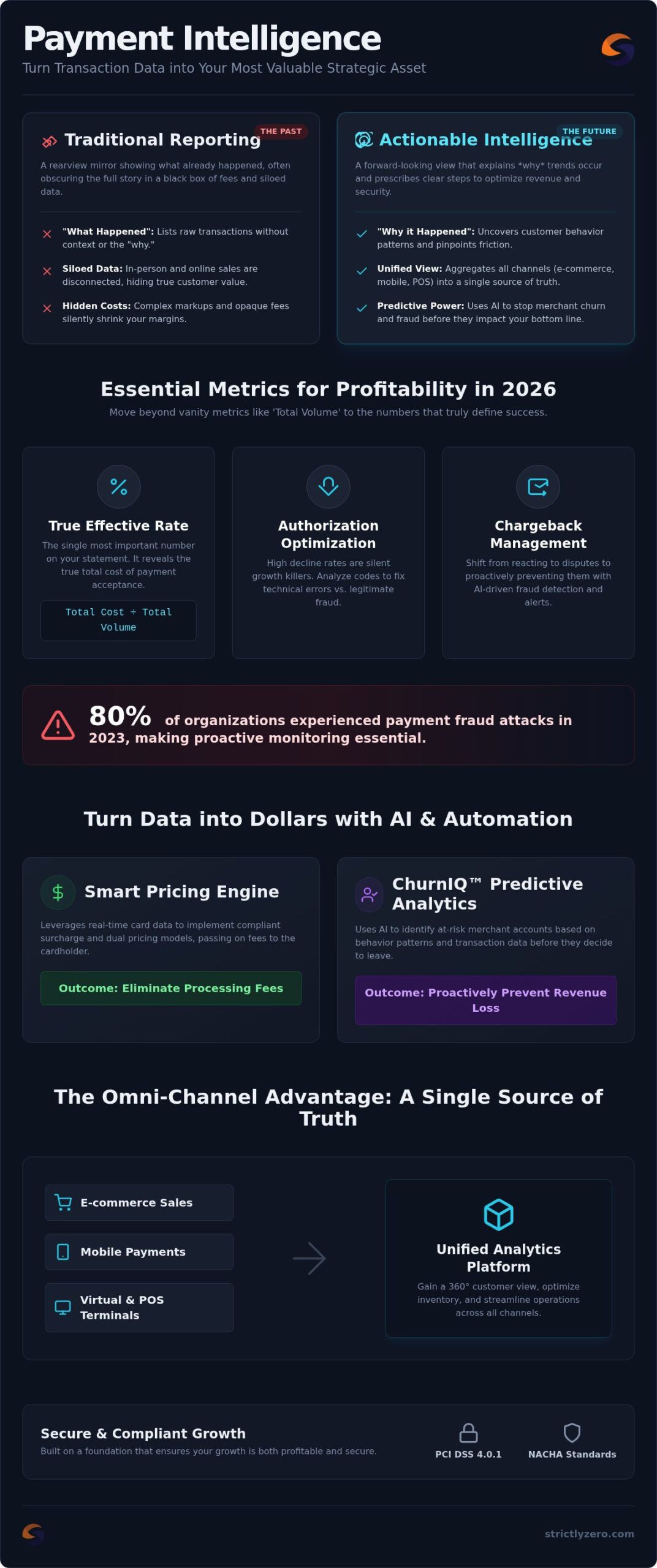
Transaction volume is a baseline, but it doesn’t tell you if your business is actually making money. To gain a competitive edge, you need to dive into the specific metrics that define your profitability. Sophisticated payment analytics for merchants allow you to look past surface-level numbers and address the friction points that cause revenue to slip through the cracks. In an era where 80% of organizations reported experiencing payment fraud attacks in 2023, watching these metrics is no longer optional; it’s a survival tactic.
Understanding Your Effective Processing Rate
Your effective rate is the single most important number on your monthly statement. It’s the total cost of acceptance divided by your total volume. Many merchants assume interchange-plus pricing is the best deal, but it often hides complex markups that eat into your margins. Using data to prepare for a zero fee credit card processing model is the most effective way to reclaim that lost revenue. By analyzing card types in real-time, you can determine exactly how a surcharge or dual pricing program will impact your bottom line before you implement it.
Authorization Optimization and Conversion
High decline rates are silent killers for growth. When a transaction fails, you lose more than just that sale; you potentially lose a customer for life. Analyzing decline codes helps you distinguish between legitimate fraud and simple technical errors. For instance, local acquiring often yields higher approval rates than global acquiring for domestic transactions. You can also use this data to identify when to offer POS lending options, giving customers more flexibility at the point of sale when a standard credit card might be declined due to limit issues.
Chargeback ratios are another critical metric that requires constant vigilance. Instead of just reacting to disputes after they happen, use your data to trigger AI-driven fraud prevention protocols that flag suspicious patterns before they become a liability. Understanding your Average Transaction Value (ATV) by channel also reveals where your most profitable customers shop. Factors like rewards programs and transaction convenience heavily influence consumers’ payment behavior. Seeing these trends across your omni-channel platform helps you allocate marketing resources where they’ll have the highest impact. You don’t have to guess which channels are performing best when you have a unified engine tracking every cent.
Intelligence vs. Reporting: Leveraging AI for Merchant Retention
Static reports tell you which merchants left your platform last month, but intelligence tells you which ones are planning to leave tomorrow. Moving from basic reporting to advanced payment analytics for merchants allows you to stop reacting to churn and start preventing it. As McKinsey highlights, monetizing payment data is the new frontier for value creation in the financial sector. For ISOs and payment professionals, this means using transaction intelligence to build a more resilient and profitable portfolio.
ChurnIQ™ and the Science of Merchant Retention
Merchant churn is often preceded by specific “red flag” behaviors that are invisible to the naked eye but obvious to AI. A gradual drop in transaction frequency, a sudden spike in chargebacks, or a shift in the card types being processed can all signal that a merchant is unhappy or looking elsewhere. ChurnIQ™ turns historical data into a proactive retention strategy by identifying the subtle shifts in transaction behavior that signal an account is at risk. For ISOs looking to scale, this predictive layer is essential. It allows your team to reach out with a solution before the merchant even picks up the phone to cancel. By focusing your energy on high-risk, high-value accounts, you can drastically reduce attrition without increasing your administrative headcount.
ClearSplit™: Automated Partner Analytics
One of the biggest gaps in standard payment analytics for merchants is the lack of transparency for partners, such as ISOs and MSPs. Managing residuals and compensation manually is a recipe for errors and disputes. ClearSplit™ solves this by automating partner analytics, providing a clear view of residuals and performance metrics in real-time. This level of transparency builds trust and allows partners to see exactly how their efforts link to end-merchant profitability. By reducing the administrative overhead associated with manual reporting, your organization can focus on strategic growth rather than spreadsheet management. Also, linking these partner tools with AI-driven fraud prevention ensures that every transaction in the network is scrutinized for risk, protecting the commissions of everyone involved.
Predictive analytics also extends to cash flow forecasting. By analyzing years of historical transaction patterns, AI can predict seasonal dips and peaks with high accuracy. This allows you to advise merchants on when to leverage POS lending or adjust their inventory levels. You’re no longer just a processor; you’re a strategic consultant powered by data. When you combine this with real-time fraud intelligence, you create a secure ecosystem where growth isn’t just possible; it’s predictable.
Turning Data into Dollars: Optimizing for Zero-Fee Processing
The ultimate goal of payment analytics for merchants is to move beyond viewing data and start using it to drive profit. While most platforms show you how much you’re paying in fees, a truly intelligent system shows you how to stop paying them entirely. By leveraging a Smart Pricing Engine, you can analyze card types in real-time to determine which transactions are eligible for a surcharge or dual pricing program. This isn’t just about saving money; it’s about using transaction intelligence to build a sustainable, zero-fee business model that scales with your ambition.
Analytics for Surcharge Compliance
Compliance is the biggest hurdle for merchants considering a surcharge model. You can’t legally apply a surcharge to debit cards, so your system must differentiate between debit and credit cards automatically at the point of sale. Automated data checks ensure you meet state-by-state rules without manual intervention, which is critical as regulations continue to evolve in 2026. By tracking customer acceptance of dual pricing models, you can see exactly how these programs affect your conversion rates and overall volume. It’s helpful to consult the 2026 map of surcharge rules by state to make data-driven decisions that keep your business protected and compliant with the latest standards.
The ROI of Eliminating Processing Fees
When you compare traditional processing costs against a $0 fee model using historical data, the impact is often staggering. For many, these savings represent a significant percentage of their total revenue that was previously lost to bank fees. These aren’t just numbers on a spreadsheet; they’re funds you can reinvest into marketing, inventory, or staff growth. The way credit card processing for small business works changes fundamentally when the burden of fees is removed. You move from a defensive posture, where you’re constantly trying to cut costs, to an offensive one, where you’re funding expansion with your own recovered margins.
The psychological impact on customers is also a key metric to track through your analytics dashboard. Data shows that when dual pricing is implemented correctly, the effect on customer loyalty and Average Transaction Value (ATV) is minimal. Customers value transparency, and offering a cash discount or a clear dual pricing option often builds trust. You don’t have to guess how your audience will react when you have the data to prove it. If you’re ready to see how these tools can transform your margins, you can explore our surcharge and dual pricing engine to get started today.
Scalability with Strictly: Unified Analytics for Omni-Channel Growth
Scalability isn’t just about handling more transactions; it’s about handling them more intelligently. As your business expands across different regions and channels, the complexity of your data increases exponentially. Strictly provides the infrastructure to unify these disparate threads into a single, cohesive strategy. By integrating payment analytics for merchants directly into your daily operations, you transform your processing from a utility into a growth engine that powers every decision.
The Strictly Virtual Terminal ensures that even your phone and mail orders aren’t left in the dark. This tool allows you to collect and analyze data from every touchpoint, providing a 360 degree view of your customer interactions. Because the platform is built with an API-first philosophy, it connects seamlessly with your existing tech stack. You don’t have to replace your favorite tools to get a superior data engine; you just have to plug them into a smarter core that unifies your e-commerce and in-person data.
Security remains the foundation of this entire ecosystem. Since March 31, 2025, PCI DSS version 4.0.1 has been the only active standard, and adhering to these best practices is vital for maintaining data integrity. When your data is secure, it’s reliable. Reliability allows you to make bold decisions about your zero-fee strategy without worrying about compliance gaps or security leaks that could compromise your merchants’ trust.
Omni-Channel Visibility in One Dashboard
Managing e-commerce and in-person payments in separate silos is a relic of the past. A unified payment processing platform for ISOs allows you to oversee every transaction from a single dashboard. This visibility is essential for customizing reports for different stakeholders. Your CFO needs to see the impact of the zero-fee model on the bottom line, while your sales team needs to understand which products are driving the most volume. Strictly makes it easy to give everyone the exact intelligence they need to succeed.
Future-Proofing Your Business for 2026
The payments industry moves fast. Visa released updated interchange fees on April 18, 2026, and staying ahead of these network increases requires constant vigilance. AI-driven fraud prevention plays a dual role here; it protects your revenue while ensuring your data isn’t skewed by fraudulent patterns. By using these tools, you ensure your business is ready for whatever regulatory or economic shifts come next. Scale your business with Strictly’s intelligent payment platform today.
Master Your Margins with Data-Driven Payments
The shift from passive reporting to active intelligence represents the most significant opportunity for business growth in 2026. By mastering payment analytics for merchants, you’re no longer just observing your processing costs; you’re actively eliminating them. A unified view of your omni-channel data reveals the direct path to a sustainable, zero-fee model while protecting your brand through AI-driven fraud prevention and automated compliance checks.
Leveraging tools like the Smart Pricing Engine and ChurnIQ™ turns raw transaction logs into a proactive strategy for retention and profit. With compliant, state-by-state surcharge automation, you can confidently scale your operations without the administrative burden of manual oversight. It’s time to stop letting processing fees dictate your margins and start letting your data fuel your expansion. Eliminate your processing fees and unlock deep payment insights with Strictly. Your transaction data is your most valuable asset. Start using it to its full potential today.
Frequently Asked Questions
What is the most important payment metric for small business merchants?
The effective processing rate is the most critical metric for small businesses. It represents the total cost of acceptance divided by your total transaction volume. While gross volume shows growth, the effective rate reveals true profitability by showing how much of each dollar is lost to processing fees. Tracking this metric via payment analytics for merchants allows you to evaluate the financial impact of switching to a zero-fee model to protect your margins.
How can payment analytics help reduce my credit card processing fees?
Payment analytics for merchants identify exactly which card types and transaction methods are driving up your operational costs. By analyzing real-time data, businesses can see where high interchange fees are eating into their bottom line. This intelligence allows you to implement a surcharge or dual pricing engine effectively. You’ll know which transactions can legally carry a fee, allowing you to pass those costs to customers and reach a zero-fee processing state.
What is the difference between a payment report and payment analytics?
A payment report is a static look at what happened, such as a list of yesterday’s sales or total volume. In contrast, payment analytics explain why those events occurred and provide a forecast for what might happen next. While a report lists simple transaction totals, analytics provide deeper insights into churn prediction, effective rate trends, and consumer behavior patterns. These insights turn raw data into a strategic growth roadmap for your business.
Can payment analytics help prevent credit card fraud?
Analytics act as the primary engine for AI-driven fraud prevention by monitoring transaction patterns in real-time. The system flags anomalies that deviate from typical customer behavior, identifying high-risk transactions before they are finalized. Using historical data to train these AI models ensures that your fraud detection becomes more accurate over time. This proactive approach reduces chargebacks and protects your business’s overall data integrity while maintaining a smooth checkout experience for legitimate shoppers.
How do I track omni-channel payments in a single dashboard?
You can track all sales through a unified platform that aggregates data from e-commerce, mobile, and virtual terminal channels. Strictly’s API-first integration allows you to connect your existing tech stack to a single data engine, eliminating silos. This gives you a 360 degree view of the customer journey without switching platforms. Whether a sale happens online or via a phone order, the data flows into one central dashboard for simplified, omni-channel reporting and management.
Is it legal to use data to pass processing fees to customers in 2026?
It is legal in most U.S. states, provided you follow specific network rules and state regulations. In 2026, compliance requires differentiating between debit and credit cards because surcharging debit cards is generally prohibited. A smart pricing engine automates this process by using real-time card data to apply fees correctly. Merchants must also provide clear signage and disclosure to stay compliant with evolving transparency laws and the latest merchant service agreements regarding fee transparency.
What is ChurnIQ™ and how does it help ISOs?
ChurnIQ™ is a specialized tool designed for merchant retention intelligence. It uses predictive analytics to identify red flag behaviors, such as declining transaction volumes or increased chargebacks, which suggest a merchant might leave. For ISOs, this means moving from reactive management to proactive retention. By catching these signals early, ISOs can reach out with specific solutions to keep their portfolio stable and continue scaling their payment business effectively without increasing their administrative workload.
How does a surcharge engine use real-time data for compliance?
A surcharge engine performs an instant BIN lookup on every card entered to determine its type. Since surcharging is restricted to credit cards, the engine uses this real-time intelligence to apply the fee only when legal. This automated check ensures state-by-state compliance and network rule adherence without requiring the merchant to manually verify every card. It’s the brain behind the zero-fee model, ensuring every transaction is processed according to the most current regulatory standards.