
Payment Gateway API for Developers: Building Zero-Fee Solutions in 2026
Published:

Why are your merchants still losing nearly 3% of every sale to transaction fees when the technology exists to bring that cost down to zero? As a developer, you’ve likely spent countless hours wrestling with complex PCI compliance and multi-party residual splits, only to have high processing costs eat into your partners’ margins. It’s a frustrating cycle that makes scaling feel like an uphill battle. You deserve a solution that handles the heavy lifting of compliance while actually adding value to the bottom line.
This article promises to show you how to integrate a high-performance payment gateway api for developers that eliminates processing fees through automated surcharge and dual-pricing engines. We’ll explore how to build a “set it and forget it” system that maintains strict state-by-state compliance in the 2026 regulatory landscape. You’ll also learn how to leverage tools like ClearSplit for automated partner payouts and ChurnIQ for retention. By the end, you’ll have a clear roadmap for delivering a zero-fee processing environment with transparent reporting and enterprise-grade reliability.
Key Takeaways
- Learn how to implement a RESTful payment gateway api for developers that uses JSON-based patterns and unified tokenization to secure data across all channels.
- Discover the technical requirements for integrating automated surcharge and dual pricing engines that programmatically eliminate processing fees for merchants.
- Master US-based surcharge compliance using a smart pricing engine that automatically adjusts for state-by-state regulatory variations.
- Automate partner residuals and merchant retention strategies using specialized API tools like ClearSplit™ and ChurnIQ™.
- Streamline your deployment process by moving from a secure sandbox environment to a live production gateway with robust webhook configurations.
Table of Contents
- Beyond the Code: Why Developers are Choosing Zero-Fee Payment APIs
- Anatomy of a Robust Payment Gateway API for 2026
- Integrating Automated Surcharge and Dual Pricing Logic
- Developer Tools for Scaling: ClearSplit™ and ChurnIQ™
- Getting Started: From Sandbox to Production with Strictly
Beyond the Code: Why Developers are Choosing Zero-Fee Payment APIs
The role of the developer in 2026 has shifted. You aren’t just connecting endpoints anymore. You’re architecting the financial health of your users. A modern payment gateway api for developers is no longer just a technical bridge for moving data; it’s a strategic engine designed to protect merchant margins. While legacy providers still lean on the standard 2.9% plus 30 cents model, forward-thinking engineers are moving toward “Zero Fee” models that leverage programmatic compliance to offset costs. It’s about profit, not just packets.
A traditional payment gateway serves as the middleman between a merchant and the acquiring bank, but the current landscape demands more than simple connectivity. It requires an omni-channel platform that builds trust through transparency and reliability. Developers are now looking for solutions that handle the complexities of fraud prevention and state-by-state regulations automatically, allowing them to focus on the core user experience.
The Evolution of the Developer-Processor Relationship
Developers used to focus solely on checkout forms and uptime. Today, you’re building full-scale financial infrastructure. This “Payment-as-a-Service” approach means you’re responsible for how a SaaS platform or marketplace handles its money. If your integration costs your users a significant portion of their revenue, you’re providing a utility. If your integration helps them keep that revenue, you’re providing a competitive advantage. You’re now a partner in their profitability, which requires a deeper level of trust in the underlying processor.
The Economic Impact of Zero-Fee Processing
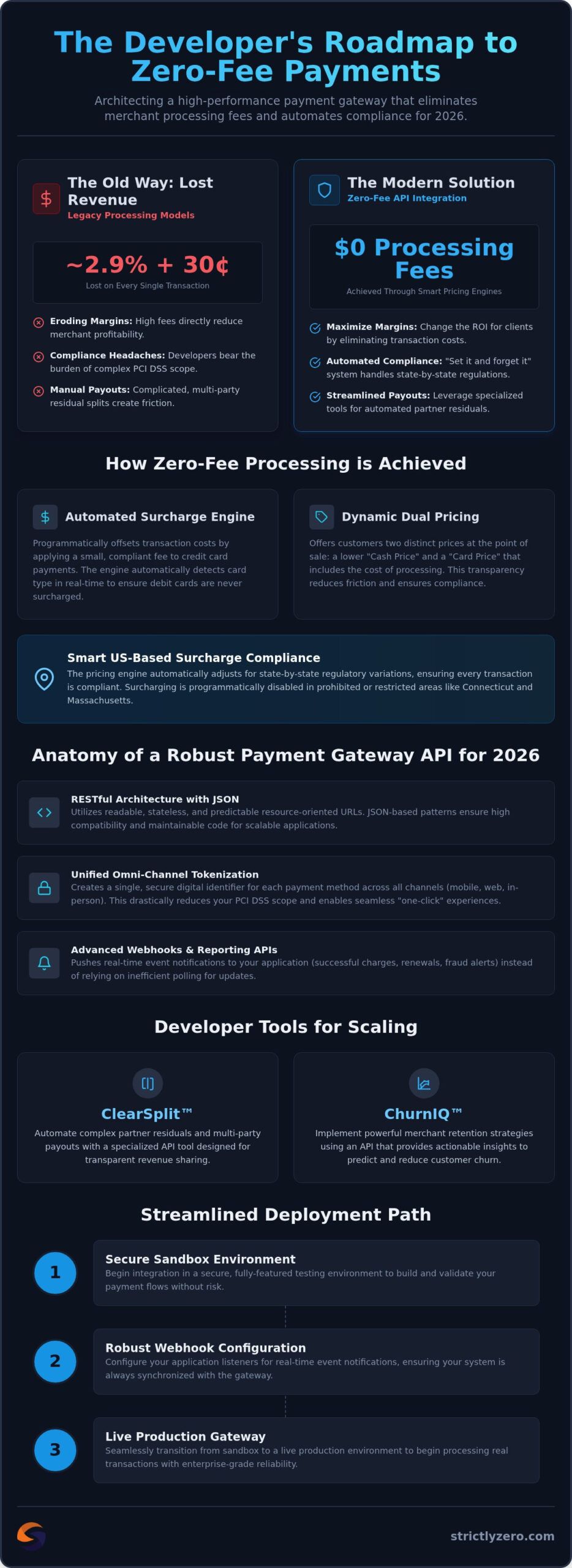
High transaction fees are the primary pain point for modern merchants. By using an API-driven surcharge engine, you can fundamentally change the ROI for your clients. Strictly’s Smart Pricing Engine automatically detects whether a customer is using a debit or credit card in real-time to ensure every transaction follows strict US-based compliance rules. This level of programmatic compliance is essential because credit card surcharging is prohibited or restricted in areas like Connecticut and Massachusetts.
Implementing a payment gateway api for developers that supports dual pricing allows you to offer a “Cash” vs. “Card” price dynamically. This transparency reduces friction at the point of sale. When you provide an integration that reaches $0 in processing fees, you aren’t just a vendor. You’re a hero to the merchant’s bottom line. This shift toward zero-fee models is the most significant trend in payment tech this year, and mastering it is how you stay ahead of the curve.
Anatomy of a Robust Payment Gateway API for 2026
Building a high-performance integration requires understanding the underlying skeleton of a modern payment gateway api for developers. In 2026, the gold standard remains a RESTful architecture that utilizes JSON-based request and response patterns. This structure ensures that your code is readable, maintainable, and highly compatible with various programming languages. When evaluating the Best Payment APIs for Developers, you’ll notice that the most effective solutions prioritize statelessness and predictable resource-oriented URLs. This technical foundation allows you to scale your application without worrying about the overhead of session management or complex state synchronization.
Unified Omni-Channel Tokenization
A significant challenge in modern payments is maintaining a consistent customer profile across different sales environments. Unified tokenization solves this by creating a single digital identifier that represents a customer’s payment method, whether they’re shopping on a mobile app, a web store, or using a card at a physical terminal. This omni-channel approach ensures that sensitive data never touches your server, which drastically reduces your PCI DSS scope. By offloading the storage of cardholder data to the processor, you minimize liability while providing a seamless “one-click” experience for returning customers. For a deeper dive into these strategies, check out our Ecommerce Payment Processing Guide.
Advanced Webhooks and Reporting APIs
Reliable integrations depend on real-time event notifications. Modern gateways use advanced webhooks to push data to your application the moment an event occurs. You should structure your listeners to handle successful charges, subscription renewals, and immediate fraud alerts. Instead of polling for updates, your system reacts instantly to state changes. This is particularly vital for managing disputes or automated refunds. Accessing transaction metadata programmatically allows you to build custom business intelligence dashboards that provide insights into merchant performance and customer behavior.
Security in 2026 has moved beyond static rules. Robust APIs now incorporate AI-driven fraud prevention signals directly into the response payload. When a transaction is processed, the system analyzes hundreds of data points in milliseconds to return a risk score. This allows you to programmatically decline high-risk transactions or flag them for manual review before they result in a chargeback. If you want to start building with these advanced tools, you can see how our platform supports developers with enterprise-grade reliability.
Integrating Automated Surcharge and Dual Pricing Logic
Implementing a standard gateway is usually a straightforward affair where you send an amount and the processor takes their cut. However, building a zero-fee environment requires a more sophisticated payment gateway api for developers. The primary technical difference lies in the pre-authorization phase. Instead of sending a static total, the API must dynamically calculate a surcharge or apply a dual-pricing discount based on the specific payment method provided. This ensures that the merchant’s net revenue remains untouched by processing costs while keeping the transaction fully compliant.
How the Smart Pricing Engine Works via API
The logic flow begins the moment a customer enters their card information. The API performs a real-time Bank Identification Number (BIN) detection to determine if the card is debit or credit. This distinction is vital because debit card transactions can never be surcharged under federal law. Once the card type is identified, the system runs a compliance check against the customer’s billing location. Strictly’s engine updates compliance rules in real-time for all 50 states, handling the heavy lifting so your code doesn’t have to track shifting legal maps in jurisdictions like Connecticut or Massachusetts where surcharging is restricted.
After these checks, the API calculates the compliant fee in milliseconds. This programmatic compliance means you don’t have to hard-code logic for every possible legal scenario. The system returns a detailed breakdown, allowing your application to present a transparent total to the user before they finalize the purchase. This transparency is the key to maintaining trust at the point of sale.
Dual Pricing Implementation for E-commerce
Dual pricing is increasingly the preferred route for developers who want to maximize compliance while offering incentives. Through the payment gateway api for developers, your front end can fetch both a “Standard Price” and a “Discounted Cash Price” simultaneously. Displaying these options clearly in the checkout UI helps maintain high conversion rates by rewarding customers for using lower-cost payment methods, such as ACH or certain debit options.
When implementing this logic, clarity is your best friend. Your interface should explain the pricing difference without adding unnecessary friction to the checkout flow. For a deeper look at how these models benefit the business side of the equation, you can refer to our Zero Fee Credit Card Processing Guide. By automating the math and the legal requirements, you turn the payment step from a cost center into a strategic advantage for your merchants.
Developer Tools for Scaling: ClearSplit™ and ChurnIQ™
Scaling a payment ecosystem requires more than just high-performance code. It demands a suite of tools that manage the financial relationships behind the transactions. When you integrate a payment gateway api for developers, you’re often building the foundation for a larger marketplace or partner network. Managing that growth shouldn’t mean hiring a team of accountants to track residuals or retention. Instead, the gateway itself should act as your back-office automation engine, allowing you to focus on product development rather than administrative overhead.
Automating Residuals with ClearSplit™
ClearSplit™ changes the game for developers who act as ISOs or manage complex partner splits. Most legacy systems force you into a cycle of manual spreadsheets and delayed payouts, which creates friction and distrust among your partners. By using an API-driven approach to automate partner residuals, you eliminate these bottlenecks entirely. This provides real-time transparency for ISOs and sub-agents through a dedicated partner portal. It ensures that everyone gets paid accurately and on time, which is essential for building a Payment Processing Platform for ISOs that can handle thousands of sub-merchants without a hitch.
Retention Intelligence with ChurnIQ™
Merchant health is the lifeblood of any long-term payment business. ChurnIQ™ gives you programmatic insights into merchant engagement and transaction health by monitoring shifts in processing behavior. By analyzing patterns in volume and frequency, the API provides signals that identify at-risk merchants before they decide to cancel. You can set up automated alerts for your team to provide proactive support to high-value users. This predictive intelligence allows you to maintain a stable, long-term portfolio rather than constantly fighting to replace lost accounts. It’s about protecting your recurring revenue with data-driven precision.
By housing these partner management tools directly within the gateway infrastructure, you reduce the complexity of your tech stack. You don’t need to bridge data between separate CRM and billing systems because everything from fraud prevention to residual splitting happens in one place. This unified approach is what allows developers to build their own “Payment Business” using our infrastructure as the backbone. If you’re ready to build a more profitable integration, contact our team to access the partner suite and start scaling your payment business today.
Getting Started: From Sandbox to Production with Strictly
Moving from a conceptual design to a live, zero-fee environment is a structured process designed for speed and security. It starts with the Developer Portal. Once you’ve secured your credentials, you can begin building with a payment gateway api for developers that prioritizes ease of use without sacrificing technical depth. The transition involves four key stages that ensure your logic holds up under real-world conditions. While some providers offer a basic “start here” button, we provide the white-glove technical support often needed for complex surcharge setups.
Step 1 & 2: Register for the portal to access the sandbox. Authenticate your calls using secure API keys and set up your webhook endpoints to receive the real-time signals we discussed earlier. This setup allows you to monitor transaction states and event notifications immediately within your local development environment.
Step 3 & 4: Test your surcharge logic by running transactions with specific test card numbers. You’ll need to verify that credit cards trigger the Smart Pricing Engine correctly while debit cards bypass surcharging entirely to maintain compliance. Finally, move to production using our automated onboarding tools to bring your first merchants online.
Sandbox Testing and Documentation
The portal provides comprehensive API specs and SDKs for popular languages like Node.js, Python, and PHP. These tools allow you to simulate various transaction outcomes, including successful authorizations, declines, and AI-driven fraud triggers. For quick manual verification, the Virtual Terminal serves as a helpful tool to test configurations before writing a single line of production code. This environment ensures your payment gateway api for developers is robust enough to handle high-volume traffic before you flip the switch to live payments.
Merchant Onboarding and Go-Live
Scaling your user base requires removing the friction of manual account setups. By using automated merchant account creation APIs, you can onboard new users programmatically as they sign up for your software. It’s helpful to review the Best Credit Card Processing for Small Business to ensure your integration aligns with what merchants actually need in 2026. Your final checklist should confirm that your dual-pricing display is transparent and your surcharge logic complies with the specific state regulations of your merchant’s location. Once these tests pass, you’re ready for a compliant, zero-fee omni-channel launch that protects your users’ margins from day one.
Architecting the Future of Zero-Fee Payments
The world of digital payments has moved past the era of high transaction fees and fragmented processing. By integrating a modern payment gateway api for developers, you aren’t just shipping code; you’re delivering a strategic asset that protects merchant margins and automates complex financial operations. You now have the blueprint for a system where programmatic compliance removes the burden of tracking legal shifts across various jurisdictions. This transition allows you to focus on building great products while the infrastructure handles the heavy lifting of security and fee elimination.
Scaling your payment business no longer requires manual oversight or endless spreadsheets. With our Unified Omni-Channel API, a compliant Smart Pricing Engine, and ClearSplit™ for automated residuals, you can build a self-sustaining ecosystem that rewards both you and your users. It’s time to embrace a model where processing costs are a choice, not a requirement. Build Your Zero-Fee Integration with Strictly Today and start leveraging a platform built for the 2026 economy. Your merchants will appreciate the immediate boost to their bottom line.
Frequently Asked Questions
What is a payment gateway API and how does it work?
A payment gateway API is a set of programming instructions that allows your software to communicate directly with a payment processor. It works by securely transmitting transaction data from your application to the payment network for authorization. When a customer submits their info, the API sends a request, receives an approval or decline, and returns that result to your system in real-time to complete the sale.
Can I use your payment API to eliminate credit card processing fees for my merchants?
Yes, you can use our surcharge and dual pricing engine to reach $0 in processing fees for your merchants. By integrating the payment gateway api for developers, your application can programmatically pass transaction costs to the customer at the point of sale. This model ensures the merchant receives the full amount of the sale while the system handles the fee calculation and collection automatically.
Is surcharging legal in all US states for e-commerce transactions?
Surcharging is legal in most states, but specific restrictions apply in jurisdictions like Connecticut and Massachusetts. Additionally, debit cards can never be surcharged regardless of the state. Our Smart Pricing Engine manages these complexities by providing automated state-by-state compliance. It’s always best to verify the current 2026 surcharge map requirements before launching to ensure your integration follows the latest local and federal regulations.
How does the API distinguish between credit and debit cards for surcharge compliance?
The API uses real-time Bank Identification Number (BIN) detection to identify the card type the moment a customer enters their card details. This process happens in milliseconds during the pre-authorization phase. If the system detects a debit card, it automatically disables the surcharge logic to maintain compliance. This ensures that only eligible credit card transactions are processed with the additional fee, protecting the merchant from legal liability.
What security standards does the Strictly API follow for PCI compliance?
Strictly follows the highest security standards, including PCI DSS Level 1 certification and unified omni-channel tokenization. Our API ensures that sensitive cardholder data never touches your server by replacing it with a secure token. We also integrate AI-driven fraud prevention to monitor transactions for suspicious activity. This multi-layered approach reduces your compliance scope and protects your business from data breaches and unauthorized access.
Does Strictly offer SDKs for mobile app integration?
Yes, we provide comprehensive SDKs for popular mobile environments to help you build a unified omni-channel platform. These tools allow you to integrate secure payment processing directly into your iOS or Android applications with minimal code. By using our mobile libraries, you can maintain a consistent user experience while leveraging the same surcharge and fraud prevention logic used in your web-based integrations.
How do I manage partner residuals and payouts through the API?
You can manage partner residuals and payouts using ClearSplit™, our specialized tool for automated compensation. The API allows you to set up complex revenue-sharing rules for ISOs, agents, or sub-partners without manual spreadsheets. ClearSplit™ provides real-time transparency through a dedicated portal, ensuring that every partner receives their accurate share of the transaction fees automatically as sales are processed through the gateway.
What is the difference between a payment gateway API and a payment processor?
A payment gateway API is the software interface that connects your application to the financial network, while a payment processor is the entity that actually moves the money. Strictly serves as both, providing the technical payment gateway api for developers and acting as the processor. This unified approach simplifies your stack, as you don’t have to manage separate relationships or technical bridges between your code and the bank.