
Payment Processing for SaaS Platforms: The 2026 Guide to Unified Commerce and $0 Fees
Published:

What if you could reclaim the 3% of revenue currently disappearing into your processor’s pockets without raising your subscription prices? Most SaaS leaders accept high transaction fees and fragmented reporting as an unavoidable cost of doing business. You’re likely frustrated by manual reconciliation errors and the friction of managing payment processing for saas platforms across disconnected systems. It’s time to stop letting processing costs eat into your margins while your team struggles with data silos.
To address churn that isn’t purely administrative, many platforms also integrate automated Cancellation Flows to understand why users leave and offer targeted alternatives to unsubscribing.
In this guide, you’ll learn how to master the shift to unified commerce. We’ll show you how to consolidate your entire stack into a single dashboard while utilizing a compliant surcharge and dual pricing engine to effectively eliminate processing fees. From implementing AI-driven fraud prevention to meeting the now-mandatory PCI DSS v4.0 standards, you’ll discover how to streamline your operations and protect your bottom line in 2026. This is the roadmap to a more profitable, seamless customer journey.
Key Takeaways
- Discover how a single-stack API architecture replaces fragmented systems to provide a unified view of every transaction across all channels.
- Master the zero-fee model by using a surcharge and dual pricing engine to offset costs and optimize payment processing for saas platforms.
- Understand how to leverage virtual terminals and invoicing tools to bridge the gap between digital and physical sales without investing in physical hardware.
- Secure your platform with AI-driven fraud prevention while meeting the mandatory data requirements of PCI DSS v4.0.
- Follow a clear roadmap to audit current fee leakage and consolidate your payment stack for better scalability and partner management.
Table of Contents
- Beyond Omnichannel: What Unifying SaaS Payment Processing Means in 2026
- The Architecture of a Unified Payment Stack: API-First Integration
- Strategic Advantages: Data Intelligence and the Zero-Fee Advantage
- Implementation Roadmap: Bridging the Phygital Gap Without Friction
- Scaling with Strictly: The Unified Platform Designed for SaaS Growth
Beyond Omnichannel: What Unifying SaaS Payment Processing Means in 2026
In 2026, the traditional omnichannel approach is no longer enough for high-growth companies. While omnichannel focuses on connecting different sales channels, unified commerce merges them into a single, cohesive architecture. This shift is essential for payment processing for saas platforms because it eliminates the friction between online subscriptions and physical touchpoints. By moving to a single platform, you’re not just syncing data; you’re creating a frictionless environment where the backend and frontend operate as one.
To better understand how this landscape is shifting for SaaS businesses, watch this helpful video:
The “phygital” trend isn’t just for retail brands. SaaS platforms now frequently require a presence in physical spaces, whether through sales-assisted billing at industry events or hybrid service models that involve in-person interactions. Managing these through separate systems leads to fragmented reporting and manual reconciliation errors. By choosing a unified payment processor, you ensure that every transaction, regardless of where it happens, flows into one source of truth. This consolidation is the most effective way to kill siloed data for good.
The Evolution from Omnichannel to Unified Commerce
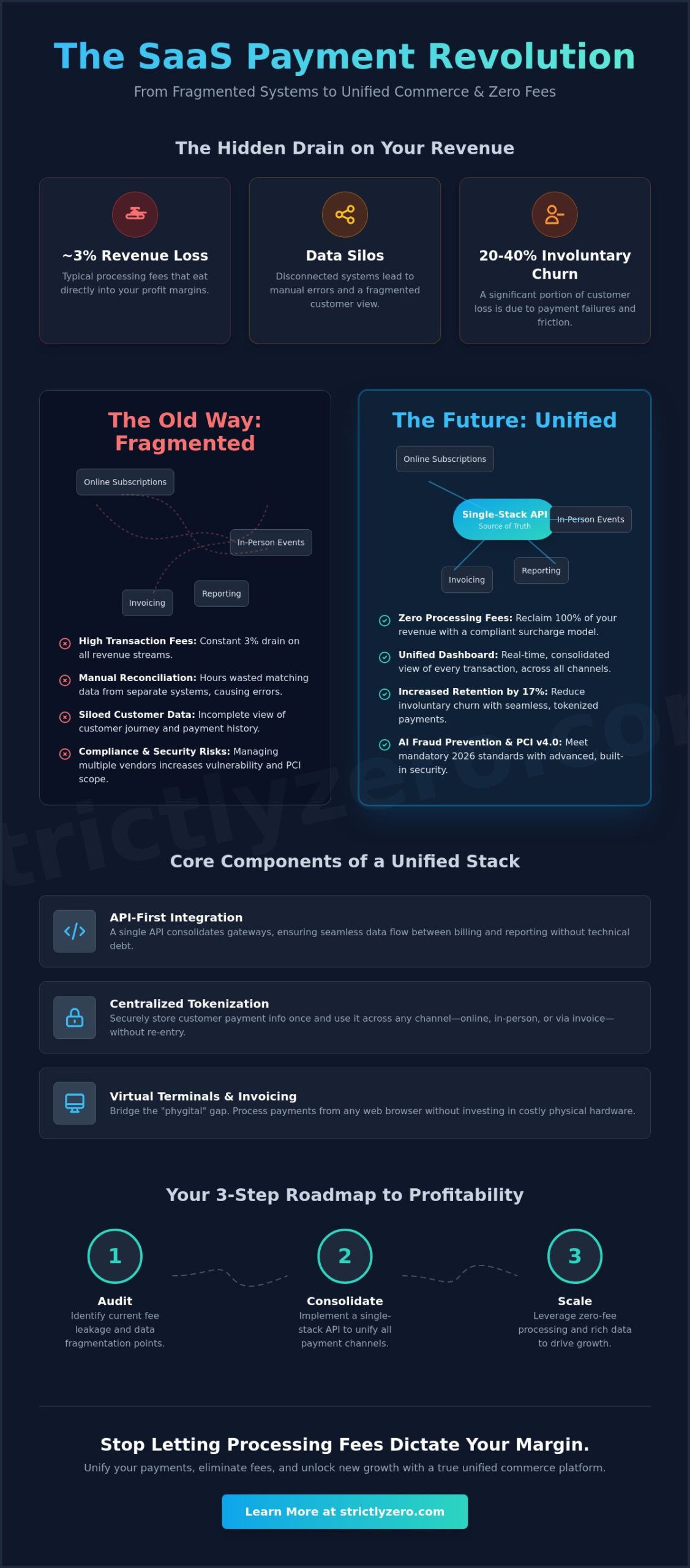
Moving beyond omnichannel means moving away from “bolted-on” solutions that don’t talk to each other. In 2026, business agility depends on a single-stack API that syncs customer data and payments in real-time. This level of integration allows for faster decision-making and better responsiveness to market shifts. Some industry reports suggest that this deep data visibility can drive a 17% increase in customer retention by reducing involuntary churn. This is a critical metric, considering involuntary churn accounts for 20% to 40% of all SaaS customer losses according to recent data.
Key Components of a Unified Payment Stack
A modern stack relies on centralized tokenization. This allows a customer’s payment info to be stored securely and used across any channel without re-entry. It also requires universal merchant accounts that cover both Card-Not-Present (CNP) and Card-Present (CP) transactions. Instead of juggling multiple vendor logins, you get an integrated reporting dashboard. This setup removes the hidden costs of fragmentation and paves the way for a zero-fee model using a surcharge and dual pricing engine. It’s about building a foundation that supports payment processing for saas platforms through virtual terminals and invoicing without the need for expensive physical hardware.
The Architecture of a Unified Payment Stack: API-First Integration
API-first integration is the backbone of modern payment processing for saas platforms. It’s not just about adding features; it’s about building a foundation that doesn’t crumble under technical debt. When you move away from multiple, disconnected gateways, you simplify your developers’ lives and your company’s ledger. This approach is central to effective ecommerce payment processing, where every API call needs to be efficient and secure. By consolidating your stack, you ensure that data flows seamlessly between your billing engine and your financial reporting tools without manual intervention.
SaaS companies don’t need clunky physical registers or expensive proprietary hardware. A virtual terminal allows your team to process payments securely through any web browser. This replaces hardware costs while maintaining the same level of security found in traditional payment systems overseen by regulatory bodies. Centralized tokenization takes this a step further by enabling hybrid workflows. For example, a customer can sign up online and have a sales rep modify their subscription in person at a conference, all without re-entering credit card details. This flexibility is a hallmark of true unified commerce.
Leveraging Virtual Terminals for SaaS Sales Teams
SaaS sales often involve custom contracts and high-touch interactions that happen outside a standard web checkout. Your sales team can use a virtual terminal to close deals over the phone or at trade shows using just a laptop or mobile device. It’s safe, professional, and integrates directly with your invoicing system. This ensures that enterprise-level deals are captured immediately in your single-view dashboard. You can explore our unified processing tools to see how they can streamline these high-touch sales workflows.
Security and Compliance in a Single Stack
Security is a major concern now that PCI DSS v4.0 is mandatory for all organizations processing card data. By using a single stack, you reduce the surface area for potential breaches. Instead of securing three different platforms, you secure one. This consolidation makes it much easier to achieve and maintain compliance across all touchpoints simultaneously. Our AI-driven fraud prevention analyzes patterns across all your channels. It learns from every transaction, whether it’s a recurring web subscription or a manual invoice payment, to identify and block threats before they impact your revenue.
Strategic Advantages: Data Intelligence and the Zero-Fee Advantage
Many SaaS companies treat merchant fees as a fixed tax on their growth. When you use multiple vendors for different regions or sales channels, your effective rate often creeps higher than the standard 2.9% + $0.30 you might expect. These hidden costs of fragmentation are the silent killers of SaaS margins. By moving to a model of zero fee credit card processing, you flip the script. This approach allows payment processing for saas platforms to become a revenue-neutral operation rather than a constant drain on resources. You gain a massive capital advantage over competitors who are still losing nearly 3% of every dollar to legacy processors.
Unified data provides more than just cost savings; it offers deep visibility into customer behavior. When your payment data is no longer siloed, you can create smarter pricing tiers and personalized loyalty programs that actually move the needle. You’re not just guessing what your customers want. You’re using real-time transaction history to inform your product roadmap. This intelligence is the ultimate competitive edge in a crowded market where every percentage point of margin counts toward your valuation.
Eliminating Merchant Fees with Smart Surcharging
The core of the zero-fee model is our Surcharge and Dual Pricing Engine. This technology detects card types in real-time during the checkout process. It identifies whether a customer is using a credit card or a debit card and applies the appropriate pricing model instantly. This allows you to pass processing costs to customers compliantly in all 50 states. While some worry about friction, there’s a clear psychological shift happening. Most customers accept small convenience fees for SaaS products that provide high value, especially when compared to the rising costs of traditional software licenses.
Unlocking Merchant Intelligence with ChurnIQ™
Involuntary churn, often caused by billing system failures or expired cards, accounts for 20% to 40% of all customer churn for SaaS businesses. Our ChurnIQ™ tool uses unified payment data to identify “at-risk” subscribers before they have a chance to cancel. By analyzing cross-channel purchase history, the system can predict behavior and automate retention strategies. For example, if a user’s card is nearing expiration, the system can trigger an automated update request via our integrated invoicing tool. This proactive approach saves revenue that would otherwise be lost to simple administrative errors.
By leveraging these tools, you transform your payment stack from a back-office necessity into a front-line growth engine. You stop paying for the privilege of receiving money and start using your transaction data to build a more resilient, profitable business.
Implementation Roadmap: Bridging the Phygital Gap Without Friction
Transitioning to a unified model doesn’t require an overnight overhaul of your entire infrastructure. Instead, it’s about a strategic migration that plugs revenue leaks while enhancing the customer experience. For payment processing for saas platforms, the first step is a thorough audit of your current fee leakage. This includes identifying where fragmented vendors are inflating your effective rate across web and sales-assisted channels. You’ll often find that manual reconciliation is costing you more in labor than the actual transaction fees themselves.
Once you’ve identified the gaps, the next phase is consolidation. You should move your operations to an API-first processor that provides a secure virtual terminal. This allows your sales team to handle enterprise deals without needing physical hardware. After consolidation, configure your state-by-state surcharge settings to ensure every transaction remains compliant with local regulations. Finally, launch cross-channel loyalty features and use ChurnIQ™ to monitor residuals and subscriber health. This five-step process turns your payment stack into a profit center.
Navigating Surcharge Compliance
Compliance is often the biggest hurdle for SaaS companies looking to eliminate fees. Our automated engine handles the heavy lifting by detecting the card type and location in real-time. It’s vital to remember that while you can surcharge credit cards in all 50 states, debit cards are legally restricted from these fees. The system automatically manages these nuances for you. Proper disclosure is also required, especially for in-person sales at events. You must ensure that your virtual terminal and invoices clearly show any applied fees to maintain 100% legal processing. You can get started with our compliant surcharge engine to automate this entire process.
Training Your Team for Unified Commerce
A unified stack only works if your team knows how to use it. Fortunately, a single dashboard simplifies the training process significantly. Your sales staff can manage the entire checkout process, from initial deposit to recurring billing, in one place. This visibility empowers employees with customer insights right at the point of sale, allowing them to handle returns or exchanges across different channels without confusion. By removing the need for multiple logins and complex software, you reduce the risk of human error and improve overall operational efficiency. This level of clarity is a cornerstone of modern payment processing for saas platforms.
Scaling with Strictly: The Unified Platform Designed for SaaS Growth
Scaling a SaaS platform isn’t just about adding users; it’s about ensuring your infrastructure handles increased volume without leaking revenue. Strictly provides the trust you need as a processor while acting as a strategic partner for your development team. We’ve built our system to handle the complexities of unified commerce from the ground up, ensuring that as you grow, your payment stack remains a source of profit rather than a cost center. This is why the best credit card processing for small business in 2026 must be unified. If your payment processing for saas platforms remains fragmented, you’re essentially leaving money on the table every time you scale.
Managing partner compensation is often a manual nightmare for growing platforms. Our ClearSplit™ technology automates partner compensation across every merchant channel you operate. Whether you’re dealing with referral fees, commissions, or complex revenue-sharing agreements, the system executes these splits instantly. This level of automation allows you to focus on high-level growth rather than getting bogged down in spreadsheets. By consolidating your operations, you gain the agility needed to outpace competitors who are still tethered to legacy, multi-vendor setups.
Tools for ISOs, MSPs, and Developers
Many ISOs and MSPs struggle to offer a modern, unified experience to their clients. By white-labeling our unified gateway, you can provide a high-end solution under your own SaaS brand. Our payment processing platform for ISOs is specifically designed for high-volume portfolio management. You can automate the calculation and distribution of residuals, allowing you to scale your payments business without increasing your administrative headcount. It’s a foundation built for developers who need reliable APIs and partners who need transparent management tools.
Future-Proofing Your SaaS for 2026 and Beyond
The payments landscape is evolving toward invisible and biometric transactions where friction is almost non-existent. Strictly uses AI-driven fraud prevention and smart pricing engines to maintain your $0 fee structure even as industry regulations shift. By adopting a unified stack now, you’re preparing your platform for the next wave of “phygital” commerce. You’ll have the data intelligence to adapt to new consumer behaviors without needing to rebuild your backend every few years. Ready to unify? Contact Strictly to eliminate your processing fees today.
Take Control of Your SaaS Revenue in 2026
Transitioning to unified commerce isn’t just about technical efficiency; it’s a strategic move to protect your margins. By consolidating your stack, you eliminate the data silos that lead to reconciliation errors and revenue leakage. Effective payment processing for saas platforms now requires a shift toward zero-fee models that leverage compliant surcharging to reclaim lost capital. You’ve seen how API-first integration simplifies operations and how data intelligence can stop churn before it starts.
You don’t have to navigate these complexities alone. Our Smart Pricing Engine ensures 50-state compliance automatically, while ClearSplit™ handles the heavy lifting of partner residuals. With ChurnIQ™ providing the merchant retention intelligence you need to stop involuntary churn, your platform is built for sustainable growth. It’s time to stop letting processing fees dictate your profitability and start scaling with a partner that values your bottom line.
Eliminate your processing fees and unify your payments with Strictly today. Building a future-proof SaaS platform starts with a foundation of trust and transparency. You have the roadmap; now it’s time to take the first step toward a fee-free future.
Frequently Asked Questions
What is the difference between omnichannel and unified payments for SaaS?
Unified payments merge all sales channels into a single backend architecture, while omnichannel simply connects separate systems. This single-stack approach ensures that your web subscriptions and in-person sales share the same data pool. You won’t have to worry about syncing inventory or customer profiles between different platforms because they already exist in one place. It’s the most efficient way to manage payment processing for saas platforms that operate across multiple touchpoints.
Can I use a surcharge program for both online and in-store sales?
You can implement a surcharge program for both online and in-person transactions using a compliant dual pricing engine. The system identifies the card type in real-time to ensure fees are only applied to credit cards, as debit card surcharging is restricted. Whether a customer pays through your web portal or a virtual terminal at a trade show, the compliance engine handles the calculations automatically to keep your business within legal guidelines.
How does a unified payment system help with SaaS accounting and reconciliation?
A unified system simplifies accounting by consolidating all transaction data into a single dashboard for real-time reporting. This removes the need for manual reconciliation between different gateways and merchant accounts, which often leads to human error. Your finance team can view every subscription payment and manual invoice in one place. This transparency reduces the time spent on month-end closing and ensures your books stay accurate as you scale.
Do I need special hardware to unify my in-store and online payments?
You don’t need to purchase or maintain physical POS hardware to unify your payment channels. A secure virtual terminal allows your sales team to process in-person payments using any laptop, tablet, or mobile device. This approach is ideal for SaaS companies that occasionally need to take payments at events or via phone without the overhead of traditional card readers. It keeps your hardware costs at zero while maintaining full security.
Is it legal to pass credit card processing fees to customers in every state?
It is legal to pass credit card processing fees to customers in all 50 states, though specific disclosure requirements apply in each jurisdiction. Our automated engine manages these state-by-state variations to ensure your surcharge program remains compliant. It’s important to remember that you cannot legally surcharge debit cards. The system automatically detects debit transactions and bypasses the fee to ensure your payment processing for saas platforms stays 100% legal.
How long does it take to implement a unified payment platform for a SaaS?
Implementation timelines vary based on your existing technical stack and specific integration requirements. API-first platforms are designed for rapid deployment, often allowing developers to begin testing in a sandbox environment within a short timeframe. While a full migration of legacy data might take longer, the use of standardized documentation and partner management tools helps streamline the process. You should consult with your technical team to establish a specific roadmap for your platform’s needs.
What happens if a customer buys online and wants to return the item in-store?
Unified commerce enables “Buy Online, Return In-Store” (BORIS) workflows through centralized tokenization. Since the customer’s payment data is stored in a single secure vault, your staff can access the original transaction and issue a refund regardless of where the purchase happened. There’s no need for the customer to present their physical card again or for your team to hunt through separate systems. This creates a frictionless experience that builds customer trust.
Can I integrate a unified payment system with my existing SaaS billing software?
You can integrate a unified payment system with most modern SaaS billing software through a flexible API. This ensures that your recurring subscription logic remains intact while you benefit from better processing rates and zero-fee models. The integration allows your billing engine to talk directly to the unified processor, syncing transaction results and customer updates in real-time. It’s a powerful way to upgrade your financial infrastructure without replacing your entire software stack.