
Payment Processing Solutions for Service Businesses: The 2026 Guide to Maximizing Margins
Published:

What if your largest service contract didn’t come with a hidden 4% tax paid directly to a credit card company? For most providers, losing thousands of dollars to transaction fees feels like an unavoidable cost of doing business. You work hard to deliver professional results, yet standard payment processing solutions for service businesses often eat 3% to 4% of your gross revenue before you even see a dime. It’s frustrating to watch your profit margins shrink while you wait days for funds to clear and worry about whether your billing practices meet the latest PCI DSS v4.0.1 requirements.
You don’t have to settle for retail rates in a professional service world. This guide shows you how to eliminate those processing fees entirely and streamline your cash flow with modern, compliant solutions. We’ll explore the shift toward real-time payments, the legality of surcharging in 2026, and how to use virtual terminals to get paid instantly without needing a physical storefront.
Key Takeaways
- Learn why generic retail processors drain service margins and how specialized systems provide the flexibility needed for high-value contracts.
- Discover how to collect payments instantly via SMS or browser-based virtual terminals, eliminating the need for expensive physical hardware.
- Master the “Zero-Fee” model to compliantly pass credit card costs to customers using advanced payment processing solutions for service businesses.
- Stay ahead of 2026 regulatory shifts by understanding PCI DSS v4.0.1 requirements and state-specific surcharging laws to avoid costly legal penalties.
- Unify your invoicing, mobile collections, and fraud prevention into a single dashboard to scale your operations with total financial visibility.
Table of Contents
- Why Service Businesses Need Specialized Payment Processing Solutions in 2026
- Virtual Terminals and Payment Links: The Backbone of Service Payments
- The Cost of Doing Business: Traditional Fees vs. Zero-Fee Surcharging
- Navigating Compliance and Security for Professional Service Providers
- Scaling Your Service Business with Strictly’s Unified Payment Platform
Why Service Businesses Need Specialized Payment Processing Solutions in 2026
Service businesses like law firms, HVAC companies, and consultants don’t operate like a coffee shop. While a retail store needs to process hundreds of small transactions, a service provider might handle five $5,000 contracts in a single month. A payment processor designed for high-volume retail often fails to account for these larger ticket sizes and the complexities of remote billing. Relying on standard payment processing solutions for service businesses that were built for a physical checkout counter can lead to unnecessary overhead and delayed cash flow.
To better understand how the industry is shifting toward more efficient models, watch this helpful video:
Service vs. Retail: The Critical Difference in Payments
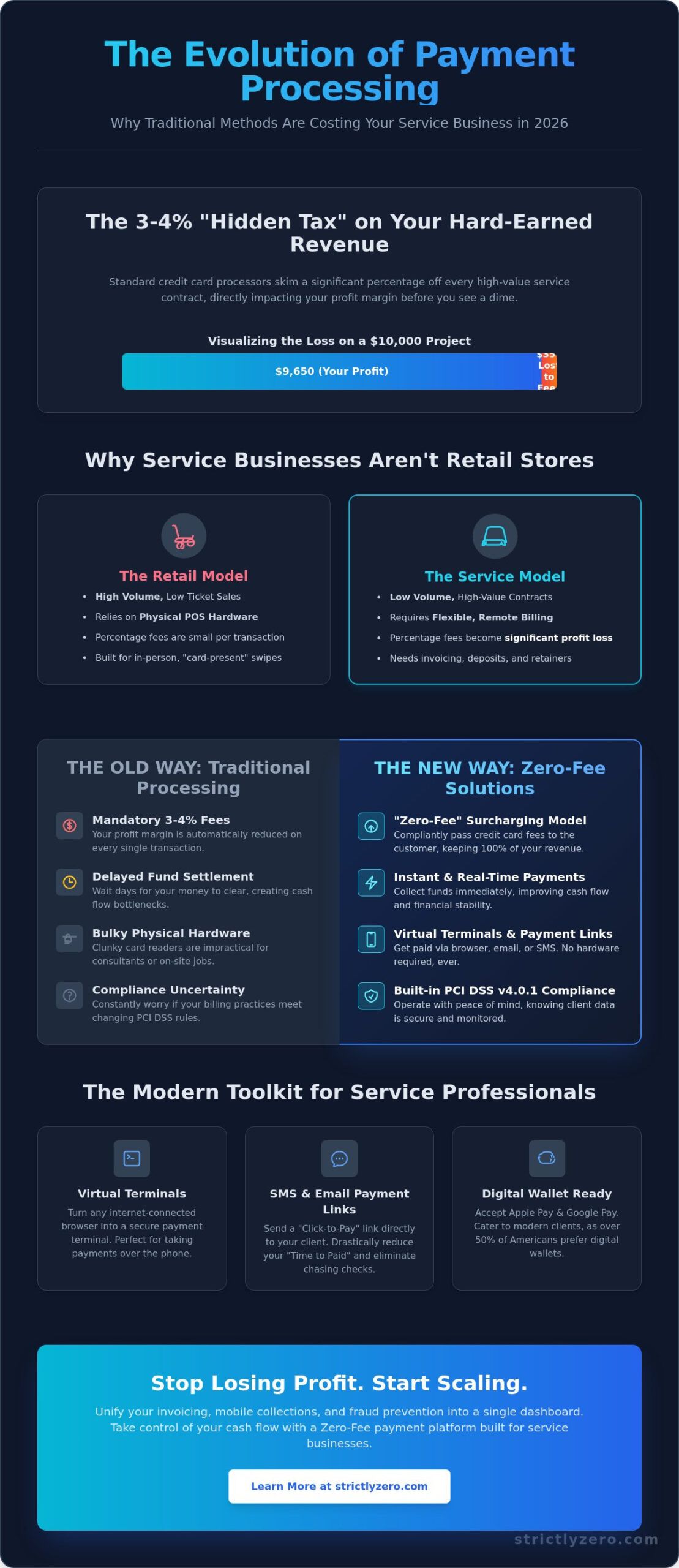
Physical POS terminals are a relic for most service providers. If you’re a consultant working from a home office or a plumber on a job site, carrying a bulky card reader is often more trouble than it’s worth. High-ticket service contracts amplify the pain of percentage-based fees. On a $10,000 project, a standard 3% fee isn’t just pocket change; it’s $300 taken directly from your net profit. Retail-focused platforms also lack the sophisticated invoicing tools needed to handle deposits, progress payments, and recurring retainers that keep a professional service business healthy.
The 2026 Landscape for Service Providers
Consumer behavior has shifted dramatically. More than half of Americans now use digital wallets like Apple Pay more frequently than traditional cards. Clients expect to pay an invoice with a single click from their smartphone, not mail a check or call in a credit card number. This digital-first environment has paved the way for zero fee credit card processing to become the industry standard. In an era where trust is the primary currency, providing a secure, professional, and friction-free payment experience is how you differentiate your brand. Using specialized payment processing solutions for service businesses ensures you meet these expectations while protecting your margins from the retail tax. Compliance is also non-negotiable; as of 2026, all businesses must be fully aligned with PCI DSS v4.0.1 standards to ensure continuous monitoring and security of client data.
Virtual Terminals and Payment Links: The Backbone of Service Payments
Virtual terminals and payment links are the true workhorses for modern service providers. Unlike retail stores that rely on physical hardware, service businesses thrive on flexibility. Whether you’re an architect closing a deal over the phone or a landscaper sending an invoice from the field, you need payment processing solutions for service businesses that don’t require a card swipe. A virtual terminal allows you to enter credit card details directly into a secure web browser. This eliminates the need for bulky equipment and ensures you can get paid anywhere you have an internet connection.
Payment links take this convenience even further. Instead of waiting for a client to log into a portal, you can send a direct link via SMS or email. This creates a frictionless path to payment. Since more than half of Americans now use digital wallets more frequently than physical cards as of 2026, providing a “Click-to-Pay” option is essential. It dramatically reduces your “Time to Paid” and cuts out the administrative headache of chasing down late checks. Modern payment processing solutions for service businesses make this transition effortless by automating the entire billing cycle.
Maximizing Efficiency with a Virtual Gateway
Security is a major concern when handling card-not-present transactions. Using a robust virtual gateway ensures that every phone order is encrypted and compliant with the latest security standards. One of the biggest advantages is tokenization. This technology allows you to store customer card data securely without actually keeping the sensitive numbers on your own servers. It makes recurring billing for retainer-based services seamless. When you integrate your terminal with your CRM, you create a unified workflow that saves hours of manual data entry every week.
Invoicing and Payment Links: Getting Paid Faster
The psychology of a digital invoice is powerful. When a client receives a professional, branded email with a clear “Pay Now” button, they’re far more likely to settle the bill immediately. Paper checks often sit on desks for weeks. In contrast, a digital link can be paid in under 30 seconds. You can also automate the follow-up process. Instead of making awkward phone calls about overdue balances, your system can send automated, polite reminders. This reduces administrative overhead and keeps your cash flow steady. If you’re ready to modernize your billing, you might want to explore a unified invoicing platform that handles the heavy lifting for you.
The Cost of Doing Business: Traditional Fees vs. Zero-Fee Surcharging
Accepting credit cards often feels like a partnership where you do all the work and the bank takes the reward. For high-ticket providers, standard payment processing solutions for service businesses often hide the true cost of these transactions under a single, simplified percentage. In reality, that fee is split into three distinct parts: interchange fees set by the card-issuing banks, assessment fees from the card networks, and the processor’s markup. On a $10,000 service contract, these layers of fees can strip away $300 to $400 from your revenue. When your business deals in high-value expertise rather than high-volume inventory, losing that much profit on every invoice is unsustainable.
Understanding the Zero-Fee Revolution
The rise of zero fee merchant services has flipped this dynamic. Instead of the business owner subsidizing the client’s travel points or cash-back rewards, the surcharge model passes the cost of convenience to the cardholder. While some owners fear this might alienate clients, the reality in 2026 is that transparency builds professional respect. Service providers are uniquely positioned for this model because their relationships are based on value and trust. Most clients are happy to pay via ACH or check to avoid the fee, or they’ll knowingly pay the surcharge for the convenience of using their credit line.
Comparing the Models: Flat Rate vs. Interchange Plus vs. Surcharge
Many providers push flat-rate pricing because it sounds simple, but it’s often the most expensive option for payment processing solutions for service businesses with high average ticket sizes. You’re effectively paying a premium for the “simplicity” of a high, fixed rate. Interchange-plus is more transparent, showing you the raw costs plus a small markup, but you’re still the one losing margin. The Strictly advantage comes from our surcharge engine, which removes the transaction cost from your ledger entirely. By separating the cost of the service from the cost of the payment method, you ensure that your business keeps 100% of the quoted price on every contract.
Navigating Compliance and Security for Professional Service Providers
Compliance in 2026 is a moving target that requires more than just a basic firewall. For firms using payment processing solutions for service businesses, the legal landscape for surcharging has become particularly complex. While surcharging is legal in most of the United States, it remains strictly prohibited in Massachusetts and Connecticut as of May 2026. If you operate across state lines, you can’t apply a blanket fee to every invoice without risking significant legal penalties. You must also adhere to strict disclosure rules, ensuring the surcharge is clearly listed on both the point of sale and the final receipt. Failing to distinguish between card types is another common pitfall; federal law prohibits surcharging debit cards, even when they’re processed as “credit.”
Security standards have also tightened. Since March 31, 2025, all businesses must meet the full requirements of PCI DSS v4.0.1. This standard shifted the focus from periodic checkups to continuous monitoring and validation of security controls. For service providers handling sensitive client data, this means your processing environment must be under constant surveillance to detect and block vulnerabilities before they’re exploited. High-ticket service contracts are prime targets for “friendly fraud” and chargebacks, making AI-driven fraud prevention a necessity rather than a luxury.
Automated Compliance: The Smart Pricing Engine
Manually calculating a legal surcharge is a recipe for disaster. Different card networks have different caps; for instance, Visa limits surcharges to 3%, while the general industry cap is 4%. A smart pricing engine removes this burden by automatically identifying the card type in real-time. If a client enters a debit card number, the engine suppresses the surcharge instantly to keep you compliant. It also adjusts based on the client’s location, ensuring you don’t accidentally charge a fee to a customer in a restricted state like Connecticut. To stay protected, you should implement an automated compliance engine that handles these variables for you.
Security Beyond the Transaction
Protecting your revenue involves more than just hitting “authorize.” You need credit card processing services that offer end-to-end encryption and robust chargeback management tools. In the service industry, a single disputed $5,000 invoice can cripple your monthly cash flow. Modern security audits in 2026 look for processors that use AI to assign risk scores to transactions, flagging suspicious patterns before the funds are even captured. When vetting a partner, prioritize those who offer tokenization to keep sensitive data off your local servers and provide a transparent audit trail for every transaction.
Scaling Your Service Business with Strictly’s Unified Payment Platform
Scaling a professional practice requires more than just high-quality work; it demands a financial infrastructure that protects every dollar earned. Strictly provides specialized payment processing solutions for service businesses that go beyond simple transaction handling. By moving away from generic retail tools, you gain access to a unified platform designed specifically for the high-ticket, card-not-present environment of the service sector. This isn’t just about taking payments. It’s about optimizing your entire cash flow through a single, omni-channel dashboard that tracks every dollar from invoice to deposit. When you choose Strictly for your merchant services, you’re investing in a partner that understands the unique needs of consultants, tradespeople, and professional firms.
The Strictly dashboard offers a comprehensive view of your financial health. Whether you’re processing a retainer through a virtual terminal or a client is paying an invoice via a mobile link, all data flows into one central hub. This eliminates the need to reconcile multiple systems and provides real-time clarity on your actual profit margins. For businesses with recurring revenue models, tools like ChurnIQ™ help identify and prevent payment failures before they lead to lost clients. This ensures your growth remains steady and predictable without the administrative nightmare of manual collections.
The Strictly Advantage for Services
The core of the platform is the Smart Surcharge and Dual Pricing engine. As we explored in previous sections, navigating the legalities of fees in states like New York or Connecticut is a major hurdle for growing firms. Strictly’s technology handles these complexities automatically, ensuring you stay compliant while eliminating the 3% to 4% fee typically associated with credit cards. For firms with custom software or specialized workflows, the API-first architecture allows for seamless integration. You can embed the power of zero-fee payment processing solutions for service businesses directly into your existing client portal or mobile app without rebuilding your entire tech stack.
Ready to Eliminate Fees?
Transitioning to a modern payment model shouldn’t be a headache. The process begins with a comprehensive, free processing audit to identify exactly where your current provider is hiding extra costs. Once you’re ready to switch, the onboarding process is designed for speed. Most service businesses are up and running with their new virtual terminal and invoicing tools within 24 to 48 hours. You don’t have to wait weeks for hardware or complex approvals. If you’re tired of watching your margins shrink every time a client pays, it’s time to scale your service business with Strictly today and keep your profits where they belong.
Secure Your Future Margins Today
The landscape of 2026 demands more than just a simple way to swipe cards. You’ve seen how specialized payment processing solutions for service businesses can transform your bottom line by removing the 3% to 4% “retail tax” that often drains high-ticket contracts. By adopting virtual terminals and automated surcharge engines, you stay ahead of complex state laws while providing the digital-first experience your clients now expect.
Scaling your firm requires a foundation of trust and security. With Strictly’s omni-channel platform, you gain access to a Smart Pricing Engine that ensures 100% compliance across all jurisdictions; alongside AI-Driven Fraud Prevention to protect your most valuable transactions. You don’t have to choose between convenience and profitability. It’s about working smarter to protect your revenue.
Switch to Strictly and Eliminate Your Processing Fees Today
It’s time to stop acting as a financier for credit card companies and start keeping every dollar you earn. Your hard-earned margins deserve to stay in your business.
Frequently Asked Questions
Is it legal to pass credit card processing fees to my customers in 2026?
Yes, surcharging is legal in most U.S. states as of May 2026, though it remains prohibited in Massachusetts and Connecticut. You must clearly disclose the fee at the point of sale and on the client’s receipt. The surcharge cannot exceed your actual cost of acceptance or a cap of 4%; note that Visa specifically caps these fees at 3%.
What is the difference between a surcharge and a convenience fee for services?
A surcharge is a fee added specifically for the use of a credit card to cover processing costs. In contrast, a convenience fee is charged for using a non-standard payment channel, such as paying via a web portal when the business typically accepts payments in person. Convenience fees must usually be a flat, fixed amount rather than a percentage of the total.
How do I accept credit card payments if I don’t have a physical store?
You can use digital-first payment processing solutions for service businesses like virtual terminals and payment links. These tools allow you to take payments through any web browser or send secure links via SMS and email. This setup is ideal for consultants and contractors who work remotely and don’t need a traditional checkout counter or physical hardware to get paid.
Can I surcharge debit card transactions?
No, it’s illegal to apply a surcharge to debit card transactions under federal law. This rule applies even if the client chooses to run their debit card as “credit” at the time of payment. To stay compliant, you need a smart pricing engine that automatically detects the card type and suppresses the fee whenever a debit card is used by the customer.
What is a virtual terminal and how does it work for my service business?
A virtual terminal is a secure web-based application that turns your computer, tablet, or smartphone into a payment processing solutions for service businesses hub. You simply log in to a dashboard and manually enter the client’s card information for phone orders or remote billing. It’s a professional way to handle card-not-present transactions without the need for physical card-swiping equipment.
How long does it take for funds from a service payment to reach my bank account?
Standard settlement typically takes one to three business days. However, by 2026, many providers have adopted real-time payment networks like FedNow and RTP for immediate settlement of funds. If you need faster access, some processors offer instant payouts for a small fee, allowing you to move money to your bank account within minutes of a successful transaction.
What are the PCI compliance requirements for a small service business?
All businesses must be fully compliant with PCI DSS v4.0.1 as of May 2026. This version of the security standard requires you to implement continuous monitoring and validation of your security controls. Even if you don’t use physical hardware, you’re responsible for ensuring that any digital environment where you handle or store client card data meets these rigorous encryption and safety standards.
How can I tell my clients about a new surcharge fee without losing them?
Transparency is the best way to handle this transition. Frame the surcharge as a way to keep your base service rates competitive while offering clients the choice of how they pay. Many businesses find success with a dual-pricing model. This allows you to show a “cash price” for ACH or check payments alongside a “card price,” giving the client total control over the final cost.