
Virtual Terminal Credit Card Processing: 2026 Guide
Published:

Why are you still paying monthly rental fees for a piece of plastic hardware when every device you already own is a high-performance payment station? It’s a common frustration for modern business owners who feel trapped by hardware bloat and the constant drain of watching 3% of every remote sale disappear into processing fees. You’ve likely dealt with the headache of manual billing errors or the looming stress of staying compliant with the latest PCI DSS v4.0 requirements.
This guide explains how a modern virtual terminal for credit card processing transforms your computer or mobile device into a secure, professional checkout without the need for expensive equipment or a complex website. You’ll learn how to leverage a smart surcharge and dual pricing engine to offset transaction costs legally and safely. We will also cover how AI-driven fraud prevention and unified dashboards can streamline your remote payments, ensuring you get paid faster while keeping your margins intact throughout 2026.
Key Takeaways
- Eliminate the need for expensive physical hardware by transforming any internet-connected device into a secure, professional payment station.
- Learn how a virtual terminal for credit card processing can help you achieve a $0 processing fee business model using compliant surcharge and dual pricing engines.
- Streamline remote and phone-based sales by securely entering card details into a unified web-based dashboard from anywhere with an internet connection.
- Protect your business and customer data with AI-driven fraud prevention and built-in compliance with the latest PCI DSS 4.0 standards.
- Connect your remote payments to a larger omni-channel ecosystem that integrates invoicing, payment links, and real-time transaction data in one place.
Table of Contents
- What is a Virtual Terminal for Credit Card Processing?
- How Virtual Terminals Work: The Path from Entry to Deposit
- Virtual Terminal vs. Physical POS: Which is Right for You?
- Setting Up Your Virtual Terminal for Zero-Fee Processing
- Why Strictly’s Virtual Terminal is the Strategic Choice for 2026
What is a Virtual Terminal for Credit Card Processing?
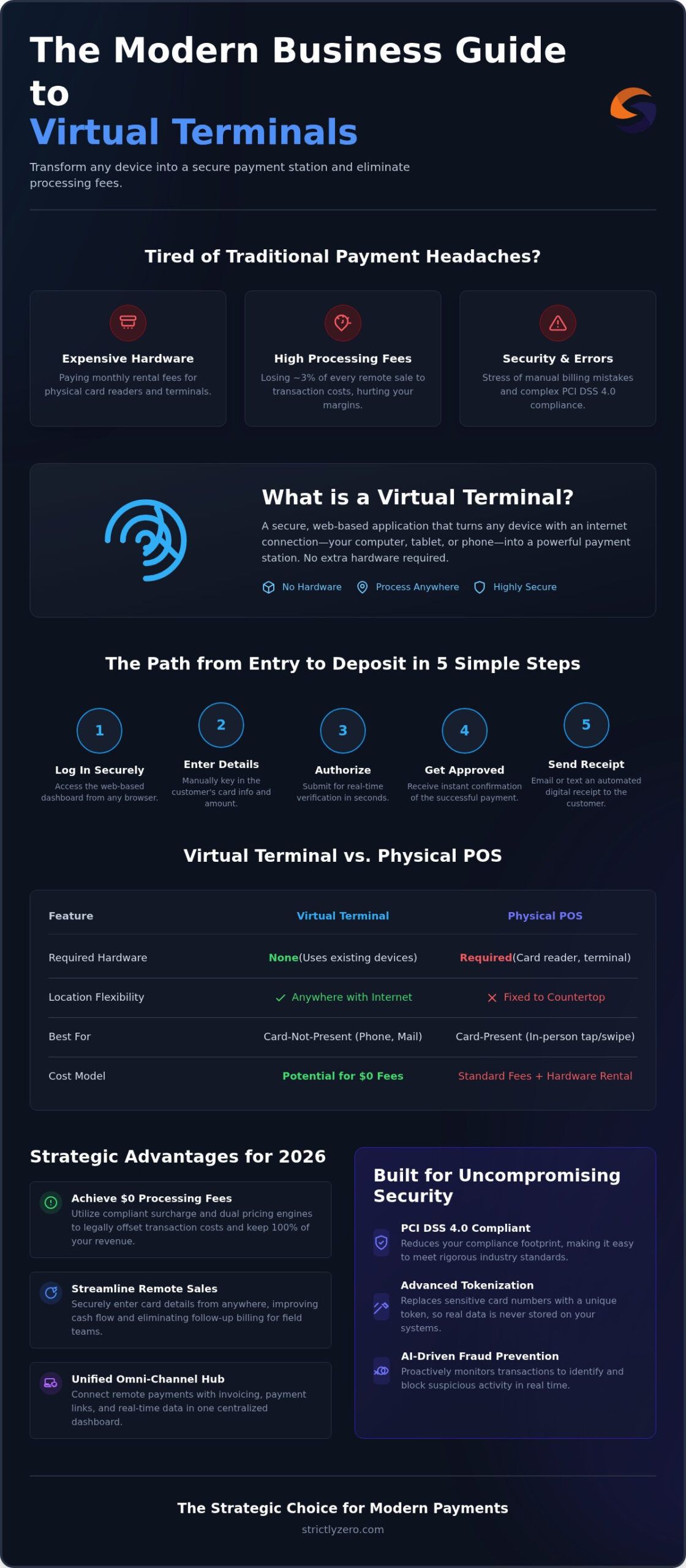
A virtual terminal for credit card processing is a secure, web-based application that turns any device with an internet connection into a functional payment station. It’s the digital equivalent of the card swiper found at a retail checkout counter, but it doesn’t require any proprietary hardware. For businesses that handle Card-Not-Present (CNP) transactions, such as phone orders or mail-in payments, it is an essential tool. You simply log into a dashboard, enter the customer’s billing information, and process the sale instantly. This setup eliminates the clutter of paper receipts and the high costs associated with maintaining dedicated analog phone lines.
To better understand this concept, watch this helpful video:
Security remains the top priority for merchants in 2026. Using a virtual terminal ensures that sensitive cardholder data is encrypted at the point of entry and transmitted directly to the processor. Since the information doesn’t live on your local computer or office server, you reduce your compliance footprint. This makes meeting the rigorous standards of PCI DSS 4.0 much easier for small and mid-sized businesses that don’t have dedicated IT security teams.
Virtual Terminal vs. Payment Gateway: Understanding the Difference
Many business owners get these two terms confused. Think of the payment gateway as the “pipe” that moves data securely between the merchant, the bank, and the card networks. The virtual terminal is the “faucet” or the user interface you interact with to start that flow. While an e-commerce website uses a gateway to process invisible transactions, a virtual terminal is used by a human to manually key in data. For maximum efficiency, you should look for an omni-channel platform that integrates both. This unified approach reduces reconciliation time and helps prevent the manual entry errors that lead to costly billing disputes.
Key Use Cases for Virtual Terminals in 2026
The shift toward remote work and digital-first services has made the virtual terminal for credit card processing a versatile asset across several sectors:
- Professional Services: Lawyers, accountants, and consultants use these portals to take retainers or billable hours over the phone without requiring the client to visit an office.
- Wholesale and B2B: Large-scale suppliers use virtual terminals to process high-ticket invoices. This avoids the need for a physical storefront while still providing a professional payment experience.
- Remote Sales Teams: Field reps and service technicians can collect payments or deposits on-site using a mobile browser. This ensures the transaction is finalized immediately, improving cash flow and reducing the need for follow-up billing.
How Virtual Terminals Work: The Path from Entry to Deposit
The journey of a transaction begins when you log into your secure merchant dashboard through a standard web browser. Unlike physical hardware that requires specific cables or local software installations, a virtual terminal for credit card processing is accessible from any internet-connected device. Once you’re inside the portal, you manually enter the customer’s card number, expiration date, CVV, and the total transaction amount. This flexibility allows you to close sales from a home office, a retail floor, or even while traveling.
After you submit the details, the system initiates a real-time authorization through the payment processor’s network. This happens in seconds as the network verifies available funds and security credentials. Once the transaction is approved, the system generates an automated digital receipt that you can email or text to the customer immediately. This digital record-keeping eliminates the clutter of paper slips and ensures your transaction history is organized for instant retrieval during audits or reconciliations.
Security and PCI Compliance in the Cloud
In 2026, protecting customer data is a non-negotiable requirement. Modern systems utilize tokenization, a process where the actual card number is replaced by a unique, non-sensitive “token.” This ensures that the cardholder’s real information is never stored on your computer or local servers. Strictly adds an extra layer of protection by utilizing AI-driven fraud prevention to monitor manual entries for suspicious patterns or high-risk behaviors. While the software handles the technical heavy lifting, merchants still play a vital role in PCI DSS 4.0 compliance by maintaining secure login practices and avoiding the use of physical paper to record card details.
Reporting and Data Management
A major advantage of using a cloud-based system is the ability to view all your financial data in one centralized dashboard. You can track sales across multiple locations or individual sales reps in real time. For businesses looking to save time on bookkeeping, you can export this data directly into accounting software like QuickBooks or Xero. Additionally, the platform includes ChurnIQ™ to provide retention intelligence. This tool identifies at-risk customers by analyzing payment history, giving you the chance to re-engage them before they stop buying. If you’re ready to modernize your workflow, you can explore our virtual terminal solutions to see how these features integrate into your daily operations.
Virtual Terminal vs. Physical POS: Which is Right for You?
Choosing between hardware and software depends largely on your business model. If you run a high-traffic retail store, a physical POS makes sense for quick swipes. However, for many modern businesses, a virtual terminal for credit card processing offers a level of flexibility that hardware simply can’t match. Physical terminals require significant upfront investment and ongoing maintenance. In contrast, a virtual terminal is software-only. It allows you to use the laptops, tablets, or smartphones you already own to accept payments instantly.
Mobility is another major differentiator. Physical POS systems are often tethered to a specific counter or restricted to a local network. In contrast, virtual terminals work anywhere you have Wi-Fi or cellular data. This makes them the superior choice for service providers who bill clients remotely or sales teams working from the field. While a traditional POS is designed for “Card-Present” transactions where a chip is dipped, a virtual terminal is specifically optimized for “Card-Not-Present” security. It ensures that keyed-in data is handled safely without the need for a physical card reader.
The Cost of Hardware Maintenance
Owning hardware involves hidden expenses that go beyond the initial purchase price. You have to account for thermal paper rolls, software updates, and the inevitable downtime when a device fails. Service-based businesses are increasingly ditching these bulky terminals in favor of browser-based tools that don’t break. By integrating credit card processing for small business with mobile access, you can eliminate these physical failure points and reduce your overhead costs significantly.
When to Choose a Hybrid Approach
You don’t always have to choose just one. Many businesses use a hybrid model where a virtual terminal handles back-office billing and phone orders while a physical POS stays at the front desk for walk-in customers. The key is ensuring your data stays synchronized. A robust omni-channel payment processing strategy bridges the gap between these two worlds. It allows you to see all your sales data in one unified dashboard, regardless of whether the card was swiped in person or keyed in over the phone.
Setting Up Your Virtual Terminal for Zero-Fee Processing
Stop viewing payment processing as an inevitable tax on your revenue. In 2026, the most successful merchants are those who treat their virtual terminal for credit card processing as a profit protector rather than a cost center. By implementing a compliant surcharge or dual pricing model, you can effectively eliminate the 3% to 4% drain on your margins. This shift doesn’t require complex coding or expensive hardware; it simply requires a platform that understands the nuances of modern payment regulations.
The core of this strategy is the Smart Pricing Engine. This tool automatically detects whether a customer is using a credit card or a debit card the moment the numbers are entered. Since federal law and card network rules prohibit surcharging debit and prepaid cards, the engine ensures you stay compliant by only applying fees where they are legally permitted. This automated logic removes the guesswork for your staff and protects you from the heavy fines associated with improper fee application.
Navigating Surcharge Compliance in 2026
Compliance is a moving target because state-specific regulations vary wildly. For instance, while most states allow surcharging, Connecticut, Massachusetts, and Maine still prohibit the practice as of 2026. Strictly’s platform uses automated state-by-state rule application to ensure your business follows local laws based on the customer’s location. For service providers operating nationwide, “Dual Pricing” is often the safest bet. It presents a clear cash price alongside a card price, satisfying transparency requirements in every jurisdiction. You can find a deep dive into these regulations in our Zero Fee Credit Card Processing guide.
Communicating Fees to Your Customers
Transparency is the most effective way to build trust and reduce the risk of chargebacks. When taking phone orders, your team should clearly state the total for both payment methods. A simple script like, “Your total is $100 for cash or debit, or $103 for credit,” fulfills your disclosure obligations while giving the customer a choice. Once the transaction is complete, the virtual terminal sends an automated email receipt that clearly itemizes the sale and the surcharge. This level of clarity ensures customers aren’t surprised when they see their bank statement, which significantly lowers the likelihood of payment disputes. If you’re ready to reclaim your margins, you can get started with zero-fee processing today.
Why Strictly’s Virtual Terminal is the Strategic Choice for 2026
Choosing a virtual terminal for credit card processing isn’t just about finding a way to key in numbers; it’s about selecting a partner that protects your bottom line. While many providers offer basic entry screens, Strictly provides a comprehensive financial ecosystem. Our platform is designed to eliminate the standard 3% to 4% processing fees that eat into your margins. By utilizing the industry’s most advanced surcharge and dual pricing engine, you can finally keep the full amount of every sale while remaining fully compliant with state and federal regulations.
Security isn’t an afterthought or a paid add-on here. Every transaction processed through our terminal is protected by enterprise-grade, AI-driven fraud prevention. This system monitors manual entries in real time, identifying suspicious patterns before they become costly chargebacks. Whether you’re processing your first hundred dollars or managing a global enterprise with billions in annual volume, the infrastructure remains rock-solid. It’s built to scale with your ambition, providing the same high-level performance at every stage of your business growth.
Unified Commerce: Beyond Just a Terminal
A standalone terminal can create data silos that make reconciliation a nightmare. Strictly solves this by connecting your virtual terminal to our broader zero fee merchant services. This means your manual entries, digital invoices, and e-commerce sales all flow into one unified dashboard. If a customer isn’t ready to pay over the phone, you can instantly generate a payment link and send it via text or email. For businesses with complex structures, you also gain access to ClearSplit™. This tool automates partner or affiliate payouts, ensuring that everyone gets paid their share without manual spreadsheets or errors.
Getting Started with Strictly
We know that time is money, especially when you’re waiting to get paid. That’s why we’ve streamlined our onboarding process to be as fast as possible. Most merchants can move from application to their first live transaction within 24 hours. We don’t believe in trapping our partners with long-term contracts or hidden “junk” fees that show up unexpectedly on your statement. Our goal is to provide a transparent, high-performance platform that proves its value every day. Ready to stop paying for processing? Get started with Strictly today and join the zero-fee revolution.
Future-Proof Your Payments with Zero-Fee Technology
The landscape of 2026 demands more than just a place to swipe cards. Adopting a virtual terminal for credit card processing is a strategic move for businesses that want to ditch hardware costs and protect their margins. You’ve seen how easy it is to set up a secure, web-based station that handles everything from phone orders to complex invoicing. By leveraging a compliant Smart Pricing Engine, you can finally move away from the high costs of traditional processing and keep more of what you earn.
With AI-driven fraud prevention and a unified omni-channel dashboard, your data stays safe while your operations remain streamlined across every sales channel. This isn’t just about taking payments; it’s about building a scalable infrastructure that supports your growth without the weight of unnecessary fees. It’s time to stop letting transaction costs eat into your hard-earned profit and start using tools that work for your bottom line. Take control of your revenue today and build a more resilient, profitable business for the years ahead.
Eliminate your processing fees with Strictly’s Virtual Terminal
Frequently Asked Questions
Is a virtual terminal safe for taking credit card numbers over the phone?
Yes, using a virtual terminal is highly secure for phone orders because sensitive card data is encrypted and tokenized immediately. This ensures the actual card number never touches your local servers or computer storage. Strictly also includes AI-driven fraud prevention as standard, which monitors for suspicious patterns during manual entry. This setup helps your business maintain compliance with the latest PCI DSS 4.0 standards while protecting your customers from data breaches.
Can I use a virtual terminal on my smartphone or tablet?
You can absolutely use a virtual terminal on your smartphone or tablet. Since the platform is web-based, you don’t need to download specific apps or buy proprietary hardware. You simply log into your secure dashboard through any mobile browser like Chrome or Safari. This flexibility allows your sales team to process payments from the field or a home office, turning any internet-connected mobile device into a professional payment station.
How do I avoid high fees when using a virtual terminal?
To avoid high fees, you should implement a compliant surcharge or dual pricing program within your virtual terminal for credit card processing. This model allows you to pass the cost of the transaction onto the customer when they choose to pay by credit card. By using a smart pricing engine that automatically detects debit cards to ensure compliance, you can effectively reach a $0 processing fee model and protect your business margins.
Do I need a merchant account to use a virtual terminal?
Yes, you need a merchant account to use a virtual terminal. The virtual terminal is the interface you use to enter data, but the merchant account is the underlying financial account that allows you to accept and settle credit card funds. Strictly acts as your payment processor to provide this integrated setup, ensuring that your manual entries and digital sales all flow into one unified merchant account for easier reporting and faster deposits.
What is the difference between a virtual terminal and a payment link?
The main difference lies in who enters the payment data. A virtual terminal requires the merchant to manually key in the card details, which is ideal for phone or mail orders. A payment link is a URL you send to a customer so they can enter their own details on their own device. Both tools are part of an omni-channel system, but they serve different customer preferences and security workflows.
Are there monthly fees for using Strictly’s virtual terminal?
Strictly focuses on transparent pricing without hidden “junk” fees or long-term contracts. While we don’t list specific monthly costs, our platform is built to help you eliminate processing costs through our surcharge and dual pricing programs. This approach ensures that the value you receive from the unified dashboard and AI-driven fraud prevention supports your bottom line. Our goal is to provide a scalable infrastructure that grows with your business from day one.
How does Strictly ensure my surcharge program is compliant with state laws?
Strictly ensures compliance through our automated Smart Pricing Engine. This technology detects the card type in real time and applies state-specific surcharge rules based on where your business and customer are located. Since federal law prohibits surcharging debit cards, the system automatically bypasses the fee for those transactions. This removes the manual work from your team and protects you from the legal risks associated with improper fee application across different jurisdictions.
Can I set up recurring billing through a virtual terminal?
Yes, you can easily set up recurring billing through your virtual terminal for credit card processing. This feature is perfect for service providers like lawyers or consultants who bill clients on a regular schedule. You can store customer profiles securely using tokenization and schedule automated payments for weekly, monthly, or custom intervals. This automation reduces the need for manual follow-ups and ensures your cash flow remains consistent without additional administrative work.