
What Are Interchange Fees? A 2026 Guide to Credit Card Swipe Fees
Published:

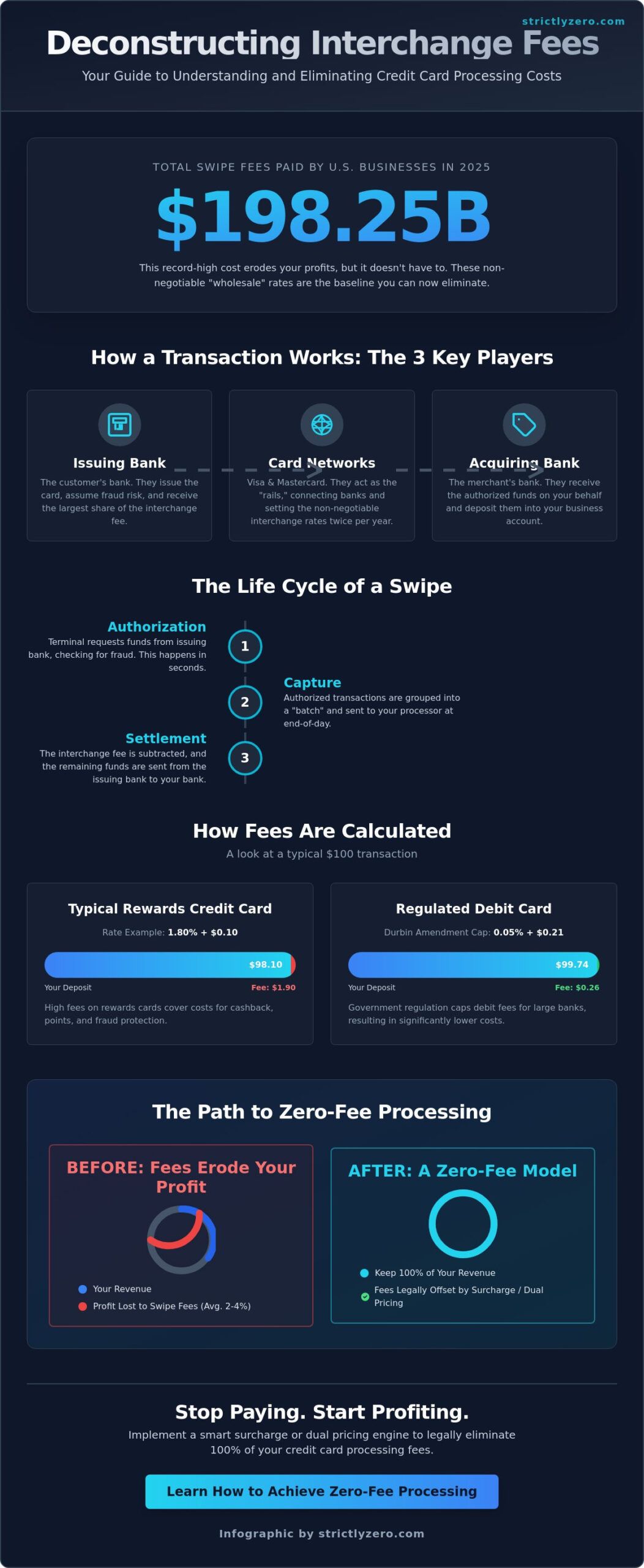
In 2025, U.S. businesses paid a staggering $198.25 billion in swipe fees, a record high that continues to climb as we move through 2026. You probably feel the weight of these costs every time you open a confusing merchant statement and wonder, what are interchange fees, and why do they keep increasing? It’s exhausting to watch your hard-earned revenue vanish into a black box of processing costs without a clear explanation of where that money actually goes.
These fees represent the non-negotiable floor of the payment industry, but they don’t have to be a permanent drain on your resources. We’ll show you how to move from simply paying these costs to eliminating them entirely using smart surcharge and dual pricing engines. This guide breaks down the April 2026 rate updates from Visa and Mastercard, explains the pending Credit Card Competition Act, and provides a clear roadmap to help you identify overcharges and slash your processing overhead for good.
Key Takeaways
- Gain a clear understanding of what are interchange fees and how they function as the non-negotiable foundation of the payment ecosystem.
- Discover the specific variables, from high-tier rewards cards to transaction methods, that determine your final processing costs.
- See how semi-annual rate updates from major networks directly influence your monthly merchant statements.
- Identify the exact ways swipe fees erode your net profit and learn to spot hidden overcharges in your billing.
- Learn how implementing a surcharge and dual pricing engine can legally move your business toward a zero-fee processing model.
Table of Contents
- What Are Interchange Fees? The Foundation of Card Processing
- How Interchange Fees are Calculated and Processed
- Factors That Influence Your Interchange Rates
- The Impact of Swipe Fees on Business Growth
- Eliminating Interchange Costs with Strictly's Zero-Fee Model
What Are Interchange Fees? The Foundation of Card Processing
Every time a customer taps their card at your register, a complex chain of financial handshakes begins. At the center of this process is a cost that represents the “wholesale” price of accepting digital payments. To understand what are interchange fees, you have to look at them as the baseline expense paid from your bank to the customer’s bank. These aren’t fees your processor makes up; they’re the non-negotiable rates set by card networks like Visa and Mastercard to keep the entire payment ecosystem running.
To better understand this concept, watch this helpful video:
While your merchant statement might list these as a single line item, they actually cover the price of convenience and risk. The issuing bank, which is the bank that gave your customer their card, receives the lion’s share of this fee. They take on the risk that the customer might not pay their bill and provide the security infrastructure that keeps the transaction safe. It’s a system designed to ensure that you get paid instantly, even if the customer takes weeks to pay their credit card statement. You’re essentially paying for the guarantee that the funds are valid and will arrive in your account.
The Three Key Players in Every Transaction
Every swipe involves a trio of heavy hitters. First, the Issuing Bank provides the credit or debit card to the consumer and assumes the primary risk of the transaction. Second, the Acquiring Bank, which is your merchant bank, receives the funds on your behalf and manages your account. Finally, the Card Networks like Visa, Mastercard, Discover, and American Express act as the digital “rails” that connect these banks. They don’t actually keep the interchange fees, but they set the prices that determine how much you pay for every transaction.
Why Do Interchange Fees Exist?
It helps to think of these fees as the fuel for the modern economy. They fund massive fraud prevention systems and security infrastructure that protect your business from theft. They also cover the interest-free grace period that credit card users enjoy before their monthly bill is due. Perhaps most importantly for your sales volume, these fees finance the high-end rewards programs, like cashback and travel miles, that incentivize consumers to spend more at your business. Without these fees, the convenience of instant, global credit would likely disappear, forcing businesses back to the slow and risky world of cash and paper checks.
How Interchange Fees are Calculated and Processed
Calculating the true cost of a transaction involves a two part formula: a percentage of the total sale plus a fixed per-transaction fee. For instance, a typical credit card transaction might carry a rate of 1.80% + $0.10. While this sounds straightforward, the specific numbers change constantly. Card networks like Visa and Mastercard update their complex rate schedules twice a year, typically in April and October. As of April 18, 2026, Visa’s latest reimbursement fees are in effect, with rates varying based on card type and merchant category.
Understanding what are interchange fees in the context of your monthly bill means recognizing that these are moving targets. Government regulations also play a role in these calculations. For example, the Durbin Amendment continues to cap debit fees for large banks at $0.21 plus 0.05% of the transaction value. You can find more granular details in the Federal Reserve data on swipe fees, which tracks how these regulated rates affect the broader market. These baseline costs are the starting point before your processor adds their own markup.
The Life Cycle of a Swipe
- Step 1: Authorization – When the customer swipes, the terminal sends a request to the issuing bank to verify funds and check for fraud. This happens in seconds.
- Step 2: Capture – Once authorized, the transaction sits in a “batch.” At the end of the day, you send this batch to your processor to initiate the transfer of money.
- Step 3: Settlement – The issuing bank sends the funds to your acquiring bank. Crucially, they subtract the interchange fee before the money ever reaches your account.
Comparing Pricing Models: Which is Best for You?
Most processors offer one of three pricing structures. Interchange Plus is the most transparent, showing you the exact “wholesale” cost plus a small, flat markup. Flat-rate pricing models offer simplicity by charging one high rate for every transaction, but this often results in you overpaying for low cost debit transactions. Tiered pricing is the least transparent, often grouping various transactions into “qualified” or “non-qualified” buckets that hide the processor’s true profit margins.
If the complexity of these models feels like a burden on your bottom line, implementing a surcharge and dual pricing engine can simplify your life by passing these costs directly to the cardholder. This shift allows you to focus on growth rather than deciphering monthly rate changes. By choosing a model that aligns with your volume, you can stop the slow erosion of your profit margins.
Factors That Influence Your Interchange Rates
The cost of a transaction isn’t just about the total dollar amount; it’s about the metadata attached to every swipe. Factors like the card brand, the security level of the transaction, and even your specific industry category play a role in how interchange rates are set. While card networks publish these rates, your specific mix of customers determines your effective cost. Understanding what are interchange fees in the context of these variables helps you see why your monthly statement varies even when your sales volume stays the same.
The Credit vs. Debit Divide
Debit cards are generally the most affordable for merchants because they’re regulated by the Durbin Amendment. For banks with over $10 billion in assets, the fee is capped at $0.21 + 0.05% of the transaction value. However, credit cards operate on a much wider scale. Premium rewards cards like the “Visa Infinite” or “Mastercard World Elite” carry higher rates because the interchange fee funds the cashback and travel points the cardholder receives. Strictly’s zero fee credit card processing automatically detects these card types in real-time. This ensures compliance while protecting your margins from high-cost rewards cards.
Risk is the other primary driver of cost. A Card-Present (CP) transaction in your store is viewed as lower risk than a Card-Not-Present (CNP) online order. For example, as of April 18, 2026, a regulated Visa Check Card in a Card Present environment has a rate of 0.05% + $0.21. Online transactions often face higher tiers to account for the increased potential for fraud. Additionally, your Merchant Category Code (MCC) places you in a specific “risk bucket.” A grocery store typically enjoys lower rates than a high-risk travel agency or a digital goods provider. If you handle B2B sales, providing Level 2 or Level 3 data, like tax IDs and line-item details, can significantly lower your interchange costs.
Geography and Regulation in 2026
International transactions are almost always more expensive. Cross-border fees apply when the card-issuing bank is in a different country than your business. On the regulatory front, 2026 is a pivotal year for the industry. The Credit Card Competition Act was reintroduced in January 2026. While it remains a pending bill as of May 2026, it aims to force large banks to offer at least two unaffiliated payment networks on their cards. This would theoretically allow you to choose the cheaper “rail” for routing transactions, potentially lowering swipe fees across the board. Staying informed on these legislative shifts, or exploring innovative alternatives like the Fuse blockchain ecosystem for low-cost, last-mile payments, is the only way to keep your overhead from spiraling out of control.
The Impact of Swipe Fees on Business Growth
While the technical side of what are interchange fees is complex, the financial side is painfully simple: they act as a persistent drain on your business’s growth potential. For many low-margin companies, like local retailers or independent restaurants, processing fees don’t just take a small slice of the pie. They can easily consume 20% to 30% of your total net profit. This creates an invisible ceiling on your ability to scale, as every new sale brings with it a mandatory payout to a multibillion-dollar banking institution.
This dynamic often forces you into a difficult corner regarding your pricing. To maintain your margins, you might feel pressured to raise prices for everyone, effectively forcing your cash-paying customers to subsidize the luxury travel rewards and cashback programs of your credit card users. It’s a hidden tax that most merchants pay without realizing they’re the ones funding their customers’ perks. Beyond the direct cost, fee deduction at the source creates cash flow friction. When your processor takes their cut before the funds even hit your bank account, your daily liquidity suffers, making it harder to cover immediate operational expenses.
Calculating Your Effective Rate
To see the true damage, you need to look past the individual transaction rates and calculate your effective rate. You can find this by taking your total monthly fees and dividing them by your total processing volume. If your statement is cluttered with confusing line items, be on the lookout for “junk fees” disguised as interchange. Some processors add their own padding to the network rates, hoping you won’t notice the discrepancy. For a deeper dive into these statements, check out our guide on understanding credit card processing for small business.
The Opportunity Cost of High Fees
The real cost of swipe fees isn’t just the dollar amount on the statement; it’s what that money could’ve done if it stayed in your business. Imagine reinvesting 3% of your annual revenue into a targeted marketing campaign, a new piece of equipment, or better wages for your staff. High-volume businesses often assume they’ll eventually “outgrow” the problem, but without a strategic shift in your processing model, scaling only increases the total amount you lose to the banks. Instead of letting these fees dictate your growth, you can reclaim your profit margins by switching to a model that eliminates these overhead costs entirely.
Eliminating Interchange Costs with Strictly’s Zero-Fee Model
Most financial guides treat the question of what are interchange fees as a discussion about an unavoidable business tax. In 2026, that narrative has shifted. You no longer have to let swipe fees erode your bottom line or dictate your growth strategy. By leveraging a surcharge or dual pricing engine, you can legally move the cost of credit card processing from your balance sheet to the transaction itself. This shift allows you to keep your base prices lower for all customers while ensuring that those who choose the convenience and rewards of a credit card cover the associated “wholesale” costs of the transaction.
The transition to a zero-fee model is becoming the standard for U.S. merchants in 2026. As interchange rates from Visa and Mastercard continue to climb, businesses are realizing that they can’t simply absorb these costs anymore. Surcharging involves adding a small, compliant fee to credit card transactions. Dual pricing, a popular alternative, offers customers a “Cash Price” and a “Card Price,” giving them the choice of how they want to pay. Both methods effectively neutralize the impact of swipe fees on your net profit.
Strictly’s Smart Surcharge Engine
Compliance is the biggest hurdle for businesses looking to eliminate fees, and it’s where most DIY attempts fail. You can’t simply add a fee to every transaction. Federal regulations and the Durbin Amendment make surcharging debit cards illegal. Our engine solves this by using real-time automatic detection at the point of sale. When a card is swiped or tapped, the system identifies the card type in milliseconds. If it’s a debit card, the surcharge is bypassed automatically to keep you within the law. Our technology also handles the nuances of state-level compliance, managing the specific rules that vary from one region to another. This logic is built directly into our omni-channel processing, ensuring your virtual terminal and in-person transactions remain compliant without manual oversight.
How to Transition Your Customers
Moving to a zero-fee model requires transparency and clear communication. It’s not just a best practice; it’s a legal requirement. To stay compliant, you must follow specific steps:
- Clear Signage: Display notices at your entry point and at the register to inform customers of the pricing model before they pay.
- Receipt Transparency: Your receipts must explicitly break down the surcharge as a separate line item so there’s no confusion.
- Value Positioning: Explain to your customers that this model allows you to maintain your current prices instead of implementing a general price hike for everyone.
Most consumers in 2026 are already familiar with these models from their interactions with utility companies, government agencies, and gas stations. By explaining that this allows you to reinvest in better service or higher-quality products, you build trust while protecting your revenue. Ready to stop losing a percentage of every sale to the banks? Get started with the best credit card processing for small business today and join the zero-fee revolution.
Take Control of Your Revenue in 2026
Understanding what are interchange fees is the first step toward reclaiming your profit margins. We’ve explored how these complex costs function as the foundation of the payment ecosystem and how they can erode up to 30% of a business’s net profit. While these rates are set by the card networks, they don’t have to be a permanent drain on your liquidity. Modern technology has finally made it possible to move past the old “unavoidable tax” mindset.
Strictly offers a surcharge and dual pricing engine that is fully compliant in all 50 states. Our system uses AI-driven card detection to identify debit cards instantly, keeping you legally compliant while enabling zero-cost processing for credit cards. You can stop subsidizing high-end rewards programs and start reinvesting that capital into your own operations. Eliminate your interchange fees today with Strictly and join the thousands of merchants who have already secured their financial future. It’s time to keep the revenue you’ve worked hard to earn.
Frequently Asked Questions
Can I legally pass interchange fees to my customers?
Yes, you can legally pass these costs to customers through surcharging or dual pricing programs. Surcharging credit cards is legal in most states, provided you follow specific network rules like providing clear signage and line-item receipts. Dual pricing is a versatile alternative that offers a cash price and a card price, which is generally accepted across all 50 states without the same regulatory hurdles as surcharging.
What is the average interchange fee in 2026?
The average credit card interchange fee in the U.S. reached approximately 2.36% in 2025 and remains at a similar level in 2026. These rates fluctuate based on the specific card type and the transaction environment. For example, Visa’s April 18, 2026, schedule shows that regulated debit card rates remain capped at a much lower level than premium rewards credit cards.
Are interchange fees negotiable for small businesses?
No, small businesses cannot negotiate the interchange rates set by Visa, Mastercard, or the other major networks. These are non-negotiable “wholesale” costs that every merchant must pay. To lower your monthly overhead, you should focus on negotiating the processor’s markup or switching to a model that eliminates these costs through a surcharge engine.
What is the difference between interchange fees and processing fees?
Interchange fees are the baseline costs paid to the card-issuing bank, while processing fees are the additional markups kept by your payment service provider. Understanding what are interchange fees helps you identify the “floor” of your costs. This clarity allows you to see exactly how much your processor is charging on top of the raw network rates.
Why are American Express interchange fees usually higher?
American Express often charges higher rates because they operate as both the payment network and the issuing bank. They use these higher fees to fund premium rewards programs that attract high-spending cardholders to your business. Because they control the entire loop, they set their own rates to maintain their specific rewards and service ecosystem.
Does the Durbin Amendment affect credit card interchange fees?
No, the Durbin Amendment specifically targets debit card transactions from banks with over $10 billion in assets. It caps those specific fees at $0.21 plus 0.05% of the transaction value. Credit card interchange remains unregulated for now, though the pending Credit Card Competition Act of 2025 aims to introduce more competition to the credit market if passed.
How can I see exactly what I am paying in interchange fees?
You can see these costs clearly by requesting an “Interchange Plus” pricing model from your processor. This model breaks down every transaction on your monthly statement, showing the raw cost set by the networks separately from your processor’s markup. It’s the most transparent way to track what are interchange fees and identify if you’re being overcharged.
What happens if I surcharge a debit card by mistake?
Surcharging a debit card is a violation of federal law and card network rules. If you make this mistake, you could face heavy fines from the networks or even have your merchant account terminated. Using an automated engine that detects card types in real-time is the only reliable way to ensure you never accidentally surcharge a debit card.