
What Is a Payment Processor? The 2026 Guide to Virtual Terminals and $0 Fees
Published:

In 2026, every dollar your business loses to processing fees is a choice rather than an unavoidable cost of doing business. You likely feel like you’re constantly fighting a losing battle against unpredictable “junk” fees and confusing contract terms that eat away at your bottom line. It’s frustrating to watch your hard-earned revenue vanish into a black hole of gateway charges and interchange rates. Most merchants accept these costs as the price of entry, but that’s a mistake that costs thousands every year.
This guide will change your perspective by showing you exactly how a virtual terminal for credit card processing can protect your business margins. We’ll demystify the entire transaction journey and provide a clear framework for comparing costs so you never feel overcharged again. You’ll learn how to distinguish between gateways and terminals while discovering the path to eliminating processing fees entirely through compliant surcharge and dual pricing strategies. By the end, you’ll have a complete roadmap to transform your payment processor from a simple middleman into a dedicated profit protector.
Key Takeaways
- Understand the technical bridge between a customer’s bank and your business account to master the three-step transaction lifecycle.
- Learn how a virtual terminal for credit card processing acts as your digital storefront to securely manage payments without the need for physical hardware.
- Discover how to look beyond teaser rates to identify hidden junk fees and prioritize AI-driven fraud prevention in your contracts.
- Explore how automated surcharge engines can legally eliminate processing fees while maintaining full state-by-state compliance in 2026.
- Gain a framework for protecting your business margins by turning your payment processor into a profit protector rather than a transaction middleman.
Table of Contents
- What Is a Payment Processor? The Engine of Modern Commerce
- How Payment Processing Works: The 3-Step Transaction Journey
- Virtual Terminal for Credit Card Processing: Clearing the Confusion
- How to Choose the Best Payment Processor for Your Business
- The Future of Processing: Eliminating Fees with Strictly
What Is a Payment Processor? The Engine of Modern Commerce
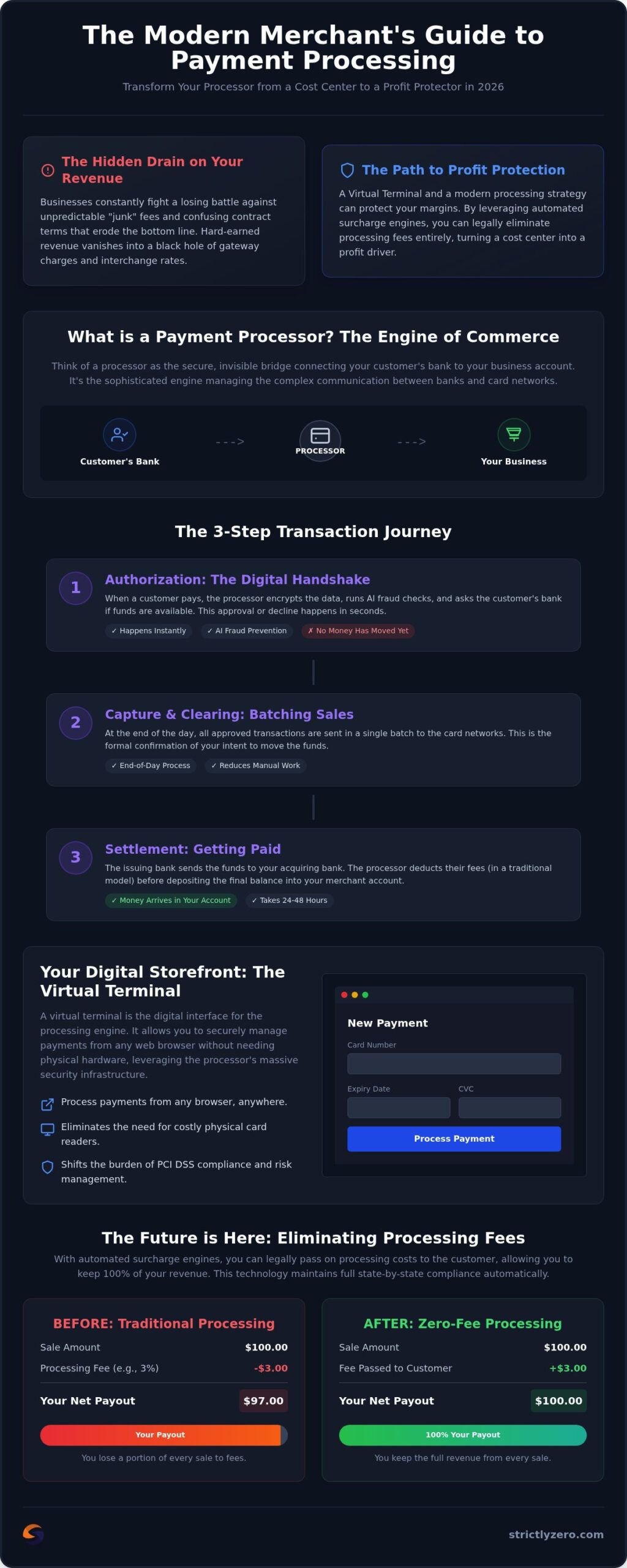
Think of a payment processor as the invisible infrastructure that keeps your business running. It’s the technical bridge connecting your customer’s bank account to your business account. Without this bridge, you simply can’t accept electronic payments. In 2026, a processor is much more than a utility; it’s a sophisticated engine that manages the complex communication between banks, card brands, and your ledger. A virtual terminal for credit card processing serves as the digital interface for this engine, allowing you to trigger these background processes from any browser without needing a physical card reader.
The processing journey is split into two distinct phases. Front-end processing handles the “handshake,” which is the initial authorization. This is when the system checks if the card is valid and if the customer has enough credit. Back-end processing follows, focusing on the settlement. This is the actual movement of funds from the issuing bank to your merchant account. Because of the technical complexity and security requirements involved, having a dedicated processor is mandatory for any business that wants to scale beyond cash transactions.
The Core Functions of a Modern Processor
A modern processor does the heavy lifting so you don’t have to. Its primary job is verification. When a customer enters their details, the processor asks the bank if the funds are available. This happens in seconds, but it involves multiple layers of security. Secure transmission is the second pillar. Every piece of data is encrypted to prevent theft. Finally, the processor manages the settlement. It aggregates your daily sales and ensures the money actually lands in your account, typically within 24 to 48 hours.
Why Businesses Cannot Process Payments Directly
You can’t just plug your business into the Visa or Mastercard network. The banking system is a closed loop with extremely high barriers to entry. To participate, you must meet rigorous PCI DSS security standards. These regulations ensure that your business isn’t a weak link in the global financial chain. Additionally, the risk is immense. Processing involves managing potential chargebacks and preventing sophisticated theft. Modern processors use AI-driven fraud prevention to spot suspicious patterns before they become a problem. By using a virtual terminal for credit card processing, you leverage the processor’s massive security infrastructure, shifting the burden of compliance and risk management away from your own shoulders.
How Payment Processing Works: The 3-Step Transaction Journey
Every time a customer pays, a complex machine springs to life. While the “approved” message appears on your screen in seconds, the actual movement of money involves a coordinated dance between five distinct parties. You are the merchant, joined by your customer, their issuing bank, your acquiring bank, and the processor who manages the whole affair. This transaction lifecycle ensures security and accuracy, but it’s important to remember that authorization is just the beginning. The settlement of funds typically takes between 24 and 48 hours to complete.
Step 1: Authorization (The Digital Handshake)
The process starts when a customer enters their details into a virtual terminal for credit card processing. Immediately, the processor encrypts this sensitive data and runs AI-driven fraud prevention checks to spot stolen cards or suspicious patterns. The processor then asks the card brand to verify the transaction with the customer’s issuing bank. Within moments, the bank checks for available funds and either approves or declines the request. This digital handshake happens instantly, but no money has actually changed hands yet.
Step 2: Capture and Clearing
Once approved, transactions aren’t sent one by one. Instead, they’re stored as authorized until the end of the business day. You then batch out, meaning the processor sends the entire day’s worth of transactions to the card networks for clearing. This step is the formal confirmation of your intent to move the funds from the customer’s account to your own. If you want to streamline this process and reduce manual work, you can automate your payment workflows with a unified platform.
Step 3: Settlement (Getting Paid)
Settlement is the final stage where the issuing bank sends the actual money to your acquiring bank. During this phase, the processor usually deducts their fees before depositing the remaining balance into your merchant account. However, if you’re using a zero-fee model, you’ll see the full transaction amount arrive. For many businesses, waiting days for money is a major pain point. This is why looking for a processor that offers Next Day Funding is vital for maintaining healthy cash flow and ensuring you can pay your own bills without delay.
Virtual Terminal for Credit Card Processing: Clearing the Confusion
Many business owners use terms like “gateway,” “processor,” and “merchant account” as if they’re the same thing. While they work together in a single ecosystem, they each serve a distinct purpose. Think of it like a physical storefront. The gateway is the front door that lets customers in. The processor is the clerk who manages the transaction. The merchant account is the safe where the money sits before you take it to the bank. Modern omni-channel platforms have simplified this by bundling these services into one unified system, but you still need to understand how each piece impacts your bottom line.
The Virtual Terminal: Process Payments Without a Website
A virtual terminal for credit card processing is essentially a digital version of a physical card reader. It’s a web-based portal where you manually type in a customer’s card information from any computer or tablet. This is a game-changer for businesses that take orders over the phone, through the mail, or while working in the field. Instead of writing down sensitive card numbers on paper receipts, which is a major security risk, you enter them directly into a secure, hosted environment. This keeps sensitive data off your own devices and drastically simplifies your PCI compliance requirements.
This tool is a cornerstone for anyone looking to build a flexible business model. It allows you to handle remote billing scenarios without needing a complex checkout page on your site. You can find more details on integrating these tools in our Ecommerce Payment Processing: The Ultimate Omni-Channel Guide. Using a hosted terminal ensures that your security isn’t compromised while you provide a convenient payment option for your clients.
The Merchant Account: Where Your Money Lives
This degree of flexibility is essential for specialized service providers like Trusted Psychic Readings, who rely on secure virtual terminals to process payments for remote consultations and maintain professional standards of data security.
A merchant account is a specialized bank account that acts as a temporary holding pen for your funds. When a customer pays, the money doesn’t go straight to your business checking account. It sits in the merchant account while the processor clears the transaction and verifies the funds. This delay protects both the customer and the bank in case of a dispute. The safe stays locked until everything is verified.
Dedicated accounts are specifically for your business, offering more stability and control over your cash flow. Aggregators lump your transactions with thousands of other businesses, which is easier to set up but comes with a higher risk of sudden account freezes. By choosing a dedicated setup, you ensure that your profit protector has the direct oversight needed to implement advanced fee-elimination strategies. This control is vital for maintaining a healthy margin.
How to Choose the Best Payment Processor for Your Business
Choosing a partner for your payments is about more than just finding the lowest percentage. Many providers use “teaser” rates to get you through the door, only to bury you in statement fees, gateway charges, and hidden surcharges later. You need to evaluate the total cost of ownership over a full year to see the real impact on your bottom line. In 2026, a truly effective partner must provide omni-channel capabilities as a standard feature. This means your virtual terminal for credit card processing should sync perfectly with your invoicing and online sales, creating a single source of truth for your revenue. For a deeper dive into these requirements, check out our Credit Card Processing for Small Business: The 2026 Essential Guide.
Evaluating Fee Structures: Flat Rate vs. Zero-Fee
Flat rate pricing is predictable, but it’s often the most expensive path for high-volume merchants. You’re paying a premium for the convenience of a single rate. Interchange plus is more transparent because it shows the raw cost of the card, but the resulting statements are often ten pages long and impossible to audit. The surcharge model stands out as the most efficient choice in 2026. It allows you to pass the processing cost to the customer, which is the only way to reach $0 in total processing fees while staying fully compliant with state regulations.
Security, Support, and Integration
Security requires constant vigilance. You need AI-driven fraud prevention that identifies suspicious patterns in real time to prevent costly chargebacks. Don’t overlook the human element either. When your virtual terminal for credit card processing has an issue, you need a live support person, not an automated chatbot. Look for a platform with an API-first design that integrates easily with your current tools. Automated compliance features are also essential to help you avoid regulatory fines. If you want to maximize your profitability, you can switch to a compliant surcharge engine now.
The Future of Processing: Eliminating Fees with Strictly
Most processors are built to extract value from your sales. Strictly flips this script by acting as a dedicated profit protector for your business. The goal isn’t just to move money; it’s to keep more of it in your business account where it belongs. By moving from a traditional cost-center model to a Strictly Zero fee model, you stop viewing processing as an unavoidable expense. This shift is the logical conclusion for any business owner who’s tired of losing 3% or more on every single transaction to middleman costs that don’t add value to the customer experience.
Understanding Compliant Surcharging
The Smart Pricing Engine is the core technology that makes fee-free processing possible. It’s not just a simple setting; it’s an automated compliance tool that works in the background of every sale. When you use your virtual terminal for credit card processing, the system instantly identifies the card type presented. It distinguishes between debit cards, where surcharging is legally prohibited, and credit cards. It also monitors state-by-state regulations in real time to ensure you stay within legal boundaries. Since surcharge caps in 2026 typically hover between 3% and 4%, the engine ensures you never exceed these limits, protecting you from regulatory fines. You can find a deeper breakdown of these mechanics in our Zero Fee Credit Card Processing: The 2026 Merchant Guide to $0 Fees.
Why Omni-Channel Matters for Your Bottom Line
True profitability requires more than just eliminating fees; it requires deep intelligence. A unified omni-channel platform gives you a single, clear view of every payment, whether it comes through a mobile link, a web checkout, or your virtual terminal for credit card processing. This visibility allows you to leverage advanced tools like ChurnIQ™ to analyze customer retention patterns. If a long-term client suddenly stops paying, you’ll have the data to act immediately, which helps you reduce churn before it impacts your annual revenue. For businesses that work with partners or ISOs, ClearSplit™ automates the compensation process. This ensures everyone is paid fairly and transparently without the need for manual spreadsheets or complex audits. This level of integration turns your payment data into a strategic asset that fuels growth rather than just recording it.
Reclaim Your Profit Margins Today
Mastering the mechanics of your payment engine is the first step toward true financial independence for your business. You’ve seen how the transaction journey works and why a virtual terminal for credit card processing is the most flexible tool for managing remote sales without the burden of physical hardware. By choosing a partner that prioritizes transparency over teaser rates, you can stop viewing processing as a drain on your resources and start seeing it as a strategic advantage.
The days of losing a significant portion of every sale to unpredictable junk fees are over. You now have the framework to transition into a zero-fee model that protects your bottom line while keeping you fully compliant with state regulations. With a unified omni-channel platform and a Smart Pricing Engine that handles the heavy lifting, you can focus on growth instead of auditing complex statements. It’s time to put your revenue back where it belongs.
Don’t let another month of profits slip away. Eliminate your processing fees today with Strictly and leverage AI-driven fraud prevention to secure every transaction. You’ve built a great business; it’s time you kept the full value of what you sell.
Frequently Asked Questions
What is the difference between a payment processor and a payment gateway?
A payment gateway acts as the secure digital tunnel that captures and encrypts transaction data at the point of sale. The payment processor is the engine that communicates with the banks to authorize and settle the funds. While the gateway is the interface your customer interacts with, the processor does the heavy lifting behind the scenes to move money into your account. Most modern platforms now bundle these services together for a seamless experience.
How much do payment processors typically charge per transaction in 2026?
Transaction costs are generally determined by a combination of interchange fees, card brand assessments, and processor markups. While these rates vary based on your specific industry and sales volume, they typically represent a significant percentage of every sale. Instead of focusing on a specific teaser rate, many modern businesses look for models that allow them to offset these costs entirely. Implementing a surcharge program is an effective way to eliminate these transaction expenses from your balance sheet.
Is it legal to pass credit card processing fees to the customer?
Yes, surcharging is legal in most states as long as you follow specific transparency and disclosure rules. In 2026, the standard surcharge cap is typically between 3% and 4% of the transaction total. You must clearly notify customers of the fee before they pay and you cannot apply surcharges to debit card transactions. Using a smart pricing engine ensures your business stays compliant with these evolving state-by-state regulations automatically.
How long does it take for a payment processor to deposit money into my account?
The standard settlement time for most processors is between 24 and 48 hours after you batch out your daily transactions. Many businesses now prioritize “Next Day Funding” to keep their cash flow moving without delays. The speed of your deposit often depends on your processor’s internal risk checks and the time of day your transactions are finalized. Weekend and holiday sales might take slightly longer to reach your business checking account.
What is a virtual terminal for credit card processing and how do I use it?
PCI compliance is a set of security standards designed to ensure that all companies accepting, processing, or storing credit card information maintain a secure environment. You need it to protect your customers from data breaches and your business from expensive non-compliance fines. Using a hosted solution for your payments significantly reduces your compliance burden by keeping sensitive data off your local servers and inside the processor’s secure, encrypted infrastructure.
Can I use one payment processor for both my online store and physical location?
Yes, using a single omni-channel payment processor for all sales channels is the most efficient way to manage your business. This unified approach gives you one central dashboard to track every transaction, whether it happens on your website or through a virtual terminal for credit card processing. It simplifies your bookkeeping and allows you to understand your customers’ buying habits across different platforms without having to reconcile data from multiple disparate systems.
How do I switch payment processors without interrupting my business?
Switching processors is a straightforward process that typically involves a short period of parallel running. You should set up your new merchant account and test your new terminal before closing your old account. Timing the switch is vital; you’ll want to batch out your final transactions on the old system before fully migrating your data. A good partner will help you migrate your saved customer profiles securely to ensure there’s no downtime for your recurring billing.